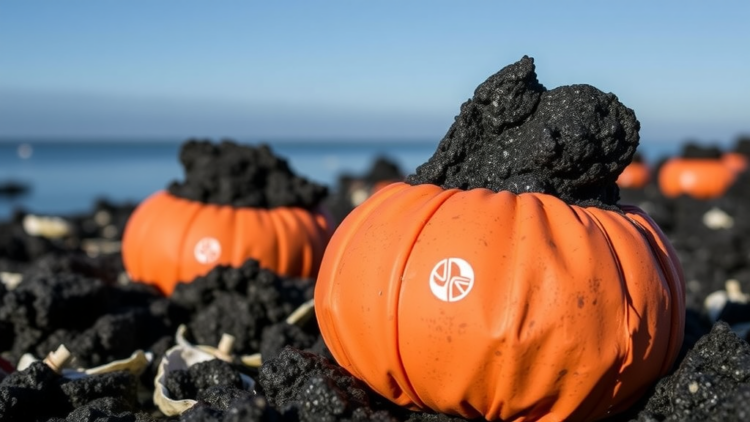
Every oyster farm in South Korea’s southern coastal waters floats on a quiet environmental disaster. Roughly 24 million expanded polystyrene buoys bob among the country’s 55 million aquaculture floats, and as they grind against waves, bake in ultraviolet light, and cycle between soaking and drying, they shed microscopic fragments directly into the waters where oysters grow. Field studies have found an average of 11.2 microplastic particles per oyster in southern coastal waters, and on beaches near Tongyeong, styrofoam debris accounts for 75 percent of macro debris and a staggering 98 percent of micro debris, with 93 percent of identifiable fragments traced back to aquaculture buoys. Now a team of Korean researchers believes it has engineered a way out: a buoy built from volcanic rock fibers and fully recyclable thermoplastic that could keep oyster farming afloat without poisoning the sea.
The scale of the problem extends far beyond Korea. An estimated 8 to 12 million metric tons of plastic waste enter the world’s oceans each year, and projections suggest flows into aquatic ecosystems could climb from around 19 to 23 million metric tons in 2016 to 53 million metric tons annually by 2030. Marine aquaculture, which supports more than 20 million livelihoods worldwide, has emerged as a significant yet underrecognized contributor, because the very infrastructure that keeps shellfish suspended in nutrient-rich water degrades continuously in place. Expanded polystyrene is particularly vulnerable: its cellular structure creates preferential paths for crack propagation, its inherent brittleness worsens in cold water, and ultraviolet radiation reflected off the sea surface accelerates polymer chain scission, embrittling the material until it fragments. Visible breakdown can occur within just one to two years of deployment.
The consequences ripple through food webs and onto dinner plates. Pacific oyster larvae readily ingest polystyrene particles ranging from 20 to 70 micrometers, with uptake efficiency varying by particle size and developmental stage. Chemical additives embedded in the foam, including the flame retardant hexabromocyclododecane and other persistent organic pollutants, can transfer into oyster tissues and enter human food chains. Microplastic concentrations in Korean coastal sediments have reached up to 390 particles per kilogram of dry weight, levels reported to be 15 to 50 times higher than international maxima. Regulators have run out of patience: South Korea’s Ministry of Oceans and Fisheries banned new expanded polystyrene buoy installations effective November 2022 and mandated replacement with eco-friendly alternatives by 2025.
There is a catch, however. The current generation of alternative buoys costs two to three times more than conventional styrofoam while often showing reduced durability in marine conditions, a combination that has slowed adoption among farmers operating on thin margins. It is against this backdrop that Sun-Min Park and So Youn Mun of the Korea Institute of Ceramic Engineering and Technology, together with Jun Hwan Jang of Yuhan University, designed their thermoplastic-basalt composite buoy system, published in Advances in Industrial and Engineering Chemistry. Their central insight is that the reinforcement fiber matters as much as the matrix. Basalt fiber, drawn by melting volcanic rock at around 1500 degrees Celsius without chemical additives, offers tensile strengths of 2800 to 3200 megapascals and an elastic modulus of 85 to 95 gigapascals, comfortably exceeding the minimum requirements of 2000 megapascals and 70 gigapascals set for certified marine buoys.
Basalt also brings environmental credentials that glass fiber cannot match. Unlike E-glass production, essentially nothing is added during basalt fiber manufacture; the rock is simply washed and melted. The fibers show superior alkali resistance compared with glass, a critical property in seawater, and the composites exhibit higher tensile modulus and strength than E-glass panels made with the same resin, with interlaminar shear strength falling advantageously between glass and carbon fiber systems. Although basalt fiber costs 1.8 to 2.2 times more than E-glass, the researchers argue the lifecycle economics favor it decisively: extended service life, fewer replacements, and no regulatory penalties or remediation costs from fragmentation. Combined with a thermoplastic matrix rather than a thermoset, the composite can be melted and reformed at end of life, closing the material loop in a way that fragmented polystyrene never can.
The manufacturing pathway reads like an exercise in precision. Raw volcanic basalt, containing roughly 48 to 52 percent silica, 14 to 18 percent alumina, and 8 to 12 percent calcium oxide, is crushed, washed, and melted in electric resistance furnaces at 1500 to 1600 degrees Celsius for two to four hours. The molten rock is extruded through platinum-rhodium alloy bushings with orifices of 1.5 to 2.0 millimeters, then rapidly cooled by air and water sprays into continuous filaments 9 to 15 micrometers in diameter. Drawing speeds of 50 to 100 meters per minute are tuned to push tensile strength above 3000 megapascals, and batch-to-batch variation is held below 5 percent through tight control of melt temperature, drawing speed, and cooling rate. The fibers are then compounded with thermoplastic at 200 to 250 degrees Celsius to a 30 percent fiber volume fraction, and compression molding at 240 degrees Celsius and 15 megapascals consolidates the final buoy shell.
The team developed two buoy configurations, each with a 60-liter capacity and a 1.6-millimeter wall. Design 1 measures 666 millimeters long with a 390-millimeter maximum diameter, weighing 2.3 kilograms, and reinforces its shell with lateral grooves 30 millimeters wide and 20 millimeters deep. Design 2 shortens the body to 638 millimeters while widening it to 406 millimeters, adds six external tape reinforcement patches, and triples the connection openings to six, cutting the load on each attachment point by 66.7 percent for redundant mooring in harsh seas. To validate both, the researchers turned to finite element analysis, modeling the material as orthotropic and applying a uniform pressure of 0.125 megapascals, the most severe durability requirement with a 1.25 ultimate factor over the nominal 1.0 bar operating pressure. A knock-down factor of 0.8 accounted for manufacturing variability and environmental effects, yielding a design allowable flexural strength of 420 megapascals.
The results were decisive. Design 1 with a six-ply laminate showed a strength margin of safety of minus 0.08, a marginal failure under the harshest load, but adding two plies transformed the picture: the strength margin rose to plus 0.41 and the buckling margin leapt from plus 0.76 to plus 2.70. Design 2 fared worse in both configurations, with a six-ply strength margin of minus 0.39 and an eight-ply margin of just plus 0.28, suggesting that geometric optimization matters as much as laminate thickness. Drop-test simulations from a height of 1500 millimeters in three orientations added further confidence. Peak stresses in the six-ply laminate ranged from 180 to 489 megapascals depending on impact direction, with axial impact most critical, while the eight-ply [0/45/90/−45]s stacking sequence cut peak stresses by 6 to 21 percent across all directions, staying within the 400 to 600 megapascal ultimate strength range of basalt composites.
The environmental payoff is the headline figure: because the composite buoy maintains structural integrity under impacts that would shatter expanded polystyrene catastrophically, the researchers estimate a greater than 95 percent reduction in microplastic generation potential. Preliminary field data indicate durability exceeding five years, compared with the one to two years typical of EPS buoys, and the circular economy design recovers 85 to 90 percent of original fiber length and more than 95 percent matrix purity when retired buoys are shredded and thermally reactivated at 180 to 200 degrees Celsius. The framework reportedly delivers a 35 percent reduction in environmental impact relative to expanded polystyrene alternatives, with recovered materials feeding new buoys or higher-value construction products.
Challenges remain before volcanic-rock buoys blanket Korean longlines, which currently stretch 100 meters with 51 styrofoam floats apiece and support oyster strings hanging 3 to 7 meters deep through 18-to-30-month grow-out cycles. Certification requires 12 months of field testing across three distinct coastal regions, buoyancy retention of at least 95 percent after three years, and continuous monitoring, all under environmental extremes that include typhoon waves of 3 to 4 meters, winds above 25 meters per second, temperature swings from minus 5 to 35 degrees Celsius, and fouling loads of 5 to 10 kilograms per square meter annually. Yet with Korea producing over 300,000 tons of oysters annually as the world’s third-largest producer, and with roughly 990,000 styrofoam buoys lost or discarded into the sea each year, the stakes could hardly be higher. A buoy that survives the sea, recycles into its own successor, and leaves no microplastic legacy may be exactly what the industry, and the ocean, have been waiting for.
Subject of Research: Development and structural validation of a recyclable thermoplastic-basalt composite buoy to eliminate microplastic pollution in marine oyster aquaculture
Article Title: Eco-friendly thermoplastic-basalt composite buoy system: eliminating microplastic pollution in marine oyster farming
Article References: Park, S.-M., Mun, S. Y., & Jang, J. H. (2025). Eco-friendly thermoplastic-basalt composite buoy system: eliminating microplastic pollution in marine oyster farming. Advances in Industrial and Engineering Chemistry, 1(1), Article 31. https://doi.org/10.1007/s44405-025-00029-6
Image Credits: AI Generated
DOI: 10.1007/s44405-025-00029-6
Keywords: microplastics, oyster farming, basalt fiber, thermoplastic composite, aquaculture, marine pollution, recyclability, finite element analysis, expanded polystyrene, circular economy, South Korea, sustainable materials
Cite Scienmag News
APA MLA Chicago
Bethany Barker. (September 25, 2026). Volcanic Rock Buoys Could End Microplastic Pollution in Oyster Farms. Scienmag. https://scienmag.com/volcanic-rock-buoys-could-end-microplastic-pollution-in-oyster-farms/
Bethany Barker. “Volcanic Rock Buoys Could End Microplastic Pollution in Oyster Farms.” Scienmag, 25 September 2026, https://scienmag.com/volcanic-rock-buoys-could-end-microplastic-pollution-in-oyster-farms/. Accessed 25 September 2026.
Bethany Barker. “Volcanic Rock Buoys Could End Microplastic Pollution in Oyster Farms.” Scienmag. September 25, 2026. https://scienmag.com/volcanic-rock-buoys-could-end-microplastic-pollution-in-oyster-farms/
Copy citation Download RIS
Tags: aquaculturebasalt fiberCircular economyeco-friendly marine buoy materialseffects of microplastics on seafood safetyenvironmentally friendly aquaculture buoysexpanded polystyrenefinite element analysisglobal plastic waste in oceansimpact of polystyrene buoys on ocean ecosystemsinnovations in marine pollution mitigationmarine pollutionmicroplastic debris in marine environmentsmicroplastic pollution in oyster farmsmicroplasticsmicroplastics ingestion by oystersoyster farmingrecyclabilityrecycling in aquaculture equipmentSouth Koreasustainable materialssustainable oyster farming solutionsthermoplastic compositevolcanic rock fiber buoys