In the rocky highlands of north-western Benin, where farmers have cultivated sorghum for generations without formal seed systems, a team of Beninese researchers has quietly completed one of the most detailed inventories of local sorghum diversity ever attempted in the region. Their findings, published in the Indian Journal of Genetics and Plant Breeding, suggest that the country’s traditional cultivars are far more than relics of subsistence farming. They are a genetically rich, agronomically promising reservoir that could underpin the next generation of climate-resilient cereals, not only for Benin but for sorghum breeding programmes across West Africa and beyond.
The study, led by Hafiz A. Salami of the National Institute of Agricultural Research of Benin (INRAB) together with colleagues from several of the institute’s regional centres and the University of Abomey-Calavi, set out to answer a deceptively simple question: what exactly is growing in Benin’s sorghum fields? Despite sorghum’s importance as a staple cereal and its remarkable nutritional value, the crop in Benin has long suffered from an absence of a formal seed production system, a gap rooted in insufficient documentation of the cultivars that farmers actually grow. Without that basic knowledge, breeders cannot select the best material, and farmers cannot access improved seed of varieties they already trust.
To close that gap, the researchers turned to the national collection maintained by INRAB, assembling a panel of local sorghum accessions originally collected in north-western Benin, an area recognised as a hotspot of sorghum genetic diversity where traditional management practices have preserved an unusually wide array of landraces. The team then took these accessions out of the gene bank and into the field, establishing trials at the Research-Development site in Kouya, near Boukoumbé, during two consecutive growing seasons in 2023 and 2024. Testing across two seasons matters enormously in sorghum evaluation, because rainfall variability and shifting temperatures can dramatically alter how a genotype performs from one year to the next.
The experimental design was rigorous. The researchers used a randomised complete block design with three replications, a gold-standard layout in agronomy that allows each accession to be compared against every other under identical field conditions while statistically controlling for variation across the trial site. In total, 120 plots were established, each measuring 16 square metres. This scale of field work, repeated across two years, represents a substantial investment of labour and land, and it reflects a growing recognition that phenotyping, the careful measurement of how plants actually look and perform, remains the indispensable foundation of crop improvement even in the era of genome sequencing.
For the measurements themselves, the team selected eleven morphological and agronomic traits based on the guidelines of the International Union for the Protection of New Varieties of Plants, known as UPOV. These internationally standardised descriptors, which typically cover characteristics such as plant height, flowering time, panicle architecture and grain characteristics, allow results from Benin to be directly compared with sorghum evaluations conducted anywhere else in the world. Standardisation is a quiet but crucial element of modern plant science: when breeders in India, Kenya or Morocco read the Beninese data, they can be confident that the traits were scored the same way they would score them in their own nurseries.
The results revealed what the researchers describe as moderate genetic variation among the accessions for the evaluated traits, a level of diversity that is neither overwhelming nor negligible but genuinely useful for breeding. Perhaps the most striking figure concerns yield. The average grain yield across the panel was 2946.5 kilograms per hectare, with individual accessions ranging from 2000 to 5000 kilograms per hectare. That top-end figure is remarkable for farmer-maintained material grown under local conditions, and it demonstrates that traditional cultivars can compete with, and in some cases outperform, expectations for the crop in the region. For context, sorghum yields across much of sub-Saharan Africa remain stubbornly low, so identifying local accessions that already reach five tonnes per hectare is a significant discovery.
Grain colour, a trait that matters intensely to West African consumers and food processors, varied considerably across the collection, with orange-red grain emerging as the most common type, accounting for 25 percent of accessions. This detail is far from cosmetic. In Benin, sorghum grain colour influences the quality and appeal of traditional foods, and previous research by Beninese food scientists has shown that consumers perceive meaningful differences between farmer varieties based on the foods derived from them. Any breeding programme that ignores these preferences risks producing improved varieties that farmers simply will not adopt, a well-documented failure mode in African crop improvement. By documenting colour diversity alongside yield, the INRAB team has kept consumer culture firmly inside the breeding pipeline.
To make sense of the multivariate data, the researchers applied cluster analysis, a statistical technique that groups accessions based on the overall similarity of their traits. The analysis sorted the collection into five distinct genotypic categories, which the team interpreted as three primary agronomic profiles. The first profile, represented by clusters 2 and 5, contains early-maturing accessions with high yields, a combination that is pure gold for breeders targeting regions with short or unreliable rainy seasons. The second profile, cluster 3, comprises late-maturing accessions with strong yield potential, material suited to longer growing periods and potentially valuable for exploiting favourable conditions. The third profile, clusters 1 and 4, includes vigorous plants that nonetheless deliver lower performance, accessions that may still carry useful genes for vigour and adaptation even if their direct yield contribution is modest.
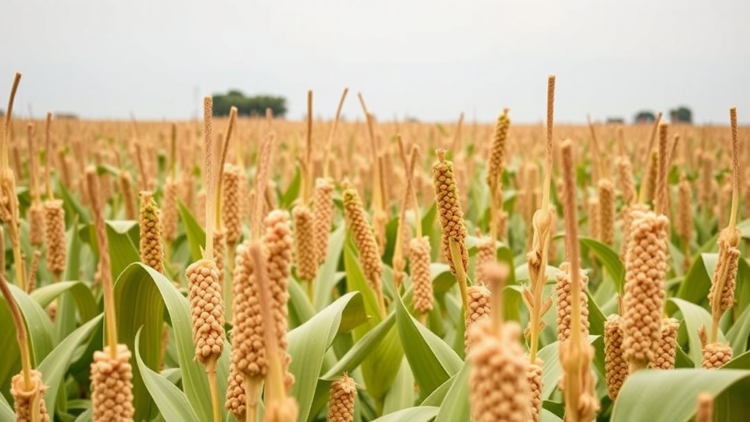
One group stood out in particular. Cluster 2 includes accessions with very dense panicles, the grain-bearing heads of the sorghum plant, and the researchers highlight these as possessing especially important agronomic traits. Panicle density is directly linked to the number of grains a plant can fill, and dense, compact heads are a classic target in sorghum improvement worldwide. That this trait appears spontaneously among farmer-maintained landraces in Benin underscores a central message of the study: centuries of informal selection by local farmers have already shaped material of genuine breeding value, material that modern science is only now learning to characterise systematically.
Among the top ten accessions ranked by grain yield, three emerged as clear leaders. S_19077 delivered five tonnes per hectare, S_19095 reached 4.5 tonnes, and S_19093 achieved 4.1 tonnes. These accession codes may look like bureaucratic labels, but they now represent the most valuable raw material in Benin’s sorghum improvement effort. Based on these results, the team reports that the most successful cultivars will be selected and deployed in a genetic improvement programme for the cereal, meaning the field data will translate directly into crossing schemes, selection nurseries and, eventually, improved varieties delivered back to the very farming communities whose fields gave rise to the collection. The work was supported by the national budget of Benin dedicated to research activities, a detail worth noting at a time when agricultural research funding in many low-income countries depends heavily on external donors.
The broader significance of the study extends well beyond Benin’s borders. Sorghum is increasingly viewed as one of the world’s most climate-proof cereals, prized for its tolerance of drought, heat and poor soils, and global breeding efforts are racing to develop varieties that can withstand the intensifying stresses of a warming planet. Yet the raw genetic variation that breeders need is concentrated in exactly the kind of farmer-maintained landraces documented in this study, and much of it remains uncharacterised. Similar evaluations in Ethiopia, Kenya, South Africa, Mozambique and Morocco have each revealed valuable diversity within national collections, and the Beninese results now add an important piece to that continental puzzle. As genomic tools become cheaper and more powerful, the bottleneck in crop improvement is shifting back to the field: knowing which accessions to sequence, which to cross and which to conserve. By rigorously phenotyping 120 plots over two seasons in the hills of Boukoumbé, Beninese researchers have shown that the answers to some of agriculture’s most pressing questions may be growing quietly in the smallholder fields they came from.
Subject of Research: Agromorphological characterisation and genetic diversity of local sorghum accessions from north-western Benin
Article Title: Agromorphological Diversity of Sorghum Accessions Collected in North-West Benin
Article References: Salami, H. A., Guedou, M., Mamoudou Alidou, G., Ahissou, D., Gogan, Y. S. C., Koi, P., Kindohoun, B., Hodonou, M., & Sina, H. (2026). Agromorphological Diversity of Sorghum Accessions Collected in North-West Benin. Indian Journal of Genetics and Plant Breeding, 86(2), 190-204. https://doi.org/10.1007/s44489-026-00024-1
Image Credits: AI Generated
DOI: 10.1007/s44489-026-00024-1
Keywords: sorghum, Sorghum bicolor, Benin, agromorphological diversity, plant breeding, genetic resources, landraces, grain yield, panicle traits, UPOV descriptors, food security, climate resilience
Cite Scienmag News
APA MLA Chicago
Alan Morgan. (September 25, 2026). Hidden Treasure in Benin’s Sorghum Fields: Local Varieties Reveal Surprising Yield Potential. Scienmag. https://scienmag.com/hidden-treasure-in-benins-sorghum-fields-local-varieties-reveal-surprising-yield-potential/
Alan Morgan. “Hidden Treasure in Benin’s Sorghum Fields: Local Varieties Reveal Surprising Yield Potential.” Scienmag, 25 September 2026, https://scienmag.com/hidden-treasure-in-benins-sorghum-fields-local-varieties-reveal-surprising-yield-potential/. Accessed 25 September 2026.
Alan Morgan. “Hidden Treasure in Benin’s Sorghum Fields: Local Varieties Reveal Surprising Yield Potential.” Scienmag. September 25, 2026. https://scienmag.com/hidden-treasure-in-benins-sorghum-fields-local-varieties-reveal-surprising-yield-potential/
Copy citation Download RIS
Tags: agricultural biodiversity in Beninagromorphological diversityBeninclimate resilienceclimate-resilient cereal cropsFood securitygenetic inventory of sorghum in West Africagenetic resourcesgenetic resources for climate adaptationgrain yieldimportance of documenting crop diversityindigenous crop varietieslandraceslocal seed systems in West Africapanicle traitsplant breedingrole of local varieties in food securitysorghumSorghum bicolorsorghum breeding programssorghum genetic diversity in Beninsorghum yield potential in traditional farmingtraditional sorghum cultivarsUPOV descriptors