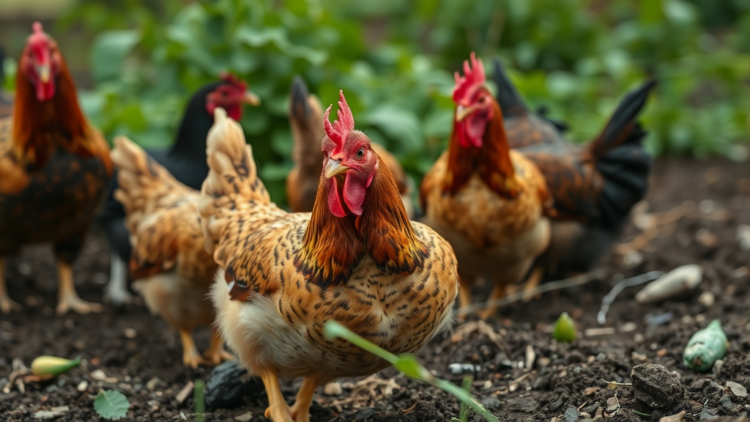
Chicken manure has long been celebrated as the green alternative to synthetic fertilizers, a way to feed crops while recycling waste. But a new study from Nigeria suggests that this organic staple carries a hidden cargo of potentially toxic elements that can seep into both soil and the vegetables we eat. Researchers at Olabisi Onabanjo University found that manure from commercially raised, battery-cage chickens delivered significantly more copper, cadmium and manganese to amended soils than manure from free-range birds, and that these metals accumulated in the edible shoots of cockscomb, a popular leafy vegetable, at application rates above six tonnes per hectare.
The study, published in the journal Discover Soil, set out to answer a deceptively simple question: does the way a chicken is raised change the pollution profile of its manure? The answer, according to the team led by Oladele Abdulahi Oguntade, is a clear yes. Commercial chicken manure, or CCM, collected from more than three thousand ISA Brown laying hens fed on maize and groundnut cake concentrates, contained more than four times the manganese and copper found in free-range manure. Zinc and cadmium were also elevated in the commercial product. Only iron and nickel ran counter to the trend, with free-range manure containing more than seven times the iron, likely because the birds pecked at small stones and pebbles in the surrounding soil.
The origin of these toxic elements lies in the poultry diet itself. Concentrate feeds, mineral supplements and veterinary drugs given to caged birds contain additives rich in copper, cadmium and manganese, and because chickens do not fully digest these elements, the residues pass straight into their droppings. When that manure is spread on fields as fertilizer, the metals ride along. Elements with densities above five grams per cubic centimeter and long biological half-lives, such as cadmium, are particularly concerning because they persist in soil and can enter the food chain, with documented damaging effects on the brain, lungs, liver and kidneys.
To quantify the risk, the researchers ran a carefully controlled pot experiment. Thirty buckets, each holding five kilograms of acidic loamy sand collected from the university’s Teaching and Research Farm at Ayetoro, were amended with either commercial or free-range manure at four rates: 4, 6, 8 and 10 tonnes per hectare, equivalent to 11.39 to 28.46 grams of dry manure per pot. An unamended control completed the design, and each treatment was replicated three times in a completely randomized layout. After two weeks of equilibration, cockscomb seeds were sown, seedlings were thinned to one per pot, and the plants were grown for six weeks under screen-house conditions before harvest.
Chemical analysis told a consistent story. Concentrations of copper, manganese and zinc in the soil rose with manure rate and were significantly higher in plots treated with commercial manure than with free-range product. At the lowest application rate of four tonnes per hectare, cadmium in the soil jumped by 103.8 percent with commercial manure and 66.8 percent with free-range manure compared to unfertilized soil. The team then applied a battery of pollution indices, including the contamination factor, degree of contamination, elemental pollution index and pollution load index, all standard tools for grading soil contamination. By these measures, commercial manure pushed the soil into severe and even extreme contamination categories at the highest rate, with a pollution load index at or above five, while manganese remained the least problematic element with contamination factors below one.
Interestingly, the amendments did not simply dump metals into an inert system. The manure raised soil pH, organic carbon and effective cation exchange capacity, the latter by 92.7 percent, and these changes altered how the metals behaved. Higher pH and abundant organic matter encouraged cadmium, copper and manganese cations to bind at cation exchange surfaces and onto organic ligands, reducing their dissolution and immediate bioavailability. The researchers found that the pollution load index itself modified soil pH by about 2.29 units, a feedback that helped restrain the transfer of metals from root to shoot. In other words, the same organic matter that fertilizes the crop also acts as a partial chemical buffer, at least in the short term.
But buffering has limits, and the cockscomb plants revealed them. The team calculated three phytoextraction metrics for each metal: the bioconcentration factor, comparing root concentration to soil concentration; the bioaccumulation coefficient, comparing edible shoot to soil; and the translocation factor, comparing shoot to root. Copper and manganese accumulated significantly more in both roots and shoots of plants grown with commercial manure than with free-range manure. Copper proved the more mobile traveler, with phytoextraction exceeding that of manganese, and its bioaccumulation coefficient climbed steadily at rates of six tonnes per hectare and above, a pattern the authors attribute to soluble metal-organic complexes forming in the soil solution at high manure doses.
The translocation story added a twist. Free-range manure actually promoted greater copper movement from root to shoot than commercial manure, despite containing less copper overall, while commercial manure favored manganese mobility. This shows that the journey of a toxic element through a plant depends not just on how much is present in the soil but on the chemistry of the amendment itself, particularly the dissolved organic carbon it releases and the pH shifts it induces. Manganese translocation, by contrast, dropped with rising manure rates, suggesting that at high doses the amendments effectively immobilized manganese in the root zone, with uptake peaking at eight tonnes per hectare and declining thereafter.
For farmers and consumers, the practical message is a dose threshold. Growth and yield of the cockscomb responded strongly to manure, with the best performance at eight tonnes per hectare for commercial manure and ten for free-range, yet the yields achieved at four tonnes per hectare were statistically comparable. Since the edible shoots carried potentially risky levels of copper and manganese above six tonnes per hectare, the authors argue that lower application rates deliver nearly the same agronomic benefit with far less contamination. Applying chicken manure above that threshold, especially the commercial variety, should be avoided to keep metals out of the food chain.
The study has clear boundaries. It was a pot experiment under controlled conditions, and the authors themselves call for field trials that track metals through topsoil and subsoil layers, for broader pollution indicators, and for health risk assessments of people who actually consume the crop in the region. Still, the findings land at an uncomfortable moment for organic agriculture, which leans heavily on animal manures worldwide. They suggest that organic is not automatically clean, that the industrial feed and drug regime behind battery-cage eggs leaves a metallic fingerprint in the fertilizer it produces, and that even a humble leafy green like cockscomb can become an unwitting courier of that fingerprint to the dinner plate. Sustainable farming, the study implies, needs to count not only nutrients but contaminants, gram by gram, in every scoop of manure it spreads.
Subject of Research: Accumulation of potentially toxic elements from chicken manure amendments in soil and cockscomb vegetables
Article Title: Accumulation of potentially toxic elements in cockscomb (Celosia argentea Linn) grown in soil amended with chicken manure
Article References: Oguntade, O. A., Yisa, N. M., Olagunju, S. O., Odelana, T. B., Adewusi, K. M., Odusanya, O. A., & Abifarin-Adegbenro, R. O. (2026). Accumulation of potentially toxic elements in cockscomb (Celosia argentea Linn) grown in soil amended with chicken manure. Discover Soil, 3(1), Article 154. https://doi.org/10.1007/s44378-026-00311-z
Image Credits: AI Generated
DOI: 10.1007/s44378-026-00311-z
Keywords: chicken manure, potentially toxic elements, cockscomb, soil contamination, heavy metals, organic farming, pollution load index, bioaccumulation, copper, cadmium, manganese, soil amendment
Cite Scienmag News
APA
MLA
Chicago
Alan Morgan. (September 25, 2026). Organic Farming’s Hidden Risk: Chicken Manure Can Load Cockscomb With Toxic Metals. Scienmag. https://scienmag.com/organic-farmings-hidden-risk-chicken-manure-can-load-cockscomb-with-toxic-metals/
Alan Morgan. “Organic Farming’s Hidden Risk: Chicken Manure Can Load Cockscomb With Toxic Metals.” Scienmag, 25 September 2026, https://scienmag.com/organic-farmings-hidden-risk-chicken-manure-can-load-cockscomb-with-toxic-metals/. Accessed 25 September 2026.
Alan Morgan. “Organic Farming’s Hidden Risk: Chicken Manure Can Load Cockscomb With Toxic Metals.” Scienmag. September 25, 2026. https://scienmag.com/organic-farmings-hidden-risk-chicken-manure-can-load-cockscomb-with-toxic-metals/
Copy citation
Download RIS
Tags: bioaccumulationcadmiumchicken manurecockscombcoppercopper and cadmium accumulation in cropsenvironmental impact of poultry wastefree-range vs. battery-cage poultry wasteheavy metalsheavy metals in vegetablesmanganeseorganic farmingpollution load indexpotentially toxic elementsrisks of commercial chicken manuresoil amendmentsoil contaminationsoil contamination from organic fertilizerssoil pollution from organic fertilizerssustainable agriculture concernstoxic metal uptake in leafy vegetablestoxic metals in manure