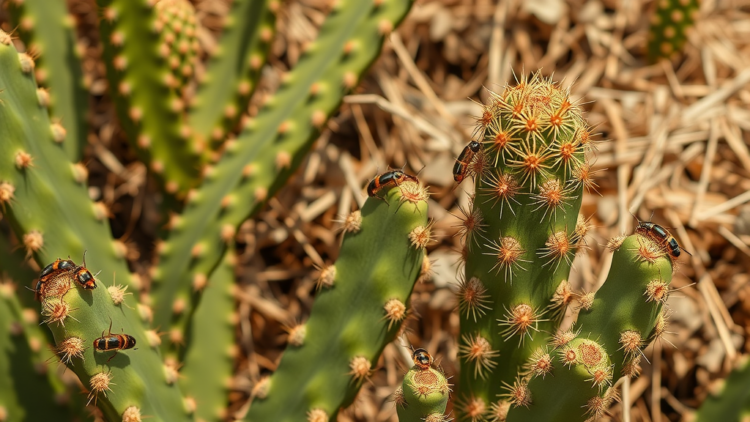
In the arid highlands of Ethiopia and Eritrea, a single plant has quietly held together an entire way of life for nearly two centuries. The cactus pear, known locally as Beles, was introduced to the region by Catholic missionaries between 1848 and 1870, when a priest named Abune Yakob planted the first cladodes in Alitena in Ethiopia and Lehe in Eritrea after recognizing that the rugged terrain was unsuitable for conventional cereal crops. Since then, the plant has woven itself into the ecological and cultural fabric of the Horn of Africa, stabilizing steep slopes, feeding families during the hungry months before the main harvest, and sustaining livestock through brutal dry seasons. Now, according to a systematic review published in Discover Agriculture, this keystone species is collapsing at an alarming rate, and the cause is a devastating convergence of biological invasion and armed conflict that researchers are calling the conflict-pest nexus.
The scale of the plant’s importance is difficult to overstate. In Ethiopia’s Tigray region alone, cactus pear historically occupied more than 360,000 hectares, supporting roughly 200,000 rural households with virtually no alternative means of securing a livelihood. In some areas, the fruit provides up to 40 percent of the annual food intake for rural families, while during the lean summer months from June to August it serves as a critical bridge when other crops have not yet matured. The plant’s unique Crassulacean Acid Metabolism, a photosynthetic adaptation shared with other succulents, allows it to open its stomata at night and minimize water loss, giving it extraordinary water-use efficiency in landscapes where indigenous woody vegetation has long since declined. Beyond food, the cactus anchors a seasonal economy of harvesting, transport, and urban street vending that once provided employment for more than 183,000 households, offering a low-entry livelihood for youth and women in cities such as Mekelle, Adigrat, and Asmara.
The catastrophe began, ironically, as a business venture. In April 2003, the carmine cochineal insect, Dactylopius coccus, was intentionally introduced from South Africa to southern Tigray with formal authorization from the Federal Ministry of Agriculture and Rural Development, with the goal of launching a commercial carmine dye industry. The insects were officially released in September 2004 across three trial sites, including the Endayesus campus of Mekelle University. Early returns were promising: farmers collected and exported dried cochineal worth up to 984 dollars per hectare, and the venture generated more than 550,000 dollars in foreign exchange during its first ten months. But the project lacked structured containment protocols, and when the investor’s license was revoked in 2010, monitoring ceased entirely. The insects escaped cultivation and transformed from a managed bio-resource into a devastating invasive pest, capable of killing cactus plants within six to ten months of attack through chlorosis, dieback, and total tissue collapse.
By 2019, more than 75,000 hectares in Tigray were infested, and communities had organized remarkable grassroots responses, including community mobilization campaigns and buffer zones that held the spread roughly in check between 2016 and 2020. Then came the Tigray War. The conflict, which raged from 2020 to 2022, caused a total collapse of these community-led mechanical and chemical control systems. Routine physical monitoring, quarantine enforcement, and the pruning and burning regimens that had kept the pest at bay simply stopped. In the vacuum, wind-borne dispersion of the insect’s mobile first-instar crawlers, driven by prevailing seasonal wind patterns, accelerated unchecked across contiguous cactus belts. Regional infestation coverage surged from roughly 80,000 hectares in 2020 past a projected 120,000 hectares by 2026, a trajectory the review’s author, Mulat Kebede of the Tigray Agricultural Research Institute, characterizes as a rapid post-war surge driven directly by the collapse of human governance.
The review, which followed PRISMA guidelines and distilled 170 core studies from an initial pool of 3,159 records across Scopus, Google Scholar, and Web of Science, quantifies the ecological toll in stark terms. In Tigray, four key indicators of ecosystem health, biodiversity, faunal habitat, soil fertility, and drought resilience, are projected to approach near-zero values by 2026, with biodiversity and faunal habitat plummeting from baseline scores of 100 to approximately 10. In the Eritrean Highlands, the decline is slightly less steep but equally sobering, with drought resilience falling from a near-perfect 98 in 2004 to roughly 32 by 2026. The social consequences are captured in a social crisis index that reaches 95 in Tigray, alongside a degraded land index of 92 and an economic loss index of 88, reflecting a regional catastrophe in which the loss of food security, livestock feed, and soil conservation has fueled rising food insecurity and youth migration from rural areas.
One of the most alarming findings concerns carbon. Managed cactus pear plantations in Tigray sequester approximately 12.8 tonnes of carbon per hectare per year, among the highest rates of any evaluated land-use category in the region, while naturalized wild stands in Eritrea sequester 8.9 tonnes and even abandoned farmlands recolonized by the cactus store 4.5 to 5.1 tonnes annually. Under sub-optimal growing conditions typical of degraded landscapes, the Food and Agriculture Organization and ICARDA estimate that cactus pear can generate sequestration rates equivalent to roughly 30 tonnes of carbon dioxide per hectare per year. As these stands die and their woody biomass decomposes, that stored carbon is released back into the atmosphere, threatening to transform a climate-smart carbon sink into an active carbon source. In a region already battered by drought and displacement, the loss of this biological buffer compounds both the humanitarian and the climate crisis simultaneously.
The review also formalizes the conceptual framework of the conflict-pest nexus as a self-reinforcing feedback loop. Armed conflict drives insecurity, displacement, and institutional disruption, which in turn produce governance failures: diminished surveillance, weakened early detection, inadequate pest control, and collapsed agricultural extension services. These deficits unleash biological outbreaks, marked by heightened insect reproduction and rapid geographic dispersal, which then drive ecological degradation and the loss of forage, soil cover, and ecosystem resilience. The resulting socioeconomic hardship, from plunging household incomes to deepening food insecurity, further erodes societal resilience and administrative capacity, feeding directly back into the initial instability. It is a cascade in which ecological collapse and human suffering amplify one another, and it explains why the cochineal crisis in the Horn of Africa has progressed so much faster than comparable invasions elsewhere.
Yet the research also points to genuine hope, grounded in tools that smallholders can deploy even amid instability. Laboratory bioassays and field trials have shown that aqueous extracts of Tree Tobacco, Nicotiana glauca, mixed with liquid soap surfactants, dissolve the insect’s protective waxy coating and achieve mortality rates exceeding 90 percent. Even more striking, methanol extractions of Solanum linnaeanum, which concentrate lethal secondary metabolites such as tannins, saponins, and alkaloids, have secured up to 99.3 percent pest mortality in controlled tests. These botanical biopesticides, alongside evaluated extracts from neem, Tagetes minuta, and Euphorbia tirucalli, offer a low-cost, decentralized alternative to synthetic organophosphates like Dimethoate, whose supply chains and ecological risks make them poorly suited to conflict zones. Complementing these interventions, tissue-culture protocols using Murashige and Skoog media enhanced with benzylaminopurine can regenerate completely pathogen-free, high-vigor planting stock, while the selection of cochineal-resistant genotypes is supported by documented smallholder willingness to pay for resilient clones.
The taxonomic complexity of the invader adds another layer of urgency. While Dactylopius coccus was the species originally introduced for dye production, ongoing regional monitoring indicates morphological and genetic overlap with Dactylopius opuntiae across expanded infestation zones. This distinction carries real operational consequences, because biological control strategies depend on host-specific predatory beetles such as Cryptolaemus montrouzieri and Hyperaspis species, whose effectiveness varies with the target biotype. Management protocols must therefore verify biotype susceptibility before releasing mass-reared predatory agents, a task that requires exactly the kind of sustained surveillance capacity that conflict has destroyed. In the Near East and North Africa region, where similar cochineal invasions threaten cactus systems, research has moved toward resistant cultivars and biological control; in the Horn of Africa, by contrast, the science has become what the review describes as a science of survival.
Halting the terminal decline, the review concludes, demands a coordinated package: immediate regional stability, formal cross-border scientific cooperation between Ethiopia and Eritrea, tissue-culture propagation hubs producing entirely insect-free clean planting stock, and the large-scale deployment of conflict-resilient integrated pest management that combines field sanitation, resistant varieties, and botanical biopesticides. The stakes extend far beyond a single crop. The cactus pear of the Horn of Africa is a soil guardian, a carbon vault, a famine buffer, and an economic lifeline all at once, and its loss would ripple through food systems, livelihoods, and climate commitments across the borderlands. Whether these highlands retain their prickly green ramparts, or watch them dissolve into white, waxy colonies of a runaway insect, will depend on whether peace and science can arrive before the last cladodes succumb.
Subject of Research: The combined impact of armed conflict and cochineal insect invasion on cactus pear ecosystems and ecosystem services in the Horn of Africa
Article Title: The conflict and pest nexus drives the catastrophic decline of cactus pear ecosystem services in the Horn of Africa
Article References: Kebede, M. (2026). The conflict and pest nexus drives the catastrophic decline of cactus pear ecosystem services in the Horn of Africa. Discover Agriculture, 4(1), Article 293. https://doi.org/10.1007/s44279-026-00762-6
Image Credits: AI Generated
DOI: 10.1007/s44279-026-00762-6
Keywords: cactus pear, Opuntia ficus-indica, cochineal, Dactylopius coccus, Tigray War, conflict-pest nexus, invasive species, carbon sequestration, integrated pest management, botanical biopesticides, food security, Horn of Africa
Cite Scienmag News
APA MLA Chicago
Gavin Prescott. (September 24, 2026). War and Invasive Insects Push a Lifesaving Cactus Toward Collapse in the Horn of Africa. Scienmag. https://scienmag.com/war-and-invasive-insects-push-a-lifesaving-cactus-toward-collapse-in-the-horn-of-africa/
Gavin Prescott. “War and Invasive Insects Push a Lifesaving Cactus Toward Collapse in the Horn of Africa.” Scienmag, 24 September 2026, https://scienmag.com/war-and-invasive-insects-push-a-lifesaving-cactus-toward-collapse-in-the-horn-of-africa/. Accessed 24 September 2026.
Gavin Prescott. “War and Invasive Insects Push a Lifesaving Cactus Toward Collapse in the Horn of Africa.” Scienmag. September 24, 2026. https://scienmag.com/war-and-invasive-insects-push-a-lifesaving-cactus-toward-collapse-in-the-horn-of-africa/
Copy citation Download RIS
Tags: Biological invasion and pest outbreaks in arid ecosystemsbotanical biopesticidescactus pearCactus pear ecological importance in Horn of Africacarbon sequestrationClimate resilience and drought adaptation in Horn of Africacochinealconflict-pest nexusConservation challenges of keystone desert speciesCultural significance of cactus pear in Horn of AfricaDactylopius coccusEffects of armed conflict on ecological stabilityFood securityHorn of AfricaImpact of invasive insects on desert plantsintegrated pest managementInvasive SpeciesInvasive species contributing to plant collapseOpuntia ficus-indicaRole of Beles cactus in local livelihoods and food securitysystematic review ofTigray WarWar and conflict effects on agriculture in Ethiopia and Eritrea