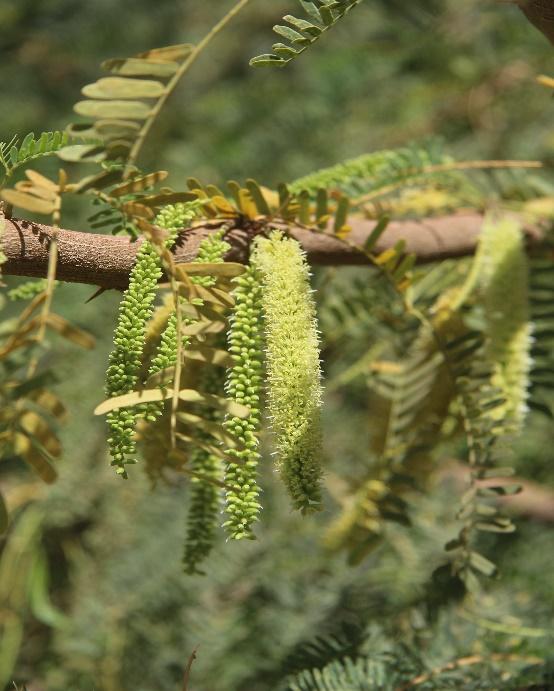
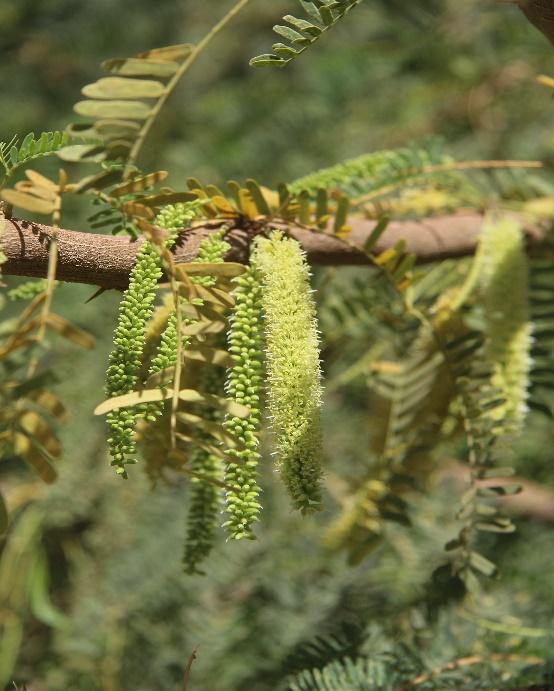
Credit: Muller et al., Malaria Journal, 2017'
Removing the flowers of an invasive shrub from mosquito-prone areas might be a simple way to help reduce malaria transmission, according to a new study published in the open access Malaria Journal. Removing the flowers from villages in Mali decreased the local mosquito vector population by nearly 60%.
The study, carried out in the Bandiagra District in Mali, is the first of its kind to trial a direct environmental manipulation as a way to control mosquito vector populations in areas at risk of malaria transmission.
Dr Gunter Muller, lead author of the study from Hebrew University Hadassah Medical School, said: "Mosquitos obtain most of their energy needs from plant sugars taken from the nectar of flowers so we wanted to test the effect removing the flowers of the shrub Prosopis juliflora would have on local mosquito vector populations. Our results show that removal of this particular shrub reduces total population levels of mosquitoes and reduces the number of older female mosquitoes in the population, which are known to transmit malaria parasites to humans. This suggests that removal of the flowers could be a new way to shift inherently high malaria transmission areas to low transmission areas, making elimination more feasible."
The study focused on the removal of the flowers of the invasive shrub Prosopis juliflora, which is native to Central and South America but was introduced to new areas in the late 1970's and early 1980's as an attempt to reverse deforestation. Prosopis juliflora is a robust plant that grows rapidly and has become one of the worst invasive plants in many parts of the world. The shrub now occupies millions of hectares on the African continent, including countries such as Mali, Chad, Niger, Ethiopia, Sudan and Kenya.
Light traps to catch mosquitoes were set up across nine villages in the Bandiagra District, six of which were home to flowering Prosopis juliflora and three that had no presence of the shrub. After a first round of analysis was conducted to assess mosquito populations, the researchers cut all the flowering branches from Prosopis juliflora in three of the six infested villages, before setting up light traps to determine the effect removal of the shrub had on mosquito vector populations.
Dr John Beier, co-author of the research from the University of Miami, said: "The presence or absence of Prosopis juliflora in villages has a significant influence on the size of the mosquito population in general, on their species composition, on the sugar feeding status and, the age structure of female populations. As well as offering a potentially environmentally reasonable and sustainable strategy in reducing the incidence of malaria, there are also other benefits to be gained from removal of these plants. For example, these plants are known to encroach on crop and pasture lands."
The researchers found that villages where they removed the flowers saw mosquito numbers collected in the traps fall from an average of 11 to 4.5 for females, and 6 to 0.7 for male mosquitoes. The total number of mosquitoes across these villages decreased by nearly 60% after removal of the flowers. After flower removal, the number of older more dangerous vector females in the population dropped to levels similar to those recorded in the villages that had no presence of the shrub. Villages infested with Prosopis juliflora also had a higher proportion of mosquitoes with a sugar meal in their gut, which enhances their survival. This proportion was reduced 5-fold following removal of the flowers.
According to the researchers, it may be worthwhile to abstain from the introduction of exotic plants that have the potential to become invasive, not only because of their potential negative impacts on the environment and livelihoods, but because some of them may have negative significant consequences for public health and specifically for malaria.
###
Media Contact
Matthew Lam
Press Manger
BioMed Central
T: +44 (0)20 3192 2722
M: +44 (0)75 4079 9187
E: [email protected]
Notes to editor:
1. A picture of the shrub Prosopis juliflora can be found here: https://goo.gl/BAaD6v
Please credit 'Muller et al., Malaria Journal, 2017'.
2. Research article:
The invasive shrub Prosopis juliflora enhances the malaria parasite transmission capacity of Anopheles mosquitoes: a habitat manipulation experiment
Muller et al.
Malaria Journal July 2017
DOI:10.1186/s12936-017-1878-9
During embargo period please contact Matthew Lam for a copy of the article.
After the embargo lifts, the article will be available at the journal website here: https://malariajournal.biomedcentral.com/articles/10.1186/s12936-017-1878-9.
Please name the journal in any story you write. If you are writing for the web, please link to the article. All articles are available free of charge, according to BioMed Central's open access policy.
3. Malaria Journal is aimed at the scientific community interested in malaria in its broadest sense. It is the only journal that publishes exclusively articles on malaria and, as such, it aims to bring together knowledge from the different specialities involved in this very broad discipline, from the bench to the bedside and to the field. Malaria Journal offers a fast publication schedule while maintaining rigorous peer-review; this is achieved by managing the whole of the publication process electronically, from submission to peer-review.
4. BioMed Central is an STM (Science, Technology and Medicine) publisher which has pioneered the open access publishing model. All peer-reviewed research articles published by BioMed Central are made immediately and freely accessible online, and are licensed to allow redistribution and reuse. BioMed Central is part of Springer Nature, a major new force in scientific, scholarly, professional and educational publishing, created in May 2015 through the combination of Nature Publishing Group, Palgrave Macmillan, Macmillan Education and Springer Science+Business Media. http://www.biomedcentral.com
Media Contact
Matthew Lam
[email protected]
020-319-22722
@biomedcentral
http://www.biomedcentral.com
Related Journal Article
http://dx.doi.org/10.1186/s12936-017-1878-9
############
Story Source: Materials provided by Scienmag