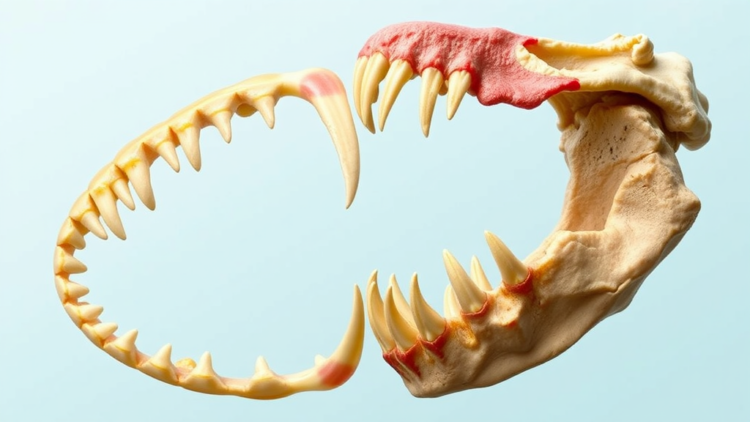
Every bite a carnivore takes leaves a microscopic signature on its teeth. Scratches, pits, and fine polish accumulate on dental enamel as food is sheared, crushed, and ground, and paleontologists have learned to read these tiny scars like a dietary ledger. For decades, researchers analyzing dental microwear have made a quiet but consequential assumption: that the upper and lower teeth that grind against each other wear in the same way, so either can be sampled to reconstruct an animal’s diet. A new study published in The Science of Nature puts that assumption to a rigorous statistical test on the carnassial teeth of living carnivores, and the verdict is good news for anyone hoping to squeeze more information out of scarce fossil material.
The carnassial is the slicing hallmark of the order Carnivora, the modified cheek tooth pair that functions like a pair of scissors. In the upper jaw it is the last premolar, in the lower jaw the first molar, and together they shear flesh and other foods during each chewing stroke. Because these teeth meet blade against blade, their wear facets record the mechanical history of feeding with particular clarity. Dental microwear analysis samples these facets, ideally ones that occlude directly with one another, and uses the resulting texture to infer whether an animal was slicing tough meat, crunching bone, or processing a more varied diet. The method has become a standard tool for reconstructing the ecology of extinct mammals, from sabertooth cats to Pleistocene hyenas.
The practical problem that motivated the new research is one of scarcity. Fossil carnivore teeth are rare, and a usable analysis typically requires many individuals to reach statistically meaningful sample sizes. To maximize the number of usable observations, researchers routinely pool upper and lower teeth, treating the opposing, homologous wear facets as interchangeable. Previous work on fossil herbivores, however, had suggested that upper and lower teeth do not always carry identical wear signals, particularly when comparing facets that are not true functional counterparts. If the same discrepancy applies to carnivores, then pooling upper and lower carnassials could quietly contaminate dietary reconstructions with a methodological artifact.
Cecilia Loddi of the University of Florence and colleagues, including Riccardo Stefani, Lorenzo Rook, and Saverio Bartolini-Lucenti, set out to test whether the slicing portions of the upper and lower carnassials in living carnivores can genuinely be analyzed without distinction. Their question was precise: do the homologous wear facets of the upper and lower carnassials produce the same ecological evidence, or are they statistically distinct? To answer it, they turned to Dental Microwear Texture Analysis, or DMTA, a high-resolution technique that treats tooth surfaces as three-dimensional landscapes rather than flat images.
DMTA works by scanning a small patch of enamel at sub-micrometer resolution, producing a detailed topographic map of the wear surface. Software then quantifies that landscape using a set of parameters derived from scale-sensitive fractal analysis, known as SSFA attributes. These descriptors capture features such as surface complexity, roughness at different scales, heterogeneity, and the anisotropy of the texture, meaning the degree to which scratches run in a consistent direction. Complexity, for example, tends to rise when hard items like bone are processed, while anisotropy reflects the directionality of shearing movements. Together, the SSFA variables provide a numerical fingerprint of diet that can be compared across individuals, species, and, crucially for this study, across upper and lower teeth.
The team sampled four species of extant carnivores, examining the homologous wear facets of the slicing portion of the upper and lower carnassials in museum specimens. Working with modern animals whose diets are known is the essential calibration step: if upper and lower facets from animals with identical feeding habits were to show different textures, the difference could only come from the teeth themselves rather than from diet. The specimens were molded and cast following established replication techniques, and the resulting surfaces were scanned and characterized in the laboratory at the University of Florence, with the authors acknowledging curatorial and technical support from several European natural history museums in Basel, Paris, Berlin, Florence, and Munich.
The statistical approach is where the study distinguishes itself. Rather than simply running a null-hypothesis test and concluding that no difference was detected, the authors employed equivalence testing, a framework more familiar in psychology and clinical research than in paleontology. A conventional significance test can only fail to find a difference, which is not the same as demonstrating that two things are alike. Equivalence tests, such as the two one-sided tests procedure implemented in the TOSTER R package, flip the logic: they ask whether any observed difference is small enough to fall within a predefined zone of practical equivalence. Failing to reject a null hypothesis of no difference is weak evidence of sameness; formally rejecting the hypothesis of a meaningful difference is strong evidence of it.
By that stricter standard, the results were clear. Similarity tests found no statistically significant differences in the SSFA attributes between upper and lower homologous carnassial facets, and, more importantly, the parameters proved statistically equivalent. In other words, the texture signatures recorded on the upper carnassial and its lower counterpart carry the same ecological message, at least in the extant carnivores examined. The upper tooth really is the lower tooth, at least as far as microwear is concerned, and the old pooling practice survives its first formal challenge in this group.
The practical implications reach well beyond the four study species. If upper and lower carnassial facets can be combined without distortion, every fossil jaw fragment bearing either tooth becomes admissible evidence, effectively doubling the pool of available data for a given fossil assemblage. For groups where sample sizes have always been the bottleneck, this is a substantial gain. Fossil carnivores are notoriously underrepresented in microwear studies compared with the richer herbivore record, and the authors highlight this data scarcity as a central obstacle to reconstructing the dietary ecology of ancient predators. A validated doubling of usable teeth could make previously marginal assemblages analytically viable.
Some caveats remain and are worth keeping in view. The equivalence demonstrated here applies to homologous, occluding facets of the slicing carnassial in extant carnivores; earlier work on herbivores suggests that non-homologous facets and other tooth positions may behave differently, so researchers should not assume the result generalizes beyond the specific pair of surfaces tested. Extending the analysis to a broader range of carnivore species, and eventually to fossil taxa themselves, would strengthen the conclusion. Even so, the study converts a long-standing convenience into a validated protocol, giving paleontologists a firmer statistical footing the next time they combine an upper carnassial with a lower one to reconstruct what an ancient predator ate.
Subject of Research: Equivalence of dental microwear texture patterns between upper and lower carnassial teeth in extant carnivores
Article Title: Up is down: testing the equivalence in dental wear patterns of the upper and lower carnassial
Article References: Loddi, C., Stefani, R., Rook, L., & Bartolini-Lucenti, S. (2026). Up is down: testing the equivalence in dental wear patterns of the upper and lower carnassial. The Science of Nature, 113(5), Article 110. https://doi.org/10.1007/s00114-026-02158-4
Image Credits: AI Generated
DOI: 10.1007/s00114-026-02158-4
Keywords: dental microwear, Dental Microwear Texture Analysis, carnassial, Carnivora, paleoecology, tooth wear, SSFA, equivalence testing, diet reconstruction, fossil carnivores, wear facets, paleontology
Cite Scienmag News
APA
MLA
Chicago
Daisy Hatcher. (September 24, 2026). Upper Meets Lower: Carnassial Teeth Prove Interchangeable for Reconstructing Carnivore Diets. Scienmag. https://scienmag.com/upper-meets-lower-carnassial-teeth-prove-interchangeable-for-reconstructing-carnivore-diets/
Daisy Hatcher. “Upper Meets Lower: Carnassial Teeth Prove Interchangeable for Reconstructing Carnivore Diets.” Scienmag, 24 September 2026, https://scienmag.com/upper-meets-lower-carnassial-teeth-prove-interchangeable-for-reconstructing-carnivore-diets/. Accessed 24 September 2026.
Daisy Hatcher. “Upper Meets Lower: Carnassial Teeth Prove Interchangeable for Reconstructing Carnivore Diets.” Scienmag. September 24, 2026. https://scienmag.com/upper-meets-lower-carnassial-teeth-prove-interchangeable-for-reconstructing-carnivore-diets/
Copy citation
Download RIS
Tags: carnassialcarnassial teeth as feeding scissorsCarnassial teeth microwear analysisCarnivoracarnivora order tooth functioncarnivore diet reconstructioncarnivore feeding behavior analysisdental microweardental microwear as dietary evidencedental microwear texture analysisdental microwear versus food consumptiondiet reconstructionequivalence testingfossil carnivoresfossil dental microwear interpretationmicroscopic tooth wear signaturespaleoecologypaleontological tooth wear studiespaleontologyreconstructing extinct carnivore dietsSSFAtooth wearupper vs lower teeth wear comparisonwear facets