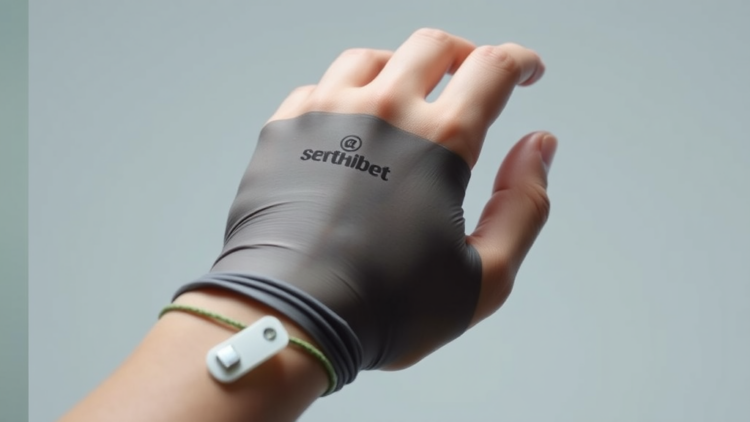
wearable electronics have long faced an awkward trade-off. To sense the faintest tremor of a pulse, a sensor must be exquisitely sensitive; to survive being wrapped around a wrist, finger, or knee, it must also stretch like skin. Materials that excel at one of these tasks usually fail at the other. A team of researchers working across institutions in Beijing and Wuhan, China, now reports a way to have both, by welding a thin, highly conductive layer onto a rubbery ionomer film so tightly that the two behave as a single, seamless material. The result is a flexible strain sensor sensitive enough to detect deformations as small as 0.03 percent, yet able to withstand stretching to more than sixteen times its original length.
The study, published in the journal Advanced Composites and Hybrid Materials, addresses what the authors identify as the central weakness of elastomer-based strain sensors: the interface between the conductive layer that does the electrical sensing and the elastic substrate that carries the mechanical load. The logic of this design is straightforward. Put the sensing chemistry in a thin skin on the surface, and let the thick rubber underneath handle all the stretching. But in practice, that surface layer is exactly where the device fails. When a rigid or poorly bonded coating is repeatedly deformed, cracks form at the boundary between skin and substrate, the electrical network fractures, and the signal drifts or dies. Interfacial integrity, the researchers argue, governs long-term signal stability under repeated deformation, and most conventional coating methods do not provide it.
Their solution is an ionomer-mediated interfacial-welding strategy. The substrate itself is a brominated butyl rubber that has been modified with 1-(2-hydroxyethyl)imidazole, abbreviated HBIIR. Ionomers of this kind contain ionic groups along the polymer chains; in this material, imidazolium groups associate with bromide counter-ions, forming reversible ionic cross-links that give the rubber both elasticity and internal cohesion. Crucially, the same polymer that makes up the bulk film is also dissolved into the coating mixture, where it serves as a molecular binder between the two layers.
The fabrication process reads like a lesson in polymer chemistry. A preformed HBIIR film is dip-coated in a tetrahydrofuran dispersion containing the dissolved HBIIR binder together with two conductive fillers: carbon black and whisker carbon nanotubes. As the film sits in this bath, the solvent swells its surface, loosening the polymer chains and allowing them to interdiffuse across the boundary between what will become the coating and what is already the substrate. There is no sharply defined line between layer and base; instead, chains from each side mingle freely in a swollen interphase. When the solvent then evaporates, it locks these intermingled chains into an entangled interfacial network, and the imidazolium-bromide associations that are characteristic of the ionomer re-form across the interface, adding a second, ionic source of cohesion on top of the physical entanglement.
What emerges is a conductive skin whose internal architecture is deliberately hybrid. Within the coating, the carbon black particles form dense local contacts, creating countless short-range conducting pathways, while the whisker carbon nanotubes provide longer-range connections that bridge neighboring carbon-black-rich regions. This division of labor matters for sensing performance. Carbon black junctions are highly sensitive to strain, because even tiny separations change their contact resistance dramatically, while the nanotube bridges keep the network connected at larger deformations, preventing the conductivity from collapsing when the material is stretched far. The combination is what allows a single sensor to cover both minute and massive strains without sacrificing sensitivity at either end.
The measured properties are striking. The optimized film combines an electrical conductivity of 45.1 siemens per meter with an elongation at break of 1640 percent, meaning it can be stretched to nearly seventeen times its original length before failing. As a sensor, it detects strains as low as 0.03 percent, a deformation far smaller than anything a human fingertip could feel. Its gauge factor, the ratio of relative change in electrical resistance to mechanical strain and the standard figure of merit for strain sensors, reaches a maximum of 14,016.92, an extraordinarily high value that reflects the extreme sensitivity of the carbon-black junction network at small deformations. Response and recovery times are 154 and 157 milliseconds respectively, fast enough to follow physiological motions in real time, and the device maintains reproducible signals over 10,000 deformation cycles, the durability benchmark that separates laboratory demonstrations from practical wearables.
That durability traces directly back to the welding chemistry. Because the coating and substrate share the same ionomer and their chains interpenetrate at the interface, repeated stretching does not peel the conductive skin away from the rubber beneath. The ionic cross-links add further resilience: like reversible Velcro at the molecular scale, imidazolium-bromide associations can break and re-form under stress, dissipating energy and healing local damage rather than letting cracks propagate. In conventional layered sensors, cycling typically produces progressive signal drift as the interface degrades; here, the authors report reproducible output across ten thousand cycles, suggesting the welded interface has effectively eliminated the weak point that usually limits such devices.
The applications demonstrated in the paper lean into the sensor’s clinical pedigree. Several of the authors are affiliated with the Eye Hospital and Guang’anmen Hospital of the China Academy of Chinese Medical Sciences, and the work was supported in part by funding programs tied to traditional Chinese medicine. Fittingly, one of the flagship demonstrations is pulse diagnosis. Placed on the wrist, the sensor records distinguishable radial pulse-wave signals at the three classical positions known in traditional Chinese medicine as Cun, Guan, and Chi, supporting multisite pulse monitoring of the kind practitioners have relied on for centuries. Where a physician’s fingertips must infer subtle pressure rhythms, the electronic skin converts those same mechanical waves into quantifiable resistance changes with millisecond resolution, offering a bridge between an ancient diagnostic tradition and modern instrumentation.
Beyond the wrist, the team showed that the sensor can track whole-body human motion and even serve as the control interface for a robotic hand, translating the flexion of human fingers into gesture commands that drive a mechanical counterpart. This kind of human-machine signaling is a growing area of interest for prosthetics, teleoperation, and soft robotics, and it exploits exactly the properties the welded-skin design provides: wide strain range, high sensitivity, and stable response over many cycles. Perhaps most surprising for a wearable, the sensor also exhibits an antibacterial rate of 99.9 percent against Escherichia coli and Staphylococcus aureus, a property the authors attribute to the material system itself and one that could help address the hygiene concerns that plague skin-contacting devices worn for extended periods.
The study’s authors, led by Liang Su and Chaoyang Yuan, who contributed equally, with corresponding authors Long Zheng, Jie Wu, and Yongzheng Jiao, present the work as a practical route toward sensitive, wide-range, and durable flexible strain sensors. The elegance of the approach lies in its simplicity: rather than inventing new conductive materials or exotic fabrication equipment, it uses the substrate’s own chemistry to weld a standard carbon-filled coating into place, with nothing more elaborate than a solvent bath and controlled evaporation. If the interfacial-welding principle transfers to other ionomer and filler systems, it could remove one of the most persistent failure modes in wearable sensing and bring pulse-monitoring electronic skins closer to everyday clinical and consumer use.
Subject of Research: Interface-welded conductive skins on elastomer ionomers for flexible strain sensing
Article Title: Interface-welded conductive skins on elastomer ionomers enable sensitive, wide-range strain sensing for pulse wave and human motion monitoring
Article References: Su, L., Yuan, C., Miao, S., Zhang, S., Zhou, Z., Yin, X., Zheng, L., Wu, J., & Jiao, Y. (2026). Interface-welded conductive skins on elastomer ionomers enable sensitive, wide-range strain sensing for pulse wave and human motion monitoring. Advanced Composites and Hybrid Materials. https://doi.org/10.1007/s42114-026-02081-2
Image Credits: AI Generated
DOI: 10.1007/s42114-026-02081-2
Keywords: flexible strain sensor, elastomer ionomer, interfacial welding, carbon black, carbon nanotubes, wearable technology, pulse wave monitoring, human motion sensing, gauge factor, antibacterial materials, traditional Chinese medicine, robotic hand actuation
Cite Scienmag News
APA
MLA
Chicago
Denise Maddox. (September 23, 2026). Welded Conductive Skin Turns Stretchy Rubber Into Ultra-Sensitive Wearable Sensor. Scienmag. https://scienmag.com/welded-conductive-skin-turns-stretchy-rubber-into-ultra-sensitive-wearable-sensor/
Denise Maddox. “Welded Conductive Skin Turns Stretchy Rubber Into Ultra-Sensitive Wearable Sensor.” Scienmag, 23 September 2026, https://scienmag.com/welded-conductive-skin-turns-stretchy-rubber-into-ultra-sensitive-wearable-sensor/. Accessed 23 September 2026.
Denise Maddox. “Welded Conductive Skin Turns Stretchy Rubber Into Ultra-Sensitive Wearable Sensor.” Scienmag. September 23, 2026. https://scienmag.com/welded-conductive-skin-turns-stretchy-rubber-into-ultra-sensitive-wearable-sensor/
Copy citation
Download RIS
Tags: advanced composite materials for wearablesantibacterial materialscarbon blackcarbon nanotubesconductive rubber skinsdurable wearable sensorselastomer ionomerelastomer-based strain sensor innovationflexible ionomer filmsflexible strain sensorgauge factorhigh sensitivity stretch sensorshuman motion sensingintegration of conductive layers in flexible electronicsinterfacial weldingpulse wave monitoringrobotic hand actuationseamless conductive-rubber interfacesstretchable wearable electronicstiny deformation detection in wearable techtraditional Chinese medicineultra-sensitive deformation detectionwearable strain sensorswearable technology