Credit: UTA
Kyle O'Connell, a fifth-year Ph.D. student in biology, was selected to receive funds from the National Science Foundation's Doctoral Dissertation Improvement Grants program, which typically awards funding to between 100 and 200 projects nationwide each year. O'Connell's faculty advisor is Matt Fujita, assistant professor of biology.
"I was incredibly excited because I had been turned down by NSF several times already and this was my last chance to receive the award," O'Connell said. "Plus, receiving a doctoral dissertation award is a huge step toward advancing in the evolutionary biology field, so it was very important to me."
The award, which is for $19,695, will support O'Connell's dissertation research, which focuses primarily on the promoters of speciation — the formation of new and distinct species in the course of evolution — on the Indonesian island of Sumatra using parachuting frogs of the genus Rhacophorus.
"I use genetic data to build phylogenetic trees that allow me to test hypotheses about what processes have been responsible for producing the extensive diversity that we see on Sumatra," O'Connell said.
The project also includes working on descriptions of some of the new species that O'Connell and others discovered during recent field work in Sumatra and the neighboring island of Java with Eric Smith, associate professor of biology, and members of Smith's lab.
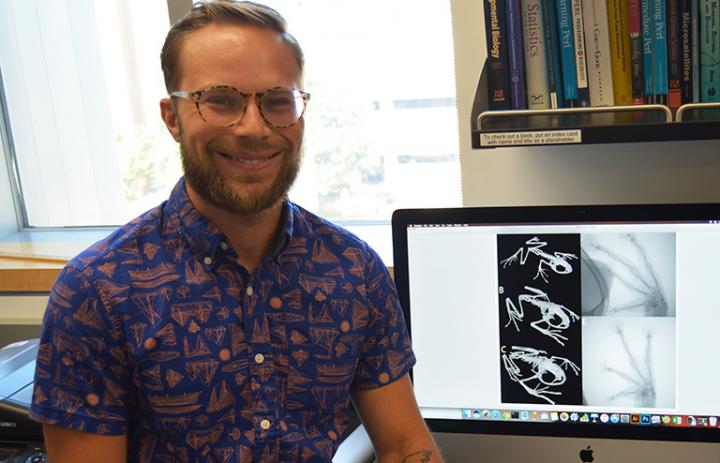
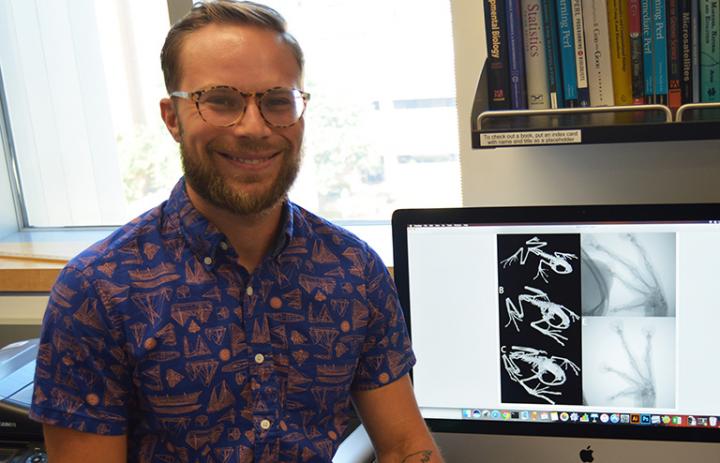
"What is exciting is that we are using integrative methods that use genetic and genomic data, as well as internal osteological (the branch of anatomy dealing with the skeleton) data generated from CT scanning done here at UTA," O'Connell said.
Additionally, O'Connell's research has included investigation of the processes underpinning diversification of North American snakes.
"This project is neat because different species exhibit genetic discontinuities, or population structure, at congruent geographical features, such as the Mississippi River or the Continental Divide," he said. "This indicates that these features have been important for diversification of a broad range of species in North America."
Fujita said that O'Connell's project takes advantage of the unique geological history of the region to address fundamental questions in biogeography.
"His project will also leverage the latest in sequencing technologies to answer his research questions," Fujita said. "The integration of all of these factors — a unique system, big questions in evolutionary biology, and the latest in sequencing and analytical tools — was deservedly recognized by National Science Foundation as an important endeavor."
Kyle O'Connell is using CT scans of parachuting frogs in his doctoral research. O'Connell received a B.S. in Fisheries and Wildlife and a B.A. in Spanish from the University of Nebraska at Lincoln in 2011 before coming to UTA to begin his doctoral work. As a child he loved watching The Crocodile Hunter, the TV show hosted by Steve Irwin, the late Australian nature expert who became famous for wrestling crocodiles. Following high school, he worked as a summer zookeeper as part of the reptile crew at the Omaha Zoo.
While at the University of Nebraska, O'Connell chose to major in Fisheries and Wildlife in the School of Natural Resources because it involved plenty of hands-on time in the field and allowed him to pursue research with reptiles and amphibians. When it came time to decide what the focus of his doctoral studies would be, reptiles and amphibians was the clear choice.
"Plus, I figured this would be the best way to get to wrestle crocs like Steve Irwin," he said. "Instead, now I study tree frogs!
###
Media Contact
Louisa Kellie
[email protected]
817-524-8926
@utarlington
http://www.uta.edu
Original Source
http://www.uta.edu/news/releases/2017/07/NSF%20doctoral%20dissertation%20grant%20biology.php
############
Story Source: Materials provided by Scienmag