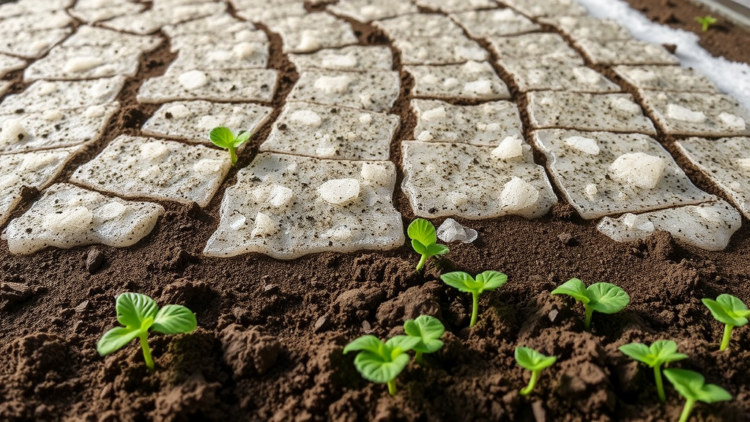
Soil salinization has long been recognized as one of the most stubborn threats to global agriculture, but a new analysis in Nature Food argues that the true price of salt in the world’s soils extends far beyond stunted crops and abandoned fields. Writing as commentators in the journal, Paolo Tarolli and Roberta Masin of the University of Padova contend that salinity imposes a hidden second cost: it undermines the efficiency with which crops use nitrogen and increases the losses of reactive nitrogen to the wider environment. That reframing matters, because nitrogen is both the engine of modern crop production and one of agriculture’s most damaging pollutants, and any process that erodes nitrogen-use efficiency ripples through food security, farm economics and planetary health at once.
The scale of the salinity problem is well documented. Salt-affected soils now cover vast expanses of every inhabited continent, a situation catalogued most recently in the Food and Agriculture Organization’s global assessment of salt-affected soils published in 2024. Estimates compiled by researchers using remote sensing and global datasets suggest that roughly a billion hectares of land are affected by salinity or sodicity, and the extent continues to grow as irrigation, climate change and poor drainage conspire to concentrate dissolved salts in the root zone. In irrigated agriculture, which supplies a disproportionate share of the world’s food, the risk is acute: every pass of irrigation water delivers a small load of dissolved salts, and without adequate leaching and drainage those salts accumulate season after season.
Salinity damages plants through well-understood physiological mechanisms. Excess salts in the soil solution raise the osmotic pressure of the soil water, making it harder for roots to extract moisture, a stress that resembles drought even in wet fields. Specific ions, particularly sodium and chloride, become toxic at high internal concentrations, disrupting enzyme function, photosynthesis and membrane transport. Plants respond by closing their stomata, slowing growth and diverting energy into defensive osmotic adjustment. The result is reduced biomass, lower yields and, crucially for the nitrogen argument, a diminished capacity of the crop to take up and assimilate nutrients from the soil.
It is this last consequence that Tarolli and Masin place at the centre of their commentary. When crop growth is suppressed by salt stress, the plant’s demand for nitrogen falls, but the nitrogen supplied to the field does not. Fertilizer applied at rates calibrated for healthy, unstressed crops meets a root system that can no longer absorb it efficiently. The surplus nitrogen does not simply wait in the soil for better times; it is mobile, and it moves. Nitrate leaches downward with percolating water toward groundwater, while microbial processes convert ammonium and nitrate into gaseous forms, including nitrous oxide, a greenhouse gas nearly three hundred times more potent than carbon dioxide over a century. Saline soils, with their altered microbial communities and often impaired structure, can be particularly prone to these gaseous losses.
The commentary draws on a growing body of evidence linking salinity to nitrogen dynamics. Recent work cited by the authors includes a 2025 review in Environmental Research Letters by Ghirardelli and colleagues examining the interactions between salt-affected soils and nutrient cycling, and a study published in Nature Food by Wen and colleagues in 2026 that quantifies how salinity depresses nitrogen-use efficiency and elevates reactive-nitrogen losses. Earlier research, including analyses published in Global Change Biology, had already established that salt stress reduces nitrogen uptake by crops and shifts the balance of nitrogen transformations in the soil. Taken together, these studies sketch a feedback loop with troubling implications: salinization degrades nitrogen-use efficiency, degraded nitrogen efficiency demands either more fertilizer or acceptance of yield losses, and additional fertilizer in salt-stressed fields leaks into water and air, compounding the environmental burden.
The concept of reactive nitrogen is central to understanding why this matters beyond the farm gate. Reactive nitrogen refers to all the chemically active forms of the element, including ammonia, nitrate and nitrogen oxides, that drive a cascade of environmental problems known as the nitrogen cascade. A landmark 2023 analysis in Nature by Gu and colleagues quantified the full costs of reactive nitrogen losses, tracing how a single molecule of nitrogen fertilizer can contribute in sequence to air pollution, ecosystem acidification, eutrophication of waterways, stratospheric ozone depletion and climate warming. Global synthetic nitrogen fertilizer use now exceeds one hundred million tonnes per year, and only a fraction of that nitrogen, often less than half, ends up in harvested products. Anything that pushes that efficiency lower, as salinity demonstrably does, multiplies the environmental and economic waste embedded in every bag of fertilizer.
Tarolli and Masin’s argument also carries a monitoring dimension. Their own research programme has explored how remote sensing and geospatial technologies can detect and map soil salinity across landscapes, work published in iScience in 2024 and extended in a 2026 study in the ISPRS Journal of Photogrammetry and Remote Sensing with Xue, Ghirardelli and Chen. Satellite and drone-based sensors can pick up the spectral signatures of salt accumulation and of vegetation stress, offering a way to identify fields where the salt-nitrogen interaction is likely to be eroding efficiency. The commentators suggest that such tools could be integrated into nutrient management, allowing farmers and advisers to adjust nitrogen applications in real time as salinity stress develops, rather than applying fertilizer on a fixed schedule that assumes ideal soil conditions.
The deeper message of the commentary is a call for integration. Soil salinity, water management and nutrient management have traditionally been treated as separate technical domains, addressed by different specialists, different policies and different parts of the agricultural research establishment. The nitrogen costs of salinity expose the weakness of that fragmentation. Drainage and leaching strategies that control salt accumulation also control the pathways by which nitrate escapes to groundwater. Irrigation scheduling that avoids waterlogging and salt concentration also protects the microbial processes that govern nitrogen availability. Fertilizer recommendations that account for salinity stress, rather than ignoring it, could simultaneously protect yields and cut reactive-nitrogen losses. The authors argue that managing soil, water and nutrients together is not merely desirable but necessary if the world is to feed a growing population without pushing the nitrogen cycle further out of balance.
The stakes are considerable. Salt-affected soils are expanding by millions of hectares each year according to global assessments, driven by seawater intrusion into coastal aquifers, melting permafrost releasing stored salts, unsustainable irrigation in arid basins and the over-extraction of groundwater that draws saline water upward. Each newly salinized hectare represents not only lost productive capacity but also, on the argument advanced in this commentary, a new source of nitrogen inefficiency and pollution. Conversely, reclaiming salt-affected soils through improved drainage, gypsum amendments, salt-tolerant crops and precision irrigation would deliver a double dividend: restored yields and improved nitrogen-use efficiency, with corresponding reductions in nitrous oxide emissions and water pollution.
For policymakers, the commentary lands at a moment when both nitrogen and salinity are climbing international agendas. The Kunming-Montreal Global Biodiversity Framework includes a target to halve nutrient pollution by 2030, and the FAO’s salt-affected soils assessment has prompted calls for national action plans. Tarolli and Masin’s analysis suggests that these two agendas should be pursued jointly rather than in parallel silos. Every investment in salinity control, they imply, is also an investment in nitrogen efficiency, and every nitrogen policy that ignores salinity risks overestimating the nutrient uptake that farmers can realistically achieve. The hidden nitrogen bill of soil salinity is now on the table, and settling it will require the kind of joined-up thinking that agricultural science has long preached and rarely practised.
Subject of Research: The impact of soil salinization on nitrogen-use efficiency and reactive-nitrogen losses in agricultural systems
Article Title: The nitrogen costs of soil salinity
Article References: Tarolli, P., & Masin, R. (2026). The nitrogen costs of soil salinity. Nature Food. https://doi.org/10.1038/s43016-026-01434-w
Image Credits: AI Generated
DOI: 10.1038/s43016-026-01434-w
Keywords: soil salinity, nitrogen-use efficiency, reactive nitrogen, soil salinization, agriculture, nitrate leaching, nitrous oxide, irrigation, soil management, remote sensing, food security, nutrient pollution
Cite Scienmag News
APA MLA Chicago
Alan Morgan. (September 23, 2026). Salt-Stressed Soils Are Quietly Draining the World’s Nitrogen. Scienmag. https://scienmag.com/salt-stressed-soils-are-quietly-draining-the-worlds-nitrogen/
Alan Morgan. “Salt-Stressed Soils Are Quietly Draining the World’s Nitrogen.” Scienmag, 23 September 2026, https://scienmag.com/salt-stressed-soils-are-quietly-draining-the-worlds-nitrogen/. Accessed 23 September 2026.
Alan Morgan. “Salt-Stressed Soils Are Quietly Draining the World’s Nitrogen.” Scienmag. September 23, 2026. https://scienmag.com/salt-stressed-soils-are-quietly-draining-the-worlds-nitrogen/
Copy citation Download RIS
Tags: agricultureClimate change and soil degradationeffects of soil salinity on food securityenvironmental nitrogen loss from saline soilsFood securityglobal assessment of saline soilsimpacts of soil salinity on farm economicsirrigationirrigation-induced soil salinitynitrate leachingnitrogen pollution from salt-stressed soilsnitrogen use efficiencynitrous oxidenutrient pollutionplanetary health and soil salinityreactive nitrogenremote sensingremote sensing of salt-affected landsSalt-affected soils and global agriculturesoil drainage and salinity managementsoil managementsoil salinitysoil salinizationsoil salinization impact on nitrogen efficiency