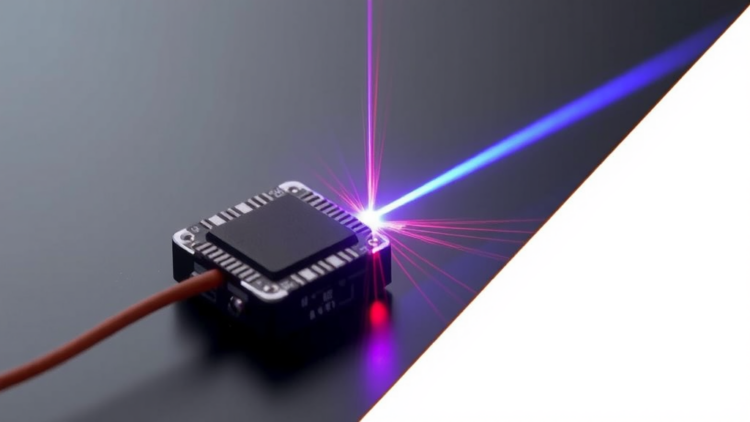
Engineers have long dreamed of millimetre-wave signals so pure that their timing never wavers by more than a few quintillionths of a second. That dream moved a decisive step closer to reality with the publication of a new study in Nature Photonics, in which researchers at IMRA America’s Boulder Research Labs report a chip-scale oscillator that reaches a timing noise floor of just 18 zeptoseconds per square root hertz — the lowest value ever demonstrated for a directly photodetected microwave or millimetre-wave signal. A zeptosecond is a trillionth of a trillionth of a second, a timescale so short that light itself travels only a few billionths of a nanometre in that interval. Integrated over the frequency band from 1 kilohertz to 1 megahertz, the new oscillator’s root-mean-square timing jitter amounts to a mere 135 attoseconds, placing the work firmly in a regime that was previously inaccessible to electronic signal generation.
The achievement matters because millimetre-wave and subterahertz carriers sit at the heart of technologies that define modern life and modern science alike. They carry data in next-generation wireless networks, probe the atmosphere in high-resolution radar, resolve rotational fingerprints of molecules in spectroscopy, drive the superconducting circuits of quantum computers, and synchronize the antennas of radio telescopes that image black holes. In all of these applications, the useful information capacity and measurement precision are ultimately limited by how cleanly the oscillation repeats in time. Any jitter in the zero crossings of the waveform blurs the constellation points of a communication link, softens the edges of a radar return, or washes out the fine spectral lines of a molecule under study. The spectral purity of conventional oscillators, however, is constrained by noise processes intrinsic to generating the signal directly at the carrier frequency, where the relative timing uncertainty scales unfavorably as frequency rises.
The IMRA team, led by Antoine Rolland with Scott Egbert and Brendan Heffernan contributing equally, sidestepped those limits with a strategy they call Kerr optical frequency division. The central idea is elegantly counterintuitive: instead of building a fast electronic oscillator and trying to clean it up, they start with an ultrastable reference at an enormous optical frequency — 3.3 terahertz — and divide it down to the millimetre-wave domain using the nonlinear dynamics of light itself. Division is the key operation. When a high-frequency reference with exquisitely low noise is divided by a large factor, the absolute timing noise of the resulting low-frequency signal is reduced proportionally, while the reference’s fractional stability is preserved. Optical frequencies are roughly ten thousand times higher than millimetre-wave frequencies, so dividing an optical reference down to 300 gigahertz buys an enormous noise advantage that no amount of electronic refinement at the carrier frequency could deliver.
The optical reference in this work is a dual-wavelength Brillouin laser, a device in which stimulated Brillouin scattering — the interaction of light with acoustic waves in an optical fiber — generates two closely spaced laser lines whose frequency difference is set with extraordinary precision. In earlier work, the same group showed that such lasers can be stabilized to molecular rotational transitions, giving them the kind of absolute accuracy normally associated with atomic clocks. Here, the 3.3-terahertz beat note between the two Brillouin laser lines serves as the multiterahertz reference whose noise will be divided. Brillouin lasers are prized for this role because the stimulated scattering process naturally narrows the laser linewidth, suppressing the technical noise that plagues conventional semiconductor and fiber lasers, and because the dual-wavelength geometry cancels much of the common-mode drift that would otherwise corrupt the difference frequency.
The division itself is performed by a chip-scale Kerr microcomb, a device that has become one of the most celebrated tools of modern photonics. A Kerr microcomb is a tiny optical resonator, typically a whispering-gallery ring or a waveguide racetrack etched onto a photonic chip, in which continuous-wave pump light circulates with such intensity that the Kerr nonlinearity of the material converts it into a stable train of ultrashort soliton pulses. The spectrum of these pulses is a frequency comb: a set of perfectly evenly spaced lines whose spacing equals the repetition rate of the solitons, in this case 300 gigahertz. The comb acts as a mechanical gearbox for light, linking the terahertz reference to the millimetre-wave output through an exact integer ratio. Because every tooth of the comb inherits the phase of the reference, whatever coherence the optical reference possesses is transferred, undiluted in relative terms, to the repetition rate that emerges when the comb light strikes a photodiode.
The crucial innovation is how the comb is locked to the reference. Rather than using electronic feedback loops — phase detectors, voltage-controlled oscillators, servo electronics — which would inject their own noise and limit the achievable purity, the researchers employed coherent injection locking. They injected the Brillouin laser light directly into the microresonator, and the Kerr nonlinearity of the cavity did the rest: the soliton comb spontaneously synchronized its repetition rate to the injected reference, a phenomenon related to the Kerr-induced synchronization of cavity solitons demonstrated by other groups in recent years. No electronic multiplication, no feedback control, no phase-locked loop. The division is enforced by physics rather than by circuitry, and the noise of the output reflects only the reference and the fundamental limits of the soliton dynamics, not the imperfections of a servo system chasing a fast signal.
Measuring a signal this pure posed its own formidable challenge, because no commercial instrument can resolve phase noise at the zeptosecond level at 300 gigahertz using conventional techniques. The team therefore built a cross-correlation phase-noise metrology system operating at the carrier frequency itself, using two independent photonic local oscillators as references. Cross-correlation metrology exploits a beautiful statistical principle: if two independent measurement channels observe the same device under test, the noise of the instruments themselves is uncorrelated between channels and averages away as the measurement accumulates, while the correlated noise of the device under test survives. The technique, whose foundations trace back to work at the National Institute of Standards and Technology in the 1970s, had to be extended to 300 gigahertz, a frequency at which suitable local oscillators simply did not exist until the team built them from the same dual-wavelength Brillouin laser technology that underpins the main experiment. The measured single-sideband phase noise of −152 dBc/Hz at a 1-megahertz offset from the 300-gigahertz carrier is the direct fingerprint of the 18-zeptosecond timing floor.
The numbers deserve a moment of reflection. A phase noise of −152 dBc/Hz means that, in a one-hertz bandwidth one megahertz away from the carrier, the noise power is 152 decibels below the carrier power — a ratio of roughly one part in 10^15. Expressed as timing, 18 zeptoseconds per square root hertz means that over any measurement bandwidth, the accumulated timing uncertainty of the signal’s zero crossings amounts to a few hundred attoseconds at most. For comparison, the orbital period of an electron in the ground state of a hydrogen atom is on the order of 150 attoseconds, so this oscillator keeps time well enough to resolve the fastest motions in ordinary atoms. Achieving this with a signal that emerges directly from a photodiode, ready to be amplified and radiated from an antenna, is what distinguishes the result from earlier demonstrations that required elaborate downstream processing or referenced their performance to optical rather than electrical outputs.
The architecture is also strikingly practical by the standards of precision oscillators. The microcomb is chip-scale, the Brillouin lasers are fiber-based, and the entire chain involves no cryogenic cooling, no atomic vapor cells, and no vacuum systems. The work builds on a rapid progression of results from the same laboratory, including a 3-terahertz Brillouin-driven oscillator with femtosecond-level jitter reported in 2024 and a carbonyl sulfide-stabilized terahertz source published in 2025, and it converges with parallel advances at other institutions, where microcombs referenced to optical cavities and integrated silicon photonics have pushed microwave generation toward zeptosecond timing noise over the past several years. What sets the new result apart is the combination of division factor, locking mechanism, and measured performance: a multiterahertz reference divided by Kerr soliton dynamics through pure optical injection, verified at the millimetre-wave carrier itself.
The implications ripple outward across several fields. For subterahertz wireless communication, where atmospheric absorption windows near 300 gigahertz promise enormous bandwidths but demand local oscillators of exceptional purity, the result removes a longstanding bottleneck. For ultrafast electronics, photonic millimetre-wave clocks of this quality could synchronize analog-to-digital converters and superconducting logic with timing margins previously unattainable. For radio astronomy, distributed oscillators of this class could phase-lock arrays of telescopes separated by continents, sharpening the resolution of very long baseline interferometry at 870-micron wavelengths and beyond. And for precision spectroscopy, a coherent 300-gigahertz carrier with attosecond jitter provides a synthesis engine for probing molecular and solid-state dynamics at their natural timescales. The authors, who have filed a provisional patent on the coherent injection architecture, describe Kerr optical frequency division as a general and scalable route to millimetre-wave and subterahertz carriers whose coherence is no longer constrained by the limits of direct generation. If the trajectory of microcomb photonics over the past decade is any guide, the zeptosecond regime they have opened will not remain a laboratory curiosity for long.
Subject of Research: Low-noise millimetre-wave generation via Kerr optical frequency division of a Brillouin laser reference
Article Title: Millimetre-wave generation with 18 zs Hz−1/2 timing noise floor via Kerr optical frequency division
Article References: Egbert, S. C., Heffernan, B. M., Greenberg, J., McGrew, W. F., & Rolland, A. (2026). Millimetre-wave generation with 18 zs Hz−1/2 timing noise floor via Kerr optical frequency division. Nature Photonics. https://doi.org/10.1038/s41566-026-02014-x
Image Credits: AI Generated
DOI: 10.1038/s41566-026-02014-x
Keywords: millimetre waves, Kerr microcomb, optical frequency division, Brillouin laser, timing jitter, phase noise, frequency combs, microwave photonics, injection locking, terahertz, photonic oscillators, zeptoseconds
Cite Scienmag News
APA
MLA
Chicago
Katie Riggs. (September 23, 2026). Chip-scale laser trick shatters timing noise record for millimetre-wave signals. Scienmag. https://scienmag.com/chip-scale-laser-trick-shatters-timing-noise-record-for-millimetre-wave-signals/
Katie Riggs. “Chip-scale laser trick shatters timing noise record for millimetre-wave signals.” Scienmag, 23 September 2026, https://scienmag.com/chip-scale-laser-trick-shatters-timing-noise-record-for-millimetre-wave-signals/. Accessed 23 September 2026.
Katie Riggs. “Chip-scale laser trick shatters timing noise record for millimetre-wave signals.” Scienmag. September 23, 2026. https://scienmag.com/chip-scale-laser-trick-shatters-timing-noise-record-for-millimetre-wave-signals/
Copy citation
Download RIS
Tags: Brillouin laserchip-scale laser oscillatorfrequency combshigh-resolution radar signal generationinjection lockingintegrated millimetre-wave technologyKerr microcombmicrowave photonicsmillimetre wavesmillimetre-wave signal stabilitynext-generation wireless network componentsoptical frequency divisionphase noisephotodetected microwave signalsphotonic oscillatorsquantum computing synchronizationspectroscopy molecular fingerprintingsubterahertz carrier signal developmentterahertztiming jitterultra-low jitter oscillatorultrafast timing noise reductionzeptosecond timing precisionzeptoseconds