Credit: David A. Broadway/cqc2t.org
Researchers at the University of Melbourne have demonstrated a way to detect nuclear spins in molecules non-invasively, providing a new tool for biotechnology and materials science.
Important research in medicine and biology relies on nuclear magnetic resonance (NMR) spectroscopy, but until now, it has been limited in spatial resolution and typically requires powerful microwave fields. A team led by Professor Lloyd Hollenberg at the University of Melbourne has used a quantum probe to perform microwave-free NMR at the nanoscale. The results were published today in Nature Communications.
"This quantum probe delivers a dramatic improvement in NMR technology. In addition to being able to detect NMR in far smaller samples than conventional machines, our technique does not require the application of microwave fields that might disrupt biological samples" said Hollenberg, who is Deputy Director of the Centre for Quantum Computation and Communication Technology (CQC2T) and Thomas Baker Chair at the University of Melbourne.
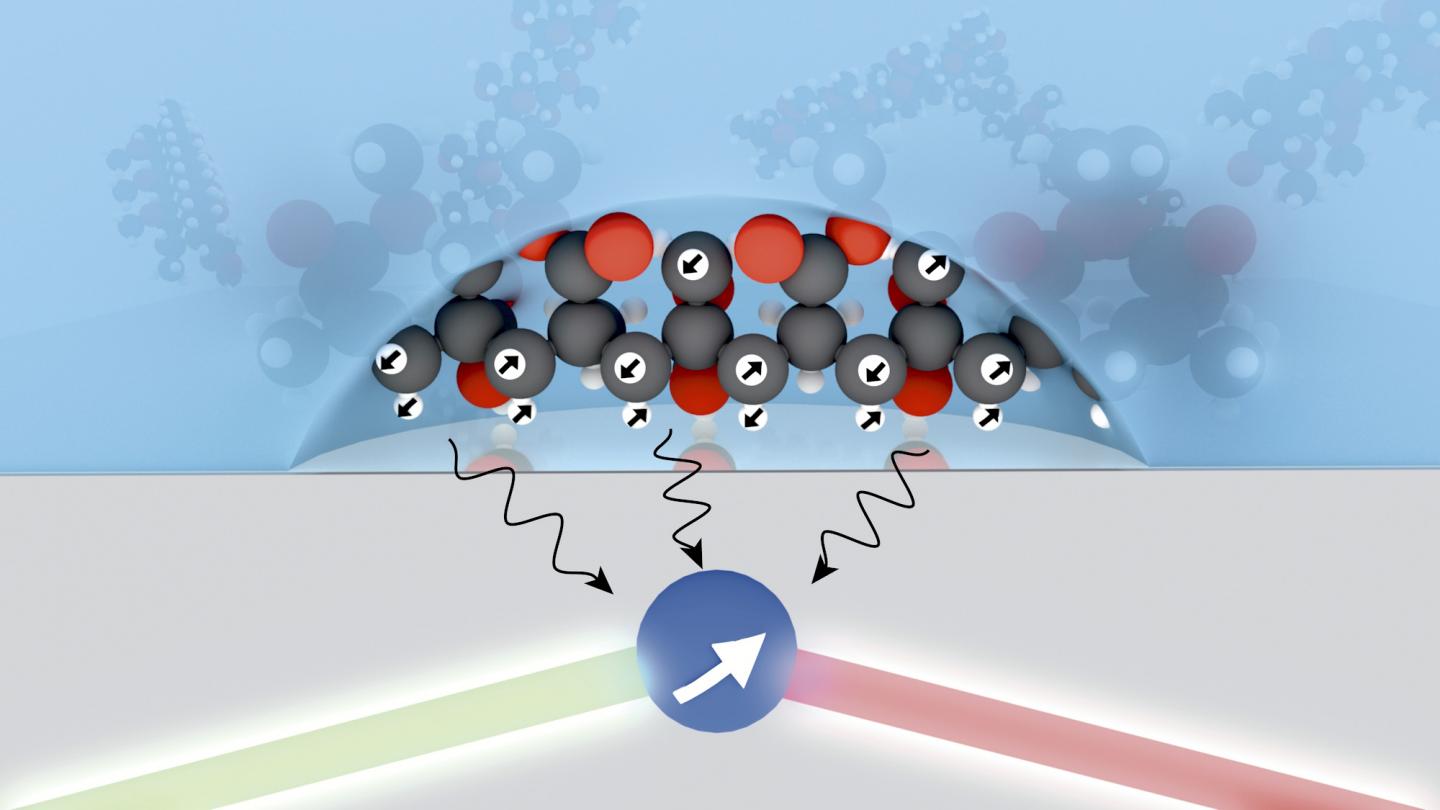
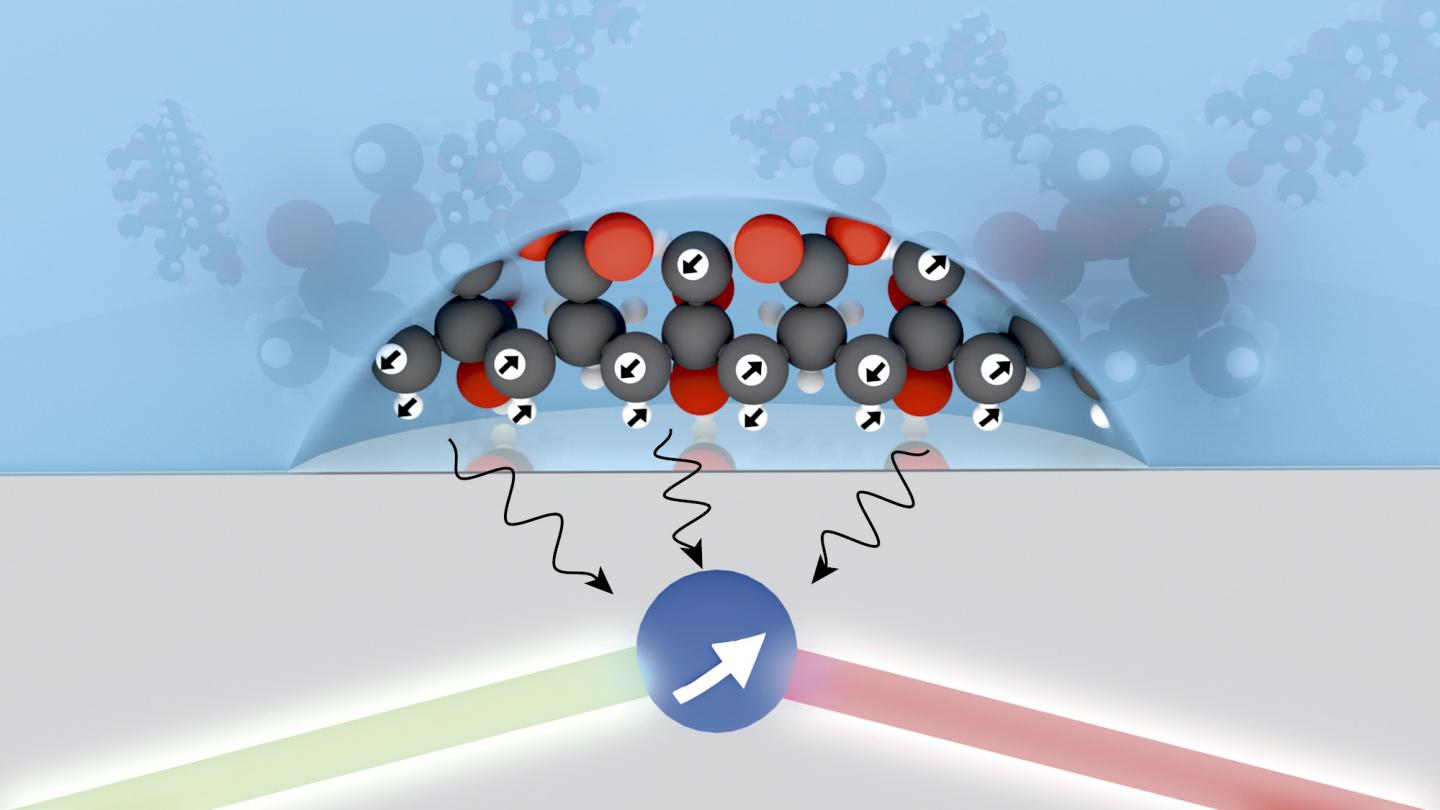
"In NMR the goal is to detect the magnetic signal from the nuclei of the atoms comprising molecules. But the signal from the nuclear "spin" is very weak and conventional NMR machines require many millions of nuclear spins to detect anything. However, using the quantum properties of a 'defect' in diamond, our technique can detect much smaller volumes down to only thousands of spins."
The discovery may overcome significant limitations with conventional NMR methods, which depend on machines that can exceed 10 tonnes.
"The problem with the large NMR machines in widespread use today is that the signals we're trying to detect are extremely small, and the distance from the measurement device to the object being measured is very large," said Dr. Alastair Stacey, a CQC2T postdoctoral researcher.
"This creates two problems: The machine can only see a larger collection of molecules, reducing the accuracy of the measurement. It also has to use very strong microwaves and magnetic fields to reach the sample, but these processes are invasive and can affect delicate bio-samples, just like the microwave in your kitchen, particularly when trying to see the molecular structure of liquids."
Lead author James Wood describes the technique as "a dramatic simplification of the nuclear detection process, where we essentially shine light on an atomic-sized defect in diamond and observe its natural response, at a fundamentally quantum level, to the target nuclear spins nearby".
"A great benefit of our approach is that we don't interfere with the sample when imaging it."
The technique offers new opportunities for researchers.
"With these advances in quantum sensing technology, we are opening the door to a new world of scientific investigation that could lead us to gain a better understanding of the smallest building blocks of life," said Hollenberg.
###
The research is supported with funding from the Australian Research Council through the Centre of Excellence and Laureate Fellowship programs.
Media Contact
Nerissa Hannink
[email protected]
043-058-8055
@cqc2t_
Related Journal Article
http://dx.doi.org/10.1038/NCOMMS15950
############
Story Source: Materials provided by Scienmag