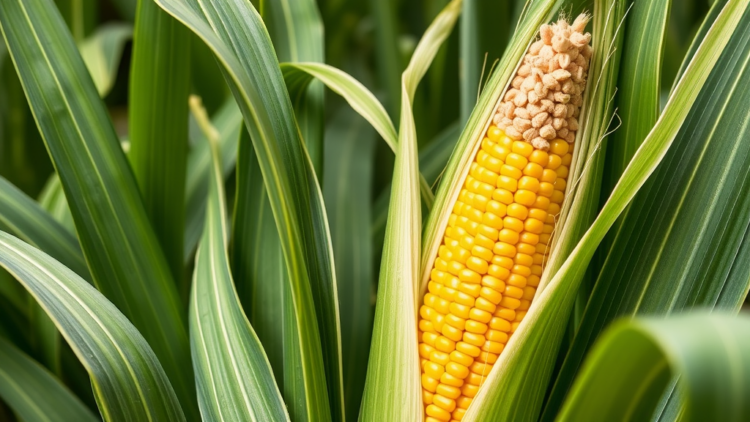
As global temperatures climb, one of the world’s most important cereal crops is quietly missing a piece of its molecular armor. Maize, a staple that feeds billions and underpins livestock and biofuel industries, accumulates raffinose but lacks stachyose, a larger sugar in the raffinose family oligosaccharides that many plants deploy as a shield against environmental stress. A team of researchers led by Tianyong Zhao at Northwest A&F University in China has now shown that this missing metabolic step is more than a biochemical curiosity. By introducing a single gene from Arabidopsis thaliana into the maize genome, the scientists reconstructed the complete raffinose family oligosaccharide pathway and produced maize lines that survive heat stress that kills most wild-type seedlings. The work, published in the journal Stress Biology, offers a striking example of how evolutionary history can leave crops vulnerable to modern climate extremes, and how metabolic engineering can restore what millions of years of adaptation discarded.
The story begins with the biochemistry of raffinose family oligosaccharides, or RFOs, a family of non-reducing sugars synthesized in the cytosol that includes raffinose, stachyose, and verbascose. These sugars are built stepwise: the enzyme RAFFINOSE SYNTHASE, or RAFS, joins a galactosyl unit from galactinol onto sucrose to make raffinose, and STACHYOSE SYNTHASE, or STS, then adds another galactosyl unit from galactinol onto raffinose to produce stachyose. In some species, an alternative enzyme called GALACTAN:GALACTAN GALACTOSYLTRANSFERASE can elongate these chains without galactinol. RFOs are thought to protect cells in several ways: they act as compatible solutes for osmotic adjustment, stabilize cellular membranes through hydrogen bonding with phospholipid bilayers, and scavenge reactive oxygen species that accumulate when heat damages the photosynthetic apparatus. Arabidopsis carries functional RAFS and STS genes and accumulates raffinose, stachyose, and verbascose in its seeds. Maize, by contrast, makes raffinose but produces no detectable stachyose, a discrepancy that pointed to the absence of a functional STS gene in its genome.
To trace the evolutionary origin of this gap, the researchers searched 62 plant genomes using Arabidopsis and maize RFO enzyme sequences as queries. They identified 391 homologous proteins, of which 135 clustered with functionally characterized RFO biosynthetic enzymes in phylogenetic analyses, all derived from seed plants. Homologous sequences found in algae, bryophytes, and ferns turned out to be more closely related to ALKALINE α-GALACTOSIDASES, suggesting that RAFS and STS arose from an ancestral alkaline α-galactosidase through evolutionary divergence. Putative RAFS and STS homologs were identified in the gymnosperm Picea abies, and STS homologs appeared across most angiosperm lineages. The exceptions were telling: in grasses such as maize and rice, only RAFS homologs were detected. Searches of MaizeGDB confirmed that no STS genes exist in wild relatives of maize, including Zea mays ssp. parviglumis, mexicana, and huehuetenagensis, while other domesticated grasses such as foxtail millet and sorghum retained STS. The authors conclude that STS originated before the split of gymnosperms and angiosperms and was subsequently lost in the maize lineage, likely early in the evolution of the genus Zea rather than during domestication, since the maize precursor Zea luxurians had already lost the gene.
Before touching maize, the team validated the protective role of stachyose in Arabidopsis itself. The Arabidopsis STS gene, At4g01970, is upregulated by heat stress, a response the researchers confirmed by quantitative RT-PCR and Western blotting. Three-week-old AtSTS-overexpressing Arabidopsis lines showed no morphological differences from wild-type controls under normal conditions, but after 36 hours at 43 degrees Celsius, control leaves yellowed and wilted while many overexpressing plants stayed green. Following a six-day recovery, two-thirds of the control plants had died, whereas more than half of the overexpressing plants resumed growth, and their leaves showed markedly lower ion leakage across the plasma membrane, a standard indicator of membrane damage.
The team then engineered the same capability into maize. They inserted the AtSTS coding region, a 2,628-base-pair sequence encoding a protein of 876 amino acids, into the maize genome under the Ubiquitin promoter using Agrobacterium-mediated transformation of the inbred line Z31. The transgenic plants were backcrossed for five generations to eliminate background variation introduced by cell culture and transformation, then self-pollinated for three generations to generate homozygous lines. Three stably inherited overexpression lines were confirmed by PCR, RT-qPCR, and Western blot. Under normal growth at 28 degrees Celsius, the transgenic lines were indistinguishable from wild type in sucrose, raffinose, and stachyose content. But after four hours at 43 degrees Celsius, stachyose appeared exclusively in the transgenic lines and rose significantly, while remaining undetectable in wild-type maize throughout the experiment.
The mechanism behind this heat-induced accumulation is elegant. Heat stress upregulated the endogenous maize RAFS gene, ZmRAFS, expanding the pool of raffinose that serves as the substrate for the introduced STS enzyme. Although AtSTS transcripts were slightly suppressed by heat, the protein remained active enough to convert the surge of raffinose into stachyose. In other words, the heat stress response that maize already possesses, the induction of raffinose synthesis, was redirected by the transgene toward the production of a longer, potentially more protective oligosaccharide. The researchers note that maize also lacks a galactinol-independent pathway for stachyose synthesis, since no GALACTAN:GALACTAN GALACTOSYLTRANSFERASE ortholog could be found in its genome, meaning that without the transgene, the raffinose that accumulates under heat has nowhere further to go.
The physiological payoff was substantial. When V3-stage maize seedlings were subjected to 24 hours at 45 degrees Celsius, wild-type Z31 leaves yellowed and wilted severely, while the transgenic lines retained greener leaves and suffered less injury. After seven days of recovery, most control plants had died, but a significant fraction of the transgenic plants survived and continued to grow. Survival percentages were significantly higher in all three transgenic lines, and ion leakage, a measure of membrane damage, was significantly reduced. Histochemical staining with diaminobenzidine and nitroblue tetrazolium revealed the likely reason: heat-stressed transgenic leaves accumulated far less hydrogen peroxide and superoxide than wild-type controls, indicating that the engineered pathway enhanced the plant’s capacity to neutralize the reactive oxygen species that heat stress generates. Similar reductions in ROS accumulation were observed in AtSTS-overexpressing Arabidopsis.
To isolate the contribution of stachyose itself, the researchers sprayed wild-type maize and Arabidopsis seedlings with stachyose solutions before and during heat stress. In maize, foliar application of a 10 millimolar stachyose solution during four days of 43-degree heat stress raised survival to 41 percent, compared with just 10 percent in controls, and significantly reduced electrolyte leakage. Exogenous stachyose did not elevate endogenous galactinol or raffinose levels, providing evidence that stachyose alone is sufficient to confer protection. The authors caution, however, that the transgenic lines accumulate elevated levels of all three RFOs under heat stress, so the improved tolerance likely reflects a combination of stachyose, raffinose, and galactinol rather than stachyose alone, and disentangling their relative contributions remains an open question for future research.
Crucially for any breeding program, the engineering came without an agronomic cost. Field trials under non-stress conditions showed no significant differences in ear morphology between transgenic and control plants. Although transgenic plants were 4 to 10 percent shorter, a trait that might even improve lodging resistance, no dwarfism or developmental abnormalities appeared. Hundred-kernel weight was unaffected in two of three lines, kernel number per ear was higher in two lines, and grain yield per plot was significantly higher in lines one and three, with no penalty in any line. The authors attribute the yield increases in two lines either to pleiotropic effects or residual background variation, but the absence of any yield penalty confirms the agronomic safety of the approach. A limitation is that all analyses were conducted in the single inbred line Z31, so validation across elite commercial germplasm representing different heterotic groups will be needed to establish breeding relevance.
Beyond the transgenic route, the demonstration that sprayed stachyose protects plants opens a non-transgenic path: if the sugar proves stable, absorbable, and cost-effective, it could be developed as a natural biostimulant for crop stress protection. The findings also raise intriguing evolutionary questions about why Zea lost STS in the first place, whether raffinose alone sufficed under historical climates, or whether the metabolic cost of stachyose synthesis outweighed its benefits. The authors even speculate, cautiously, that stachyose might act as a signaling molecule, noting recent work showing that stachyose binds HEAT SHOCK PROTEIN 90β in the mouse intestine, though no evidence yet demonstrates such binding in plants. What is clear is that restoring a lost biosynthetic step can meaningfully harden a major crop against heat. As extreme temperatures increasingly threaten global grain yields, reconstructing ancient metabolic pathways may prove to be one of the more elegant tools in the agricultural adaptation toolkit.
Subject of Research: Metabolic engineering of the raffinose family oligosaccharide pathway in maize to improve heat stress tolerance
Article Title: Reconstruction of the raffinose family oligosaccharide pathway in maize improves heat stress tolerance
Article References: Dong, Z., Li, T., Li, X., Li, D., Shi, X., Chai, J., Dirk, L. M. A., Downie, A. B., & Zhao, T. (2026). Reconstruction of the raffinose family oligosaccharide pathway in maize improves heat stress tolerance. Stress Biology, 6(1), Article 49. https://doi.org/10.1007/s44154-026-00326-0
Image Credits: AI Generated
DOI: 10.1007/s44154-026-00326-0
Keywords: maize, stachyose, raffinose family oligosaccharides, heat stress tolerance, stachyose synthase, metabolic engineering, Arabidopsis thaliana, reactive oxygen species, crop resilience, Zea mays, abiotic stress, plant biotechnology
Cite Scienmag News
APA MLA Chicago
Alan Morgan. (September 22, 2026). Scientists Engineer Stachyose Production in Maize to Boost Heat Stress Tolerance. Scienmag. https://scienmag.com/scientists-engineer-stachyose-production-in-maize-to-boost-heat-stress-tolerance/
Alan Morgan. “Scientists Engineer Stachyose Production in Maize to Boost Heat Stress Tolerance.” Scienmag, 22 September 2026, https://scienmag.com/scientists-engineer-stachyose-production-in-maize-to-boost-heat-stress-tolerance/. Accessed 22 September 2026.
Alan Morgan. “Scientists Engineer Stachyose Production in Maize to Boost Heat Stress Tolerance.” Scienmag. September 22, 2026. https://scienmag.com/scientists-engineer-stachyose-production-in-maize-to-boost-heat-stress-tolerance/
Copy citation Download RIS
Tags: abiotic stressArabidopsis thalianaBiochemical mechanisms of plant droughtClimate resilience in staple crops through molecular engineeringcrop resilienceEvolutionary loss of stress-related metabolites in cropsGenetic modification using Arabidopsis thaliana genesHeat stress survival in genetically engineered maizeheat stress toleranceIntroduction of stachyose production pathway in maizemaizeMaize genetic engineering for heat stress tolerancemetabolic engineeringMetabolic pathway reconstruction in genetically modified maizeplant biotechnologyraffinose family oligosaccharidesRaffinose family oligosaccharides biosynthesis in cropsreactive oxygen speciesRole of raffinose and stachyose in plant stress defensestachyosestachyose synthaseZea mays