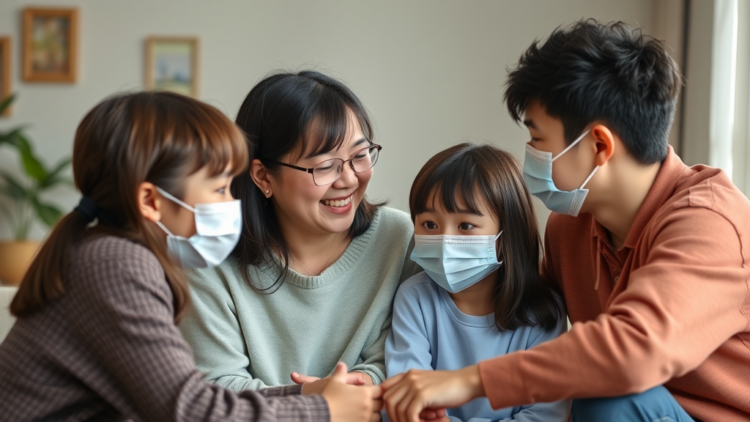
When the COVID-19 pandemic closed schools, canceled club activities, and confined adolescents to their homes, researchers around the world worried about what prolonged isolation and uncertainty would do to young minds. A new nationwide study from Japan now offers one of the clearest answers yet about what families could actually do to buffer that stress: talk. The study, conducted by a team of Japanese child development and public health researchers and published in BMC Public Health, examined whether specific, everyday parental communication practices were associated with fewer behavioral difficulties and more prosocial behavior among adolescents living through the pandemic. The findings suggest that the simplest habits — explaining things clearly, empathizing with a child’s feelings, and holding family discussions — measurably tracked with healthier adolescent adjustment during one of the most disruptive periods in modern memory.
The research team, led by Abir Nagata of Hamamatsu University School of Medicine together with Rina Yamauchi of the National Center for Child Health and Development and colleagues at several other Japanese institutions, designed the study to move beyond broad statements about ‘good parenting’ and focus instead on concrete communication behaviors that parents report engaging in. Previous work had linked supportive parent–adolescent communication to better psychosocial outcomes, but the authors noted that evidence on specific practices during the COVID-19 pandemic was sparse. Their goal was to identify which, if any, of three commonly recommended practices — explaining matters in easy-to-understand words, empathizing with adolescents’ feelings, and holding family discussions — were associated with adolescents’ behavioral profiles during the pandemic’s first year.
To do this, the researchers conducted a nationwide, population-based cross-sectional survey in December 2020, using a stratified two-stage cluster sampling method designed to produce a sample representative of Japanese households. The analysis included 641 parent–adolescent pairs, with adolescents drawn from two school grades — fifth grade and eighth grade — capturing both late childhood and mid-adolescence. Each parent reported on how frequently they engaged in the three positive communication practices, while the adolescent in each pair completed the Strengths and Difficulties Questionnaire, a widely used and well-validated screening instrument that measures emotional symptoms, conduct problems, hyperactivity, peer problems, and prosocial behavior. From these responses, the team derived scores for total difficulties as well as separate internalizing difficulties, which reflect emotional distress turned inward, and externalizing difficulties, which manifest as outward behavioral problems such as acting out.
The survey revealed substantial variation in how often parents engaged in each practice. Just over 80 percent of parents — 80.3 percent — reported explaining things to their adolescent in easy-to-understand words, making this by far the most common practice. Empathizing with adolescents’ feelings was reported by 57.9 percent of parents, and 59.4 percent said they held family discussions. This variation mattered, because when the researchers ran weighted multivariable linear regression models — adjusting for demographic, household, and parental factors such as family structure and parental characteristics — the three practices showed distinct and statistically robust associations with adolescent behavioral outcomes. The use of weighted models and the population-based sampling framework strengthen the argument that these patterns reflect the broader Japanese population of families with adolescents rather than an unrepresentative convenience sample.
Explaining in easy-to-understand words was associated with lower total difficulties on the SDQ, with a regression coefficient of −1.79 and a 95 percent confidence interval spanning −3.56 to −0.03, a range that narrowly excludes zero. The same practice was also associated with lower internalizing difficulties, with a coefficient of −0.87 and a confidence interval of −1.73 to −0.01. In practical terms, adolescents whose parents took the trouble to translate complex information — pandemic rules, health risks, changes to daily routines — into language a young person could genuinely grasp tended to show fewer emotional and behavioral problems, particularly the anxiety- and mood-related difficulties that internalizing captures. During a period when adults themselves struggled to make sense of rapidly changing guidance, this capacity to communicate clearly appears to have given adolescents a firmer footing.
Empathizing with adolescents’ feelings told a somewhat different story. This practice was associated with lower total difficulties, with a coefficient of −1.69 and a confidence interval of −3.13 to −0.25, and notably with lower externalizing difficulties, with a coefficient of −1.02 and a confidence interval of −1.65 to −0.38. Externalizing problems — anger, defiance, acting out — are among the behaviors most commonly reported to spike during periods of household stress, and they often strain parent–child relationships further. The pattern observed here fits a familiar psychological account: when parents acknowledge and validate what an adolescent is feeling rather than dismissing or punishing emotional expression, the adolescent has less need to express distress through disruptive behavior. Empathy, in this framing, functions as an emotional regulator for the household as a whole.
But it was the third practice — family discussions — that produced the strongest and most consistent associations across every outcome the researchers measured. Adolescents whose parents engaged in family discussions showed lower total difficulties, with a coefficient of −2.40 and a 95 percent confidence interval of −3.62 to −1.18; lower internalizing difficulties, with a coefficient of −1.09 and a confidence interval of −1.79 to −0.39; lower externalizing difficulties, with a coefficient of −1.31 and a confidence interval of −1.98 to −0.63; and, uniquely among the three practices, higher prosocial behavior, with a coefficient of 1.08 and a confidence interval of 0.71 to 1.46. The prosocial finding is particularly striking. Prosocial behavior — the tendency to help, share, and cooperate with others — is not simply the absence of problems but a positive dimension of development that predicts later social competence and mental health. That family discussions were the only practice associated with boosting this positive trait suggests that structured opportunities for children to speak and be heard within the family may cultivate social skills that extend beyond the home.
The authors emphasize that their findings support promoting supportive parent–adolescent communication as a practical, low-cost approach to fostering adolescent well-being — both during periods of widespread disruption such as the pandemic and in ordinary family life. Unlike clinical interventions that require specialists, training, or significant expense, the three practices studied here are behaviors that most families can adopt with modest effort and no formal resources. Public health messaging during future crises, the study implies, might do well to include not just epidemiological guidance but concrete communication guidance for parents: explain what is happening in words your child can understand, acknowledge their feelings, and make space for the family to talk together regularly. The fact that these associations held even after adjusting for demographic and household factors suggests the practices carry independent weight rather than simply serving as proxies for affluent or otherwise advantaged homes.
As with all cross-sectional research, the study has limitations worth keeping in view. Because exposure and outcome were measured at the same point in time, the design cannot establish causality: it is possible that adolescents with fewer behavioral difficulties are simply easier to talk with, inviting more family discussion rather than benefiting from it. The data rely on parent-reported communication practices and adolescent-completed questionnaires, which introduces the possibility of reporting bias, and the survey captured a single moment — December 2020 — during a pandemic whose pressures evolved over time. The authors report no competing interests, and the study was conducted in accordance with the Declaration of Helsinki with written informed consent from parents and assent from adolescents, supported by grants from Japan’s Ministry of Health, Labour, and Welfare, the Japan Science and Technology Agency, and the Japan Society for the Promotion of Science, none of which influenced the design or interpretation. Even with these caveats, the consistency of the pattern — three distinct communication practices, each linked to better outcomes, with family discussions emerging as the most powerful of all — offers families and policymakers a rare commodity in adolescent mental health research: a simple, actionable finding grounded in a large, nationally representative sample. In a crisis that took so much ordinary life away from young people, the ordinary act of talking together at home appears to have given some of it back.
Subject of Research: Parental communication practices and adolescent behavioral health during the COVID-19 pandemic in Japan
Article Title: Association of parental communication practices with adolescent behavioral difficulties and prosocial behavior during the COVID-19 pandemic: a nationwide cross-sectional study in Japan
Article References: Nagata, A., Yamauchi, R., Ishitsuka, K., Morisaki, N., & Yamaoka, Y. (2026). Association of parental communication practices with adolescent behavioral difficulties and prosocial behavior during the COVID-19 pandemic: a nationwide cross-sectional study in Japan. BMC Public Health. https://doi.org/10.1186/s12889-026-29607-z
Image Credits: AI Generated
DOI: 10.1186/s12889-026-29607-z
Keywords: parent–adolescent communication, COVID-19 pandemic, adolescent mental health, prosocial behavior, family discussions, Strengths and Difficulties Questionnaire, Japan, cross-sectional study, internalizing difficulties, externalizing difficulties, behavioral difficulties, health communication
Cite Scienmag News
APA
MLA
Chicago
Glenn Wilkins. (September 22, 2026). Family Talks During COVID-19 Protected Teens’ Mental Health, Japanese Study Finds. Scienmag. https://scienmag.com/family-talks-during-covid-19-protected-teens-mental-health-japanese-study-finds/
Glenn Wilkins. “Family Talks During COVID-19 Protected Teens’ Mental Health, Japanese Study Finds.” Scienmag, 22 September 2026, https://scienmag.com/family-talks-during-covid-19-protected-teens-mental-health-japanese-study-finds/. Accessed 22 September 2026.
Glenn Wilkins. “Family Talks During COVID-19 Protected Teens’ Mental Health, Japanese Study Finds.” Scienmag. September 22, 2026. https://scienmag.com/family-talks-during-covid-19-protected-teens-mental-health-japanese-study-finds/
Copy citation
Download RIS
Tags: adolescent emotional well-being during COVID-19Adolescent Mental Healthadolescent prosocial behavior promotionbehavioral difficultiesCOVID-19 pandemiccross-sectional studyeffects of COVID-19 school closuresexternalizing difficultiesfamily communication during COVID-19family discussionsfamily discussions and adolescent behavioral adjustmenthealth communicationimpact of social isolation on teensinternalizing difficultiesJapanJapanese youth mental health studyparent-adolescent communicationparental empathy and explanation skillsparenting practices for stress mitigationprosocial behaviorrole of family communication in mental health resilienceStrengths and Difficulties Questionnairesupportive parent–child relationships during pandemic