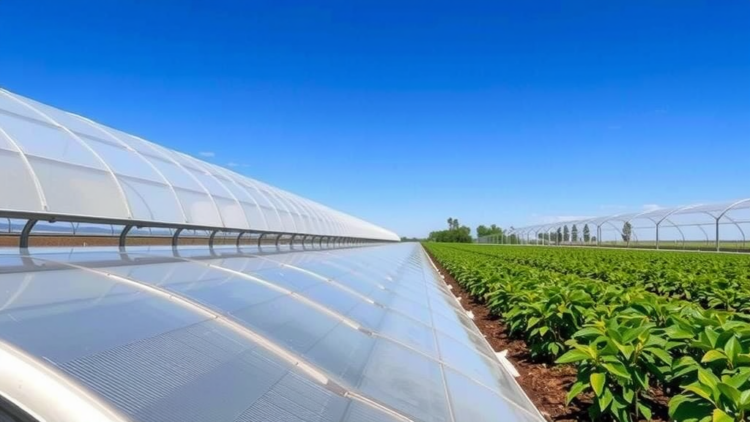
Freshwater is the most extracted natural resource on the planet, and agriculture consumes the lion’s share of it, accounting for nearly 70 percent of global freshwater withdrawals. As climate change, population growth and shifting diets intensify competition for water, two-thirds of the world’s population already endures severe scarcity for at least one month every year. Against this backdrop, a team of Italian researchers has unveiled an artificial intelligence framework that could transform how greenhouse farms ration their most precious input, cutting water consumption by nearly 80 percent in real-world trials while keeping crops healthier than ever.
The study, published in the journal Smart Agricultural Technology, tackles a problem that has long been overlooked in precision agriculture: what happens when a farm cannot simply turn on the tap whenever it wants. In many European collective irrigation systems, water is distributed through rotational schedules, with each user granted a fixed volume over a predefined time window. For an individual grower, this translates into a hard operational constraint. When the irrigation system spans multiple sectors growing different crops in different substrates, deciding how to split a limited water budget among competing demands becomes a genuinely difficult combinatorial puzzle.
Lead author Tommaso Adamo and colleagues, including Lucio Colizzi, Giovanni Dimauro, Emanuela Guerriero and Nunzia Lomonte, formalized this challenge as the Water Volume Allocation problem. At the start of each irrigation period, a supply window opens and the farm’s main pump draws water from the external infrastructure, filling an on-farm reservoir. The manager must then commit to a specific volume for every sector before the next decision window arrives. Crucially, the consequences of that commitment cannot be observed at decision time, which makes purely reactive strategies, such as the widely used hysteresis control that triggers irrigation when soil moisture drops below a threshold, structurally inadequate.
To solve the problem, the researchers turned to a paradigm known as Empirical Decision Model Learning, or EDML, which bridges machine learning and mathematical optimization. The idea is elegant in its simplicity. A machine learning model is trained offline on historical sensor data to predict how soil moisture in each sector will respond to any candidate water volume, given the current observable state of the system. This trained model, called the empirical component, is then embedded directly as a set of mathematical constraints inside a Mixed-Integer Linear Programming model, the prescriptive component, allowing an optimization solver to jointly compute the best allocation across all sectors simultaneously.
The machine learning component was built from data collected over roughly 200 days in a real multi-sector greenhouse in the province of Lecce, in southern Italy, under a Mediterranean climate. The facility hosts five heterogeneous sectors: two growing tomatoes in sandy clay loam soil, one growing tomatoes in a soilless substrate of agriperlite and coconut fiber, one growing zucchini, and one growing blueberry. Ground sensors monitored volumetric water content, electrical conductivity and pH, while actuators logged every irrigation event. The researchers enriched this stream with meteorological variables from the ERA5 reanalysis archive, including temperature, humidity, solar radiation and wind speed, creating a rich dataset spanning the full spectrum of agronomic states from water stress to saturation.
After careful preprocessing, which included spike removal, boundary clipping and linear interpolation of gaps caused by the sensors’ energy-saving transmission policy, the team engineered a key feature representing the total water volume delivered over each irrigation period. Cross-validated model selection identified XGBoost gradient boosting regressors as the best predictors for every sector, achieving coefficients of determination between 0.89 and 0.99 in the mineral soil sectors. A multivariate sensitivity analysis confirmed that the models had internalized genuine physical causality: increasing the planned water volume monotonically increased the predicted moisture gain, a property the researchers enforced through monotonic constraints to guarantee the optimizer would receive physically consistent guidance.
The optimization layer then embeds each trained regressor as explicit linear constraints, translating the decision trees of the gradient boosting ensemble into indicator constraints that a solver such as Gurobi can process. The objective is lexicographic: first, the model maximizes agronomic adequacy by steering each sector’s predicted soil moisture toward a target point within the optimal range, defined by thresholds such as the Permanent Wilting Point, Maximum Allowable Depletion and Field Capacity; second, among all solutions achieving that goal, it minimizes total water use, reflecting both the economic incentive of volumetric water pricing and the regulatory imperative of efficient water management under the European Water Framework Directive.
The results were striking. Tested across 50 heterogeneous scenarios, the EDML framework drove crops into the optimal moisture range in 74.4 percent of evaluated instances, the highest success rate among all strategies tested, outperforming fixed-interval irrigation, hysteresis threshold control and a more sophisticated predictive threshold approach. It reduced dangerous saturation events to just 5 instances and kept crops out of the irreversible Danger state in all but 6 cases. Even more remarkable was the water savings: total consumption fell to 4,514 liters, a 79.1 percent reduction compared with fixed-interval irrigation, 50.2 percent compared with predictive threshold control and 38.9 percent compared with hysteresis control, breaking the traditional trade-off in which water-saving reactive strategies compromised crop health.
The framework also proved computationally formidable. In scalability tests scaling the system from 5 to 50 sectors, resolution times remained below 0.3 seconds even for the largest instances, with the solver reaching a certified optimal solution in 100 percent of runs across every tested hardware configuration from one to eight CPU cores. This means the approach is not a laboratory curiosity but a practical tool that can deliver real-time allocation decisions within the operational windows of commercial greenhouses, and potentially scale far beyond the five-sector facility where it was validated.
The researchers emphasize that the empirical qualifier is central to the paradigm: the relationship between water decisions and soil moisture response depends on soil type, substrate and crop physiology, so the model must be learned afresh in each new farming context using locally collected data. Because the training phase is entirely decoupled from the optimization layer, growers can retrain their models with standard machine learning tools as new field data accumulates, without touching the optimization machinery. Future work will extend the framework to open-field deployment, incorporating short-term weather forecasts through stochastic programming to build a genuinely anticipatory, risk-aware allocation policy. For now, the study offers a compelling glimpse of agriculture’s data-driven future, one in which every liter of water is placed exactly where the mathematics of crop physiology says it matters most.
Subject of Research: Empirical decision model learning for multi-sector greenhouse irrigation under water supply restrictions
Article Title: Empirical decision model learning for multi-sector greenhouse irrigation under water supply restrictions
Article References: Adamo, T., Colizzi, L., Dimauro, G., Guerriero, E., & Lomonte, N. (2026). Empirical decision model learning for multi-sector greenhouse irrigation under water supply restrictions. Smart Agricultural Technology, 15, Article 102558. https://doi.org/10.1016/j.atech.2026.102558
Image Credits: AI Generated
DOI: 10.1016/j.atech.2026.102558
Keywords: greenhouse irrigation, water scarcity, machine learning, mixed-integer linear programming, soil moisture sensors, XGBoost, precision agriculture, EDML, water volume allocation, IoT sensors, smart farming, water footprint
Cite Scienmag News
APA MLA Chicago
Alan Morgan. (September 22, 2026). AI Model Cuts Greenhouse Water Use by 79 Percent Under Supply Restrictions. Scienmag. https://scienmag.com/ai-model-cuts-greenhouse-water-use-by-79-percent-under-supply-restrictions/
Alan Morgan. “AI Model Cuts Greenhouse Water Use by 79 Percent Under Supply Restrictions.” Scienmag, 22 September 2026, https://scienmag.com/ai-model-cuts-greenhouse-water-use-by-79-percent-under-supply-restrictions/. Accessed 22 September 2026.
Alan Morgan. “AI Model Cuts Greenhouse Water Use by 79 Percent Under Supply Restrictions.” Scienmag. September 22, 2026. https://scienmag.com/ai-model-cuts-greenhouse-water-use-by-79-percent-under-supply-restrictions/
Copy citation Download RIS
Tags: AI-driven water managementclimate change impact on water resourcesEDMLEuropean irrigation systemsgreenhouse crop water efficiencygreenhouse irrigationIoT sensorsMachine learningmixed-integer linear programmingprecision agricultureprecision irrigation technologyreal-world AI trials in farmingreducing water usage in farmingresource optimization in agriculturesmart agricultural systemsSmart farmingsoil moisture sensorssustainable farming practiceswater conservation in agriculturewater footprintwater rationing algorithmswater scarcitywater volume allocationXGBoost