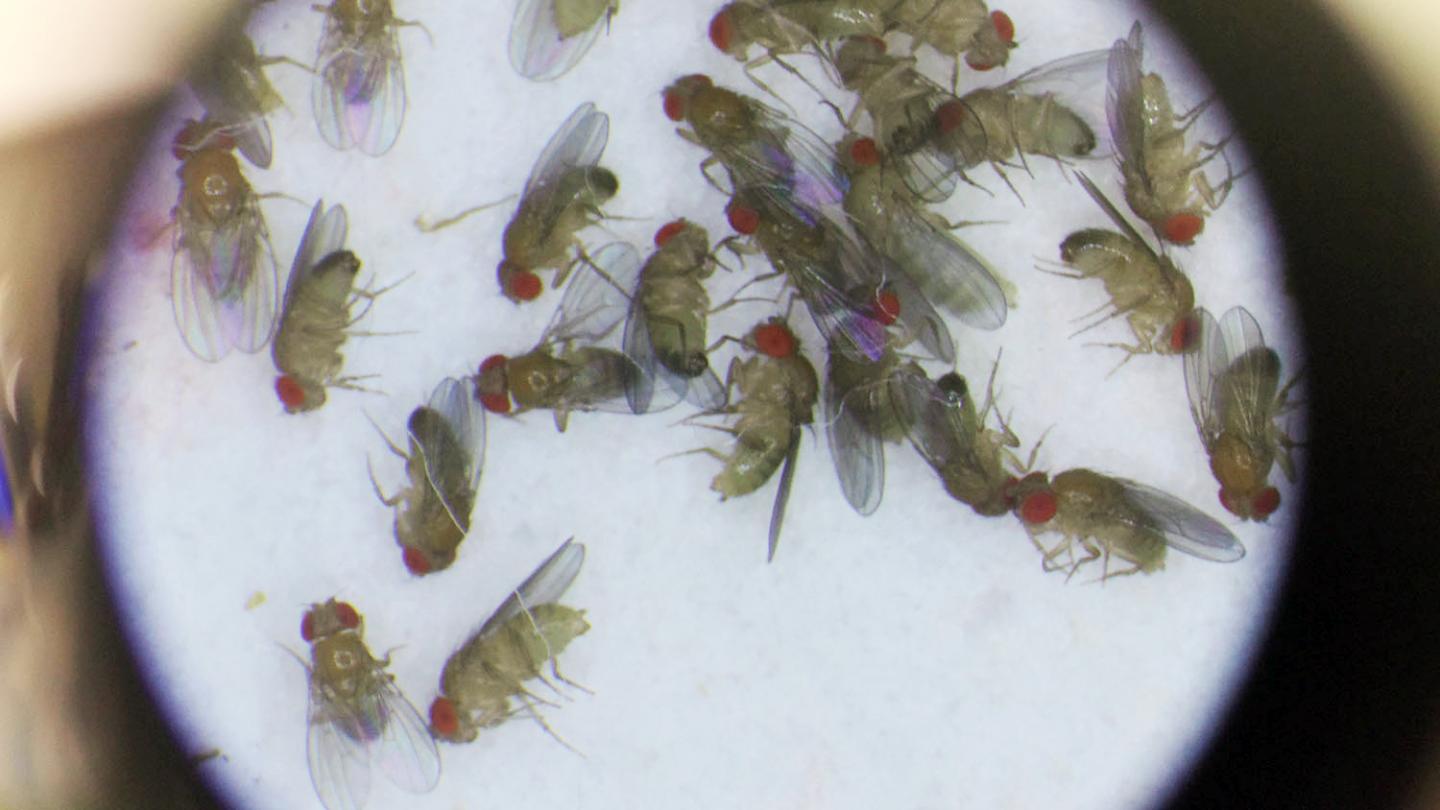
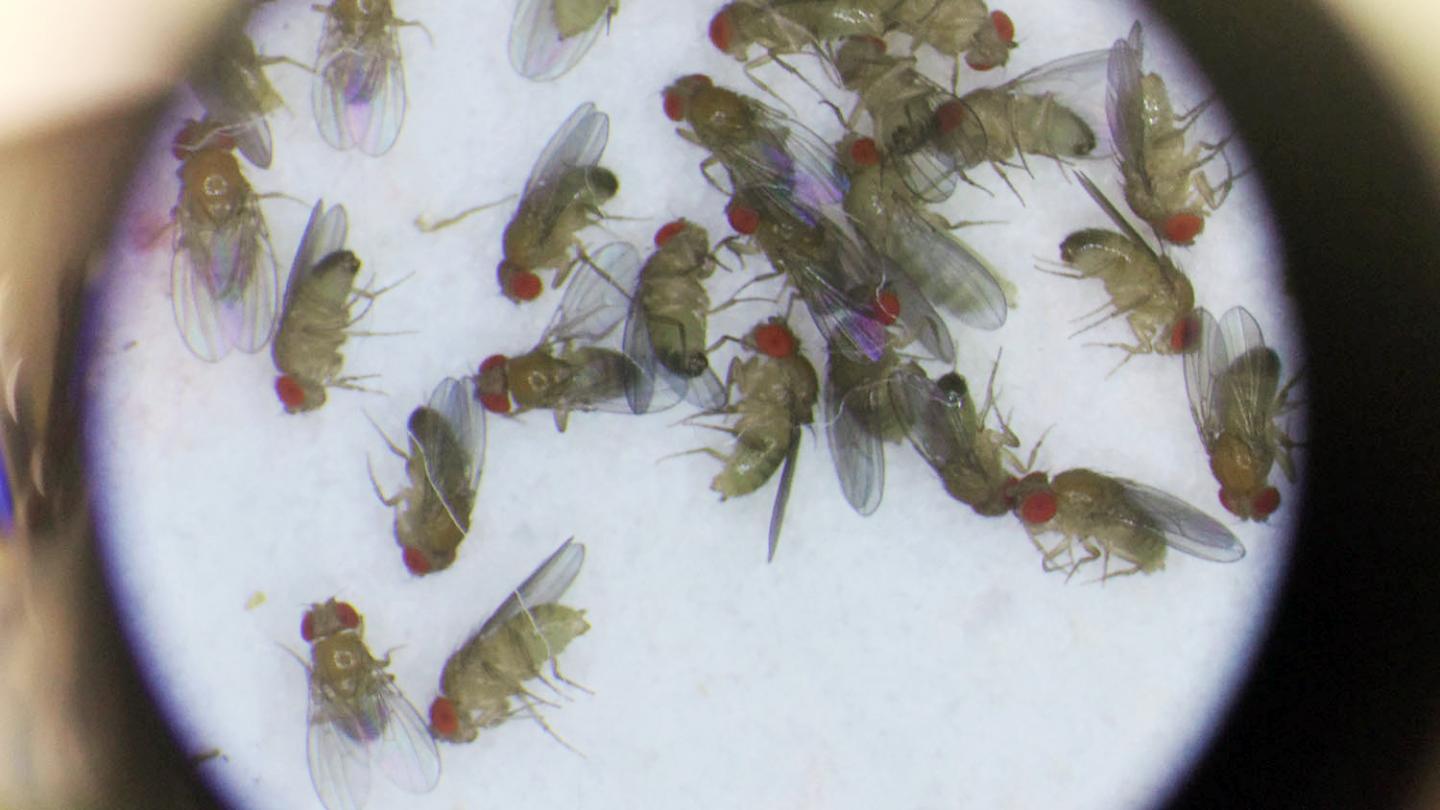
Credit: NC State University
The overexpression of an important gene that regulates energy metabolism can cause a severe shortening of lifespan in male fruit flies but has only a small negative effect on lifespans of female fruit flies, according to new research from North Carolina State University. The findings, which involve metabolic genes and pathways that are important in humans and other animals, shed more light on sex-specific differences between male and female lifespans.
NC State biologists experimented with either inhibiting or overexpressing the bellwether gene, which gives rise to a protein that helps convert nutrients into metabolic energy. Small variations in regions of that gene that regulate its expression were suspected to be correlated with differences in lifespan based on a previous study, said Robert Anholt, William Neal Reynolds Distinguished Professor of Biological Sciences at NC State and the corresponding author on a paper describing the research, published in Scientific Reports.
In the study, Julia Frankenberg Garcia, a visiting student from the University of Surrey in the UK, and Mary Anna Carbone, a research assistant professor of biological sciences at NC State, suppressed expression of the bellwether gene and found that the gene is required for fruit fly development and viability.
"Knocking down the expression of this gene is lethal for fruit flies – male and female," said Anholt, who also directs NC State's W.M. Keck Center for Behavioral Biology.
The researchers then examined a number of DNA variants in the protein production-control region of the bellwether gene in cell cultures. Some DNA variants worked better than others and some of those differences were also replicated in vivo – in living fruit flies.
Finally, the researchers overexpressed DNA variants in fruit flies that were genetically identical except for these different DNA variants. They found that one particular DNA variant shortened male fruit fly lifespan by nearly two-thirds. Females with that DNA variant had shorter lifespans, but this effect was much smaller than in males.
"This is a powerful demonstration of how we can link variation in the genome that controls expression of a central metabolic enzyme to variation in individual lifespan," Anholt said. "There are different gene-gene interactions even though the flies are genetically the same, so that the female genetic background seems to become more protective."
Anholt said that the dramatic effect on male lifespan was unexpected.
"It speaks to the importance of the gene, which is required for development but when overexpressed becomes more lethal for males," Anholt said, "Moreover, the same gene has conserved counterparts in all animals, including people."
###
Carbone, Garcia and Trudy F.C. Mackay, William Neal Reynolds and Distinguished University Professor of Biological Sciences, co-authored the paper. The work was supported by National Institutes of Health grants AG043490, AA016560 and GM059469.
Note to editors: The paper abstract follows.
"Regulation of Drosophila Lifespan by Bellwether Promoter Alleles"
Authors: Mary Anna Carbone, Trudy F.C. Mackay, Robert R.H. Anholt, North Carolina State University; Julia Frankenberg Garcia, University of Surrey
Published: June 23, 2017, online in Scientific Reports
DOI: 10.1038/s41598-017-04530-x
Abstract: Longevity varies among individuals, but how natural genetic variation contributes to variation in lifespan is poorly understood. Drosophila melanogaster presents an advantageous model system to explore the genetic underpinnings of longevity, since its generation time is brief and both the genetic background and rearing environment can be precisely controlled. The bellwether (blw) gene encodes the ? subunit of mitochondrial ATP synthase. Since metabolic rate may influence lifespan, we investigated whether alternative haplotypes in the blw promoter affect lifespan when expressed in a co-isogenic background. We amplified 521 bp upstream promoter sequences containing alternative haplotypes and assessed promoter activity both in vitro and in vivo using a luciferase reporter system. The AG haplotype showed significantly greater expression of luciferase than the GT haplotype. We then overexpressed a blw cDNA construct driven by either the AG or GT haplotype promoter in transgenic flies and showed that the AG haplotype also results in greater blw cDNA expression and a significant decrease in lifespan relative to the GT promoter haplotype, in male flies only. Thus, our results show that naturally occurring regulatory variants of blw affect lifespan in a sex-specific manner.
Media Contact
Robert Anholt
[email protected]
919-515-1173
@NCStateNews
Original Source
https://news.ncsu.edu/2017/06/variation-at-a-central-metabolic-gene-influences-male-fruit-fly-lifespan/ http://dx.doi.org/10.1038/s41598-017-04530-x
############
Story Source: Materials provided by Scienmag