
Credit: Artwork: Christian D. Peikert
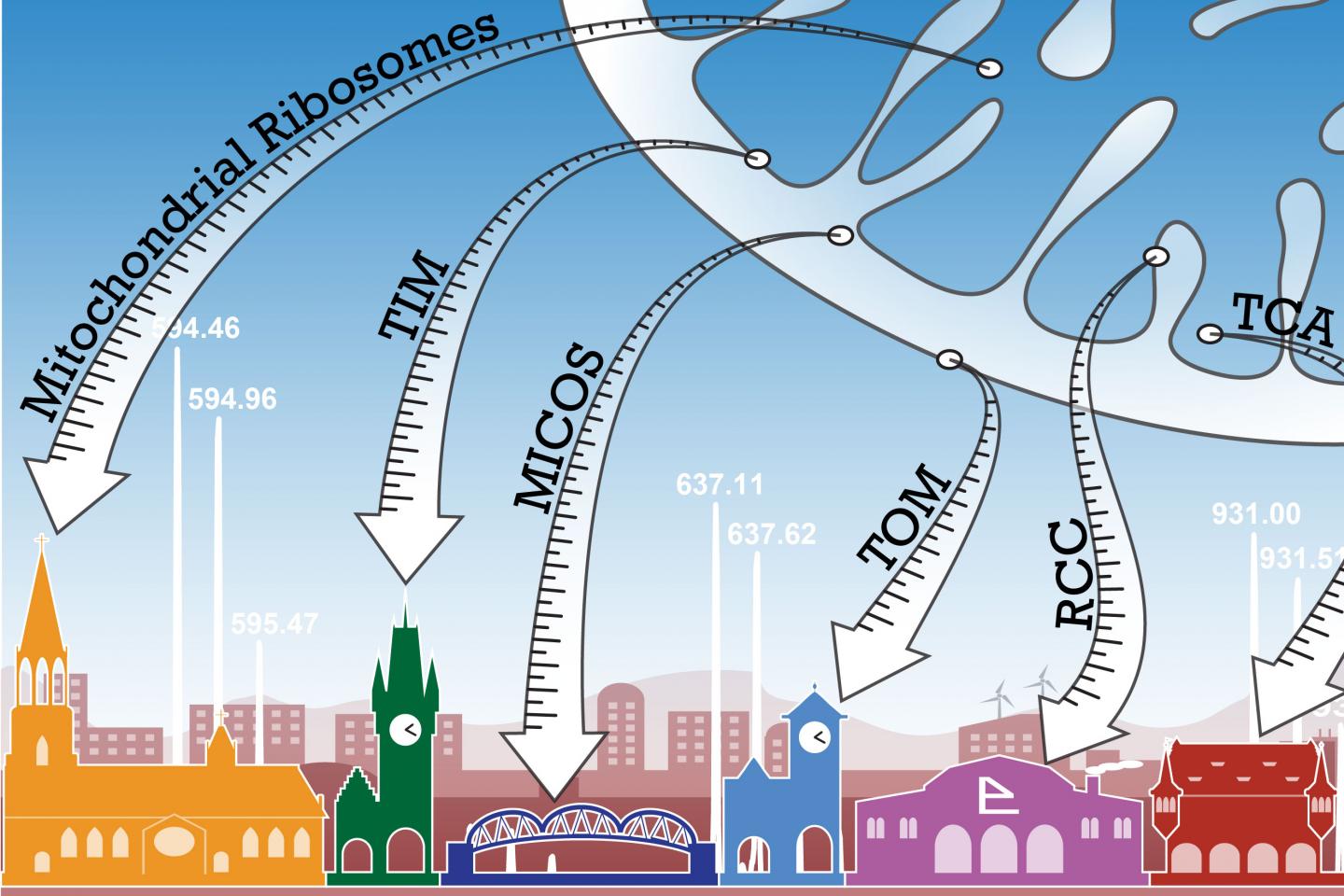
Mitochondria, best known for their role as powerhouses of eukaryotic cells, fulfill numerous vital functions. Knowledge about the precise protein composition as well as the functions of individual proteins is essential to understand fundamental processes of cell biology and diseases that are caused by cellular defects. A team of scientists from the universities of Freiburg, Homburg, and Rehovot (Israel) led by Prof. Dr. Bettina Warscheid, Prof. Dr. Nikolaus Pfanner, and Prof. Dr. Nils Wiedemann discovered, counted and determined new mitochondrial proteins with unknown function in the model organism baker's yeast. The study will serve as a source of information for researchers interested in the biology of mitochondria – from yeast to human subjects. This research was funded through European Research Council (ERC) Consolidator Grants. The study was recently published in the current issue of the scientific journal Cell Reports.
Using 'quantitative mass spectrometry' and bioinformatics methods, a team from Warscheid's research group first determined the abundance of thousands of proteins in different cellular fractions of baker's yeast. A team from Wiedemann's research group then analyzed mitochondrial proteins using biochemical methods and microscopy. The resulting mitochondrial proteome comprises a total of 901 proteins, including 82 proteins not previously associated with mitochondria. For an additional 119 a mitochondrial localization had been ambiguous.
While humans require oxygen to breathe, yeast cells can either consume oxygen or use a different metabolic pathway called fermentation, a process well known for producing alcoholic beverages. The researchers cultured yeast cells in a fermentative or respiratory medium and determined that the shift from fermentative to respiratory conditions caused dramatic changes in the mitochondria: The amount of mitochondrial proteins in a single cell doubles and the enzymes required for respiration are even four times more abundant when growing in a respiratory medium.
The scientists further studied in which areas of the mitochondrion the various proteins are localized and how newly discovered proteins interact with other proteins in a network. Through this study the researchers have gained extensive data about the newly defined mitochondrial proteome of baker's yeast.
###
Bettina Warscheid is head of the Department of Biochemistry and Functional Proteomics at the Institute of Biology II. Nils Wiedemann and Nikolaus Pfanner are leaders of research groups at the Institute of Biochemistry and Molecular Biology. Pfanner, Warscheid and Wiedemann are principal investigators of the Cluster of Excellence BIOSS Centre for Biological Signalling Studies as well as the Spemann Graduate School of Biology and Medicine of the University of Freiburg.
Original publication:
Marcel Morgenstern, Sebastian B. Stiller, Philipp Lübbert, Christian D. Peikert, Stefan Dannenmaier, Friedel Drepper, Uri Weill, Philipp Höß, Reinhild Feuerstein, Michael Gebert, Maria Bohnert, Martin van der Laan, Maya Schuldiner, Conny Schütze, Silke Oeljeklaus, Nikolaus Pfanner, Nils Wiedemann* and Bettina Warscheid* (2017): Definition of a High Confidence Mitochondrial Proteome at Quantitative Scale. Cell Reports 19. DOI: http://dx.doi.org/10.1016/j.celrep.2017.06.014 (*corresponding author)
Contact:
University of Freiburg
Institute of Biology II
Media Contact
Bettina Warscheid
[email protected]
49-761-203-2690
Original Source
http://www.pr.uni-freiburg.de/pm-en/2017/discovering-counting-cataloguing-proteins?set_language=en
############
Story Source: Materials provided by Scienmag