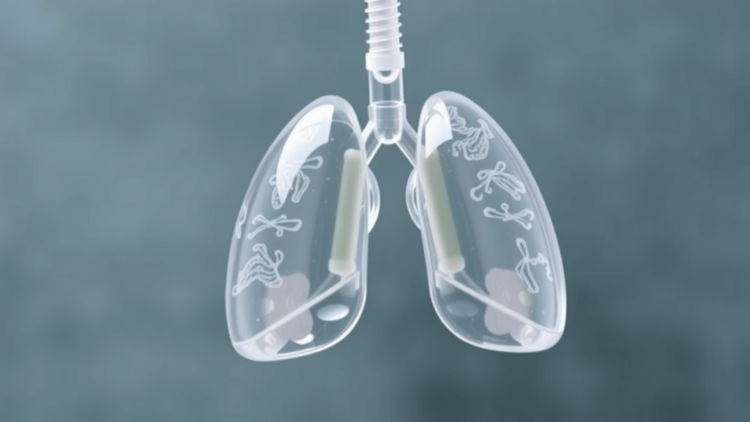
For the smallest and most fragile patients in intensive care, the difference between survival and decline often comes down to a few milliliters of oxygen. Preterm and term newborns who develop respiratory distress syndrome frequently need mechanical ventilation, and in the most severe cases extracorporeal life support, to bridge the gap while their lungs mature. Yet every artificial circuit that touches blood carries a dangerous paradox: the very surfaces designed to save lives can trigger the clotting cascade, forcing clinicians to walk a tightrope between thrombosis and bleeding. A research team at McMaster University now reports a significant step toward resolving that paradox, demonstrating that microfluidic oxygenator units can be coated with a covalent antithrombin-heparin complex that keeps blood flowing freely without sacrificing the device’s ability to deliver oxygen.
The work, published in Biomedical Microdevices, extends a long-running effort to build what the group calls an artificial placenta: a lung assist device assembled from arrays of single oxygenator units, each a microfluidic chip fabricated from polydimethylsiloxane, the transparent silicone elastomer beloved by microfluidics engineers. PDMS is easy to mold, gas-permeable and optically clear, but in contact with blood it is profoundly thrombogenic. When plasma proteins adsorb onto its hydrophobic surface, they undergo conformational changes that activate the coagulation factors, platelets and complement proteins that normally patrol the vasculature. In a device whose channels are measured in tens or hundreds of micrometers, even a small clot can occlude flow, degrade gas exchange and shed emboli into the patient’s circulation.
The McMaster strategy centers on a molecule with an unusual pedigree. Antithrombin is the body’s natural brake on coagulation, a serine protease inhibitor that neutralizes thrombin and factor Xa. Heparin accelerates this inhibition dramatically, but heparin immobilized on biomaterial surfaces has historically underperformed, because the pentasaccharide sequence that activates antithrombin must be presented in a specific orientation and because bound heparin alone cannot catalyze inhibition without recruiting antithrombin from plasma. To sidestep these limitations, Anthony Chan, John Brash and colleagues developed a covalent antithrombin-heparin complex in which the two molecules are permanently linked, preserving the catalytic machinery in a single, surface-tethered unit. Earlier studies showed that such complexes, when coated onto flat PDMS using polydopamine as an adhesive layer, could render the material blood-compatible.
Polydopamine itself is a piece of bioinspired chemistry borrowed from marine mussels, which anchor themselves to rocks in churning surf using adhesive proteins rich in the amino acid DOPA. When dopamine is oxidized under mildly alkaline conditions, it polymerizes into a thin, conformal film that adheres tenaciously to virtually any surface, from metals to polymers, through a combination of covalent and noncovalent interactions. In the new study, the team flowed a polydopamine solution through the microchannels of the oxygenator units, then introduced the antithrombin-heparin complex under flow as well, allowing the coating to build up uniformly inside the tortuous three-dimensional geometry that flat-surface experiments cannot fully replicate.
Quantifying what sticks to the inside of a sealed microfluidic device is a technical challenge in its own right. The researchers solved it by radiolabelling the antithrombin-heparin complex, which allowed them to measure surface density directly: the coated units carried 0.21 plus or minus 0.05 micrograms of the complex per square centimeter. More importantly, the coating proved durable. When the modified devices were perfused with flowing blood for two days, 76 percent of the bound complex remained on the surface, a stability figure that matters enormously for any device intended to support a neonate for days or weeks. A coating that leaches away within hours would offer only fleeting protection and might itself become a source of embolic debris.
Surface density alone does not guarantee function, so the team also measured whether the immobilized heparin retained its biological activity. Their assay exploited the fact that active heparin binds antithrombin from plasma with high affinity. Devices coated with the antithrombin-heparin complex captured 47.78 plus or minus 10.63 nanograms of antithrombin per square centimeter from plasma, roughly four times the 11.56 plus or minus 4.58 nanograms per square centimeter measured on devices coated with polydopamine alone. That fourfold difference demonstrates that the covalent complex presents heparin in a catalytically competent configuration, effectively turning the entire blood-contacting surface of the device into an anticoagulant reactor that continuously neutralizes thrombin as blood passes through.
The functional consequences were visible at the macroscopic scale. When plasma was perfused through the modified units for one hour, the devices resisted clotting, whereas unmodified or polydopamine-only controls showed the fibrin deposition and flow obstruction characteristic of biomaterial-triggered coagulation. Just as critically, the researchers verified that the coating did not compromise the device’s primary job. Oxygen permeability, the property that allows the thin PDMS membranes to transfer gas between an oxygen supply and the blood, was unchanged by the surface treatment. That dual requirement, anticoagulant function without degraded gas exchange, has been the stumbling block for many previous hemocompatibility strategies, including polyethylene glycol layers and zwitterionic coatings, which can delaminate or alter transport properties over time.
The clinical context gives the work its urgency. Neonatal extracorporeal membrane oxygenation, or ECMO, remains an anticoagulation enigma, as pediatric intensivists have described it, because the systemic heparin required to keep circuits patent exposes infants, whose hemostatic systems are immature, to serious bleeding risks including intracranial hemorrhage. Ventilator-induced lung injury adds another layer of harm for preterm babies, whose alveoli can be damaged by the very pressures meant to keep them alive. A lung assist device whose internal surfaces actively inhibit clot formation could reduce the systemic anticoagulation burden, and the artificial placenta concept envisions pumpless microfluidic oxygenator arrays that could support preterm neonates with far less trauma than conventional extracorporeal circuits.
What distinguishes the new study is the translation from flat substrates to functional devices under realistic flow conditions. Coating chemistry that works on a flat coupon frequently fails inside a microchannel, where flow profiles, channel aspect ratios and surface-to-volume ratios conspire to produce uneven films. By performing both the polydopamine deposition and the complex immobilization under flow, the team showed that the strategy scales to the device level, a prerequisite for assembling the single oxygenator units into the integrated arrays that would constitute a clinical lung assist device. The authors note that the results demonstrate a previously developed modification strategy can be translated from flat PDMS substrates to microfluidic units, providing device-level anticoagulant function without measurably compromising membrane oxygen permeability under the conditions tested.
Challenges remain before the technology reaches the neonatal intensive care unit. The one-hour plasma clotting resistance and two-day stability experiments, while encouraging, must be extended to longer durations, whole blood and ultimately animal models, and the group has already explored pairing the antithrombin-heparin coating with immobilized tissue plasminogen activator to add fibrinolytic activity to the anticoagulant function. Regulatory pathways for combination products that blend a device with a pharmacologically active surface will also demand careful scrutiny. Still, the study offers a compelling proof of concept: by borrowing the adhesive tenacity of a mussel and the catalytic elegance of a natural anticoagulant complex, the researchers have shown that the surfaces of life-supporting microdevices can be engineered to fight the clotting response they provoke, bringing the artificial placenta one step closer to the bedside of the tiniest patients.
Subject of Research: Covalent antithrombin-heparin surface modification of PDMS microfluidic oxygenator units for anticoagulant function in neonatal lung assist devices
Article Title: Surface modification of microfluidic oxygenator units with an antithrombin-heparin (ATH) covalent complex for enhanced anticoagulant function
Article References: Li, S., Sandejas, D., Saraei, N., Dabaghi, M., Atkinson, H. M., Fusch, G., Rochow, N., Fusch, C., Selvaganapathy, P. R., Chan, A. K. C., Brash, J. L., & Sask, K. N. (2026). Surface modification of microfluidic oxygenator units with an antithrombin-heparin (ATH) covalent complex for enhanced anticoagulant function. Biomedical Microdevices, 28(3), Article 60. https://doi.org/10.1007/s10544-026-00842-w
Image Credits: AI Generated
DOI: 10.1007/s10544-026-00842-w
Keywords: antithrombin-heparin complex, microfluidic oxygenator, polydopamine, PDMS surface modification, blood compatibility, neonatal respiratory distress, artificial placenta, lung assist device, anticoagulant coating, hemocompatibility, Biomedical Microdevices, ECMO
Cite Scienmag News
APA MLA Chicago
Neil Sanderson. (September 12, 2026). Mussel-Inspired Coating Keeps Tiny Artificial Lungs Clot-Free. Scienmag. https://scienmag.com/mussel-inspired-coating-keeps-tiny-artificial-lungs-clot-free/
Neil Sanderson. “Mussel-Inspired Coating Keeps Tiny Artificial Lungs Clot-Free.” Scienmag, 12 September 2026, https://scienmag.com/mussel-inspired-coating-keeps-tiny-artificial-lungs-clot-free/. Accessed 12 September 2026.
Neil Sanderson. “Mussel-Inspired Coating Keeps Tiny Artificial Lungs Clot-Free.” Scienmag. September 12, 2026. https://scienmag.com/mussel-inspired-coating-keeps-tiny-artificial-lungs-clot-free/
Copy citation Download RIS
Tags: anti-clotting surface modification techniquesanticoagulant coatingantithrombin-heparin complexartificial lung devicesartificial placentabioinspired blood compatibilitybiomedical microdevicesblood compatibilityblood-contacting device thrombosis preventioncovalent antithrombin-heparin complexdevelopment of artificialECMOhemocompatibilitylung assist devicemicrofluidic chip fabrication for medical devicesmicrofluidic oxygenatormicrofluidic oxygenator surface coatingsmicrofluidic oxygenators for neonatal respiratory supportmussel-inspired antifouling coatingsneonatal respiratory distressPDMS surface modificationpolydimethylsiloxane in biomedical engineeringpolydopaminethrombosis and bleeding risk in extracorporeal life support