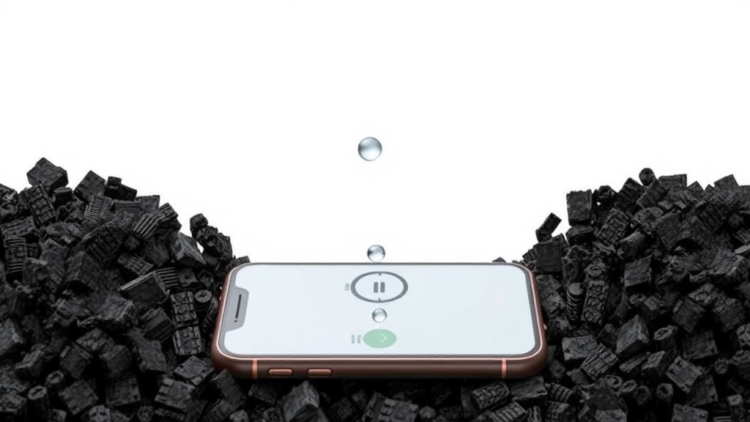
Every year, millions of lithium-ion batteries reach the end of their lives, and most of the graphite inside them is quietly thrown away. Researchers in Brazil have now shown that this overlooked material, recovered from spent cellphone batteries with nothing more than a simple acid wash, can scrub a notorious textile dye out of contaminated water. The study, published in Discover Industrial Chemistry and Materials, offers a strikingly low-tech answer to two growing environmental problems at once: an avalanche of battery waste and the persistent pollution of rivers by synthetic dyes.
The scale of the dye problem is enormous. More than 100,000 commercial dyes exist worldwide, with annual production exceeding 700,000 tons, and the textile industry alone consumes over 10,000 tons each year. Roughly 100 tons of dye are estimated to enter aquatic environments annually, where they block sunlight, suppress photosynthesis, and poison aquatic organisms. Methylene blue, the cationic dye used as a model contaminant in this work, is toxic, poorly biodegradable, and notoriously difficult to remove with conventional treatment. Adsorption, the process by which dye molecules stick to a solid surface, remains one of the most practical remediation strategies, provided the adsorbent is cheap, effective, and reusable.
That is precisely where dead batteries come in. Led by Eric M. Garcia of the Federal University of São João del-Rei, the team disassembled commercial cellphone batteries and extracted the graphite-rich anode material. Rather than applying the chemical activation or high-temperature treatment that most high-performance adsorbents require, the researchers simply washed the recovered carbon with 1.0 mol per liter hydrochloric acid for two hours to strip away surface metal contaminants. X-ray diffraction confirmed that the characteristic graphitic peak at 2θ ≈ 26.5° remained intact after purification, while peaks belonging to the copper current collector vanished, indicating that the metal had been removed without damaging the crystalline carbon framework.
Atomic absorption spectroscopy quantified how well the washing step decontaminated the material. Cobalt levels in water contacting the graphite plummeted from 14 milligrams per liter to 0.01, and lithium fell from 17 to 0.02 milligrams per liter, while nickel and manganese were present only in trace amounts throughout. The authors caution that residual metal content in the solid phase was not directly measured, but the aqueous leaching data suggest the purified carbon is substantially safer for environmental use. Fourier-transform infrared spectroscopy added a crucial insight: the anode surface is not pristine graphite but carries oxygen-containing functional groups, carboxylates, carbonyls, hydroxyls, and residues from electrolyte decomposition, and these surface chemistry features turn out to be the secret of its adsorption behavior.
Adsorption tests, run with dye concentrations of 10 to 100 milligrams per liter, an adsorbent dose of 1 gram per liter, and a 24-hour equilibration period, revealed a strong dependence on pH. Performance was poor under acidic conditions, where protonation of the surface and competition from hydrogen ions limit available binding sites, and reached a maximum at pH 10. The explanation lies in acid–base equilibria: at alkaline pH, surface carboxylic and hydroxyl groups deprotonate, generating negatively charged sites that electrostatically attract the positively charged methylene blue molecules. A Langmuir maximum capacity of 7.25 milligrams per gram, with a correlation coefficient of 0.998, described the monolayer adsorption, and the Freundlich exponent remained above one at every pH tested, confirming that adsorption stays favorable even as surface heterogeneity increases.
Thermodynamic analysis between 298 and 318 kelvin painted a picture of a gentle, physical process. The enthalpy change of −6.64 ± 0.47 kilojoules per mole sits far below the threshold typically associated with chemisorption, which exceeds 80 kilojoules per mole, while Gibbs free energy values of roughly −13 to −15 kilojoules per mole confirmed that adsorption is spontaneous. Intriguingly, the entropy change was positive, +23.4 ± 1.6 joules per mole per kelvin, suggesting that the process is driven by the release of ordered water molecules from the adsorbent surface and the dye’s hydration shell. In short, methylene blue clings to the recycled graphite through weak, reversible interactions, electrostatic attraction dominating under alkaline conditions, with π–π stacking between the dye’s aromatic rings and the graphitic domains providing a secondary assist across the whole pH range.
Kinetic measurements reinforced the electrostatic story. The pseudo-first-order rate constant climbed from 0.0202 per minute at pH 2 to 0.100 per minute at pH 10, and the pseudo-second-order constant rose fivefold over the same range, meaning adsorption is dramatically faster in alkaline water. The team also applied a generalized near-equilibrium model that unifies pseudo-first-order, pseudo-second-order, and Elovich kinetics through a coverage-dependent rate coefficient. The fitted heterogeneity parameter came out near 10⁻⁶ under all conditions, collapsing the model to a pure monoexponential relaxation identical in form to pseudo-first-order behavior. This gave the authors a physically meaningful criterion, rather than a statistical one, for classifying the kinetic regime, an approach they argue should be adopted more widely in adsorption research.
Perhaps the most commercially persuasive result is durability. After regenerating the material with dilute hydrochloric acid and drying it at 100 degrees Celsius, the researchers ran seven consecutive adsorption–desorption cycles, and the adsorbent retained more than 90 percent of its original efficiency. This resilience is exactly what one expects from physisorption: because the dye is held by weak, reversible forces rather than irreversible chemical bonds, it can be washed off without destroying the surface. The slight decline over successive cycles is attributed to partial blockage of active sites or incomplete desorption of strongly bound molecules, but the graphitic framework itself appears to survive repeated use essentially unchanged.
Comparisons with the wider literature highlight what makes this approach distinctive. Materials such as graphene oxide can achieve far higher capacities, but producing them demands concentrated acids, strong oxidizers, and controlled thermal processing, which inflate both cost and environmental footprint. The recycled anode carbon delivers a moderate capacity through acid washing alone, placing it alongside waste-derived biochars and mineral adsorbents while requiring almost no processing energy. In a circular economy framing, the anode graphite, which makes up a substantial fraction of battery mass and is usually downcycled or burned, becomes a functional water-treatment material instead of a liability.
The timing is significant. With electric vehicle production in China projected to reach roughly 15 million units per year by 2030, global lithium-ion battery waste could hit 11 million tons by 2030 and approach 900 million tons by 2048. Conventional recycling focuses on valuable cathode metals through energy-intensive hydrometallurgical and pyrometallurgical routes, often leaving the carbonaceous fraction behind. The authors acknowledge that questions remain, including tests in real wastewater, full textural characterization, leaching and toxicity studies, and life-cycle assessment, but the core demonstration stands: a material recovered from the trash, treated with nothing more exotic than dilute acid, can repeatedly pull a stubborn industrial pollutant out of water. As battery waste mounts worldwide, turning dead anodes into working adsorbents may prove one of the simplest and most elegant forms of double-duty recycling yet devised.
Subject of Research: Reusing graphitic carbon from spent lithium-ion battery anodes as a low-cost adsorbent for methylene blue dye removal in wastewater treatment
Article Title: Carbon recovered from lithium ion batteries for methylene blue adsorption and environmental remediation
Article References: Garcia, E. M., Taroco, H. A., & Melo, J. O. F. (2026). Carbon recovered from lithium ion batteries for methylene blue adsorption and environmental remediation. Discover Industrial Chemistry and Materials, 1(1), Article 10. https://doi.org/10.1007/s44508-026-00013-y
Image Credits: AI Generated
DOI: 10.1007/s44508-026-00013-y
Keywords: lithium-ion battery recycling, graphitic carbon, methylene blue, adsorption, wastewater treatment, dye removal, water purification, circular economy, physisorption, battery waste, environmental remediation, reusable adsorbent
Cite Scienmag News
APA
MLA
Chicago
Bethany Barker. (September 12, 2026). Discarded Phone Batteries Turned Into Water-Purifying Carbon. Scienmag. https://scienmag.com/discarded-phone-batteries-turned-into-water-purifying-carbon/
Bethany Barker. “Discarded Phone Batteries Turned Into Water-Purifying Carbon.” Scienmag, 12 September 2026, https://scienmag.com/discarded-phone-batteries-turned-into-water-purifying-carbon/. Accessed 12 September 2026.
Bethany Barker. “Discarded Phone Batteries Turned Into Water-Purifying Carbon.” Scienmag. September 12, 2026. https://scienmag.com/discarded-phone-batteries-turned-into-water-purifying-carbon/
Copy citation
Download RIS
Tags: adsorptionadsorption technology for dye removalbattery wasteCircular economycombating aquatic dye pollutiondye removaleco-friendly wastewater treatment strategiesenvironmental remediationgraphite recovery from batteriesgraphitic carboninnovative reuse of electronic wastelithium-ion battery recyclinglithium-ion battery waste recyclinglow-tech water treatment methodsmethylene bluephysisorptionrecycled phone batteriesreusable adsorbentsustainable environmental cleanup solutionstextile dye pollution remediationuse of spent cellphone batteries in environmental cleanupwastewater treatmentwater purificationwater purification using recycled materials