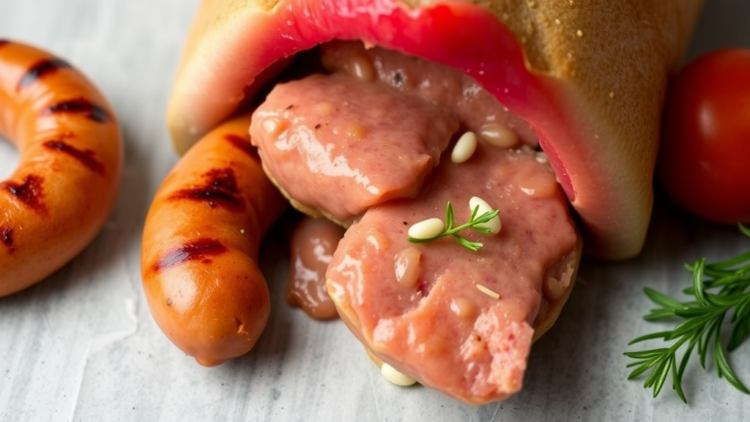
Fat is what makes a sausage taste like a sausage. It carries flavor, delivers juiciness, lubricates every bite, and quietly holds the emulsion together while the product cooks. Strip it away, and the result is usually a dry, rubbery disappointment that consumers reject on the first mouthful. Yet the health argument for cutting saturated fat from processed meat is overwhelming, given the well-documented links between excessive saturated fatty acid intake and obesity, cardiovascular disease, and other chronic metabolic disorders. The central problem for food scientists has always been that fat is not merely an energy source in emulsified meat products; it is a structural material, a lubricant, and a flavor reservoir all at once. Now, a systematic comparison of three plant-derived polysaccharides offers one of the clearest pictures yet of how to rebuild sausage quality without the fat, and the findings point toward a surprisingly simple pantry of hydrocolloid ingredients that could reshape how low-fat meat products are formulated worldwide.
Researchers at Anhui Science and Technology University and collaborating institutions set out to answer a deceptively simple question: when you remove most of the pork fat from an emulsified sausage, which gum does the best job of putting the quality back? Their candidates were three widely available food-grade polysaccharides with distinctly different molecular architectures. Guar gum, extracted from guar beans, carries a highly branched structure that excels at binding and immobilizing water. Tara gum, derived from the seeds of a South American tree, possesses a moderately branched galactomannan framework that offers greater potential for direct interaction with muscle proteins. Linseed gum, an anionic heteropolysaccharide from flaxseed, brings charged groups to the party that can participate in electrostatic interactions and help stabilize emulsion interfaces during protein gelation. Because molecular structure dictates function, the team hypothesized that these three gums would behave very differently in a real meat matrix, and they designed an unusually thorough experiment to find out exactly how.
The experimental design was rigorous and deliberately grounded in industrial practice. Chicken breast and pork back fat were combined at a ratio of 7:3 for a high-fat control and 7:1 for the low-fat formulations, cutting fat content from more than 28 percent to roughly 10 percent of the finished product. The three polysaccharides were then incorporated at five levels ranging from 0.8 to 2.4 percent of total batch mass, yielding seventeen distinct treatment groups. Batters were chopped under strictly temperature-controlled conditions, stuffed into casings, cooked to a core temperature of 72 degrees Celsius, and then subjected to a battery of analyses spanning cooking loss, proximate composition, instrumental color, texture profile analysis, pH, electronic-nose flavor profiling, low-field nuclear magnetic resonance imaging of water mobility, scanning electron microscopy of the gel microstructure, and a trained sensory panel scoring five attributes on nine-point scales. Every measurement was performed in triplicate with statistical rigor, producing a dataset comprehensive enough to disentangle the individual contributions of gum type and dosage.
Cooking loss, the most practical single indicator of emulsion stability, told the first and perhaps most commercially important story. All three polysaccharides significantly reduced the amount of water and fat that escaped during heating compared with the low-fat control. Tara gum emerged as the clear champion: at an addition level of just 1.6 percent, cooking loss dropped to 4.52 percent, approximately 27.7 percent below the untreated low-fat control, and further increases in dosage brought no additional benefit. Guar gum performed comparably at 1.6 percent but lost effectiveness at higher concentrations, while linseed gum achieved its minimum at 2.0 percent and then deteriorated sharply at 2.4 percent, revealing a narrow and unforgiving dosage window. The pattern across all treatments was consistently non-monotonic, rising again after the optimum was passed, which the authors attribute to overly dense network formation and disturbance of the delicate intermolecular balance within the protein matrix.
Compositional analysis confirmed that the gums were doing their work through structure rather than chemistry. Moisture content rose significantly in all treated sausages relative to the 54.31 percent of the high-fat control, with guar gum at 2.0 percent delivering the highest value at 64.66 percent, nearly 19 percent above the control. Fat content in every low-fat formulation settled between 9.83 and 11.93 percent regardless of gum type or level, demonstrating that the polysaccharides exert only marginal direct influence on final fat content, which is governed overwhelmingly by the base formulation. Protein content, likewise, climbed simply because the fat-to-lean ratio had shifted, and the gums played at most a secondary role. This is an important clarification for formulators: hydrocolloids are not magic ingredients that subtract fat from a recipe; they are structural scaffolds that make reduced-fat recipes work.
The texture data revealed the most dramatic and gum-specific effects. All three polysaccharides significantly increased hardness and chewiness compared with the polysaccharide-free low-fat control, but the rankings were unambiguous. Tara gum produced the greatest hardness enhancement, followed by guar gum, with linseed gum trailing yet still clearly above the control. The optimum levels were 2.0 percent for both guar and tara gum and 1.6 percent for linseed gum. Springiness, the capacity of the sausage to recover its shape after compression, was effectively restored to high-fat levels at moderate dosages, with tara gum again the strongest performer at 1.6 percent, before declining when overdosed. Cohesiveness behaved differently: guar gum left it unchanged across the range, linseed gum kept it stable, but tara gum caused a significant decline at 2.4 percent, suggesting that its gel-forming power becomes a liability when the matrix becomes too rigid and internally strained. These texture shifts reflect hydrogen bonding and cooperative interactions between polysaccharide chains and myofibrillar proteins, which together weave a denser three-dimensional gel network capable of supporting the mechanical demands of chewing.
Two imaging and spectroscopic techniques supplied the mechanistic backbone of the study. Low-field nuclear magnetic resonance showed that immobilized water remained the dominant population in all treated samples, but the gums each sculpted the secondary water fractions in characteristic ways. Tara gum significantly increased the bound-water fraction and shifted the overall relaxation distribution toward shorter T2 times, indicating the tightest restriction of molecular water mobility of the three candidates. Linseed gum continuously reduced the free-water fraction as dosage increased, most notably at 1.6 and 2.0 percent, while guar gum exerted a milder but stabilizing influence on the dominant immobilized pool. Scanning electron microscopy then showed why: the low-fat control displayed a loose, heterogeneous gel riddled with enlarged voids, whereas polysaccharide-treated samples, especially at 1.6 percent, developed compact, uniform networks with visibly reduced pore size. The tara gum sample was the most homogeneous, the guar gum sample the smoothest, and the linseed gum sample showed partial lamellar features with improved integrity. A tighter network means stronger capillary confinement of water, which translates directly into the shorter relaxation times and lower cooking losses observed.
Flavor, the make-or-break attribute for any fat-reduced product, was interrogated with an electronic nose and confirmed by trained human panelists. The sensor data showed that the low-fat control exhibited a distorted volatile profile, with elevated signals from alcohols, aldehydes, ketones, and long-chain alkanes, consistent with flavor instability after fat removal. As gum content rose, responses associated with aromatics and short-chain alkanes climbed toward a plateau between 1.6 and 2.0 percent. Principal component analysis, capturing over 91 percent of total variance in its first two dimensions, cleanly separated all treatments from the high-fat control along the first component and showed that samples formulated at 1.6 to 2.0 percent clustered nearest to the high-fat signature, identifying this window as optimal for flavor mimicry. The sensory panel corroborated these findings in the most direct way possible: linseed gum at 1.6 percent achieved a total sensory score of 43.15, numerically exceeding even the full-fat control at 42.20, with particular gains in juiciness and flavor delivery, likely because its anionic structure supports both water retention and aroma compound entrapment.
The overall verdict is nuanced and genuinely useful for product developers. Tara gum at 1.6 percent earns the recommendation as the best all-around fat replacer, offering the best combination of cooking stability, textural strengthening, water retention, and microstructural improvement. Linseed gum at the same dosage is the superior choice when sensory quality, especially juiciness and mouthfeel, is the primary target, since it most convincingly reproduced the lubricating, fat-like eating experience. Guar gum contributes reliably through viscosity and water immobilization but delivers a more modest overall uplift. Perhaps the most transferable lesson is that dosage discipline matters as much as ingredient choice: every gum improved quality up to an optimum near 1.6 to 2.0 percent and then undermined it beyond that point, as excessive hydrocolloid disrupts the protein network it was meant to reinforce. As the food industry races to reformulate indulgent products for health-conscious consumers, this head-to-head comparison demonstrates that the future of the low-fat sausage may hinge less on exotic novel ingredients than on matching the right plant polysaccharide, at precisely the right concentration, to the structural job that fat used to do.
Subject of Research: Use of guar gum, tara gum, and linseed gum as fat replacers in low-fat emulsified sausages
Article Title: Application of different polysaccharides as fat replacers in low-fat emulsified sausages: Effects on physicochemical, textural and sensory properties
Article References: Sun, J., Huang, M., Zheng, H., Zhao, S., Zhen, Z., Zhang, C., Xu, X., Tao, J., & Xiong, G. (2026). Application of different polysaccharides as fat replacers in low-fat emulsified sausages: Effects on physicochemical, textural and sensory properties. Food Chemistry: X, 39, Article 104411. https://doi.org/10.1016/j.fochx.2026.104411
Image Credits: AI Generated
DOI: 10.1016/j.fochx.2026.104411
Keywords: fat replacers, polysaccharides, guar gum, tara gum, linseed gum, emulsified sausages, low-fat meat products, water-holding capacity, texture profile analysis, LF-NMR, gel microstructure, sensory evaluation
Cite Scienmag News
APA MLA Chicago
Bethany Barker. (September 12, 2026). Gums That Trick the Tongue: Plant Polysaccharides Rescue Fat-Cut Sausages. Scienmag. https://scienmag.com/gums-that-trick-the-tongue-plant-polysaccharides-rescue-fat-cut-sausages/
Bethany Barker. “Gums That Trick the Tongue: Plant Polysaccharides Rescue Fat-Cut Sausages.” Scienmag, 12 September 2026, https://scienmag.com/gums-that-trick-the-tongue-plant-polysaccharides-rescue-fat-cut-sausages/. Accessed 12 September 2026.
Bethany Barker. “Gums That Trick the Tongue: Plant Polysaccharides Rescue Fat-Cut Sausages.” Scienmag. September 12, 2026. https://scienmag.com/gums-that-trick-the-tongue-plant-polysaccharides-rescue-fat-cut-sausages/
Copy citation Download RIS
Tags: effects of plant gums on sausage juiciness and flavoremulsified sausage quality enhancementemulsified sausagesfat replacersfood science innovations in low-fat meat productsfunctionalgel microstructureguar gumhealth benefits of reduced saturated fat in processed meathydrocolloid ingredients for meat product reformulationLF-NMRlinseed gumlow-fat meat productslow-fat sausage texture improvementPlant polysaccharides in meat product reformulationplant-derived gums for fat replacementpolysaccharidesrole of hydrocolloids in processed meatssensory evaluationstructural functions of plant polysaccharides in meatsustainable meat production with plant-based fat substitutestara gumtexture profile analysiswater-holding capacity