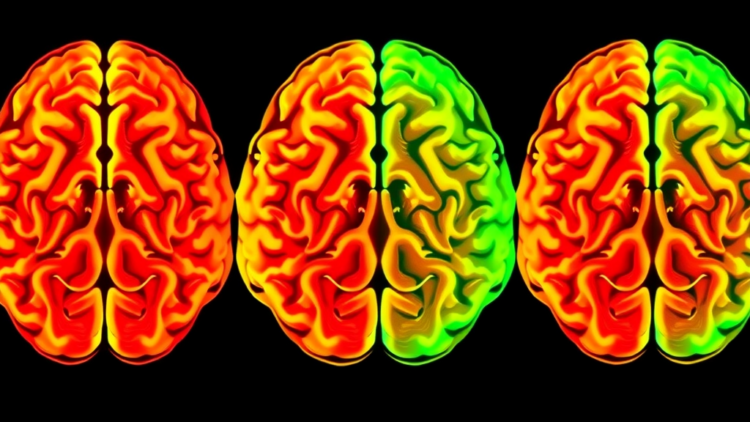
Alzheimer’s disease has long been portrayed as a story written in the cortex, the wrinkled outer layer of the brain where memory and thought reside. But a new study published in Nature Communications suggests that the opening chapters of that story may be unfolding deeper, in the evolutionarily ancient structures buried beneath the cortical surface. By analyzing global patterns of brain activity, the researchers show that degeneration in subcortical regions is progressively linked to the accumulation of tau protein in the cortex, and that this coupling strengthens as patients move through the earliest stages of the disease.
The research focuses on tau, one of the two hallmark proteins of Alzheimer’s pathology. Tau accumulates inside neurons in a remarkably stereotyped sequence, first appearing in the transentorhinal region, then spreading through the hippocampal formation and association cortices in a progression that pathologists have catalogued for decades as Braak stages. Neurofibrillary tangles of tau are closely correlated with neuronal loss and cognitive decline, which is why imaging tau in living brains has become one of the most actively pursued goals in dementia research.
What has remained less clear is how this cortical tau burden relates to the well-documented degeneration of subcortical structures such as the thalamus, basal ganglia, and brainstem nuclei. These deep gray matter regions are not passive bystanders in Alzheimer’s disease. Postmortem studies repeatedly find tau pathology and neuronal loss in structures like the locus coeruleus and the nucleus basalis, which send widespread projections throughout the cortex and are among the earliest sites of pathological change. Yet the functional relationship between subcortical damage and cortical tau spread has been difficult to quantify in living patients.
The new work addresses that gap by treating the brain as a single integrated dynamical system rather than a collection of independent regions. Using resting-state functional imaging, the team derived measures of global brain activity, capturing how fluctuations in neural signaling are coordinated across the entire organ. Instead of examining the cortex and the subcortex in isolation, the analysis explicitly tested whether the strength of global activity coupling changes systematically across Braak-defined regions as Alzheimer’s progresses from preclinical stages through mild cognitive impairment.
The results reveal a clear progressive pattern. In individuals without measurable tau pathology, the functional dialogue between subcortical structures and the cortex follows a relatively stable organization. But as tau begins to accumulate in the transentorhinal and limbic regions, defined by the early Braak stages, the relationship shifts. Degeneration in subcortical gray matter becomes increasingly tied to global activity measures, and this linkage intensifies as tau advances into neocortical association areas in later preclinical and early symptomatic stages.
Crucially, the progression is spatially organized. The researchers found that the strength of the subcortical-cortical coupling tracked the sequential involvement of Braak regions, meaning that the deepest subcortical degeneration was most strongly associated with tau burden in precisely those cortical areas known to be affected at each stage. This staged correspondence argues against the idea that subcortical atrophy is merely a nonspecific consequence of overall disease severity. Instead, it suggests a mechanistic relationship in which damage to deep nuclei that broadly innervate the cortex may influence, or at least mirror, the regional vulnerability of the cortex to tau.
One plausible biological interpretation involves the cholinergic and noradrenergic systems. The nucleus basalis of Meynert, located in the basal forebrain, supplies acetylcholine to the entire cortical mantle, while the locus coeruleus in the brainstem provides norepinephrine with an even wider reach. Both systems are compromised early in Alzheimer’s disease, and both play roles in regulating neural activity, arousal, and the cellular stress responses that govern tau phosphorylation. A failing subcortical modulatory system could plausibly alter cortical network dynamics in ways that create conditions favorable to tau aggregation and spread along existing anatomical connections.
The study’s use of global brain activity as an integrative marker also carries methodological significance. Standard analyses often average activity within predefined regions of interest, which can obscure distributed phenomena. By characterizing whole-brain signal properties, the researchers captured a systems-level signature of disease progression that single-region measures would miss. This approach aligns with a growing recognition, driven by large-scale neuroimaging consortia, that Alzheimer’s disease is fundamentally a network disorder, with pathology propagating along functional and structural connections rather than emerging randomly across the brain.
The clinical implications are potentially substantial. If subcortical degeneration and global activity disruption can be measured reliably in the preclinical window, they may serve as early indicators of impending cortical tau spread, complementing existing PET-based tau imaging and cerebrospinal fluid biomarkers. Because subcortical structures can be quantified with widely available MRI sequences, a systems-level marker derived from standard scans could extend the reach of early detection to clinical settings where advanced PET imaging is not accessible, and could provide sensitive outcome measures for trials of anti-tau therapies targeting the earliest disease stages.
The findings also reframe the conceptual geography of Alzheimer’s disease. Rather than a cortical illness with subcortical complications, the condition increasingly appears as a whole-brain process in which deep nuclei and the cortex deteriorate in a coordinated, staged fashion. Understanding the direction of causality, whether subcortical dysfunction actively promotes cortical tau spread or both reflect a shared upstream trigger, remains the central open question. Longitudinal studies combining serial tau PET, structural imaging of subcortical nuclei, and global activity mapping in the same individuals will be essential to answer it. For now, the study adds a compelling piece of evidence that the brain operates as an integrated system in health and in disease, and that the seeds of cortical destruction in Alzheimer’s may be nourished from below.
Subject of Research: Progressive coupling of subcortical degeneration and cortical tau spread across Braak regions in early Alzheimer’s disease measured by global brain activity
Article Title: Global brain activity links subcortical degeneration to cortical tau progressively across Braak regions over early Alzheimer’s disease stages
Article References: Mao, Y., Pan, B., & Liu, X. (2026). Global brain activity links subcortical degeneration to cortical tau progressively across Braak regions over early Alzheimer’s disease stages. Nature Communications. https://doi.org/10.1038/s41467-026-77748-x
Image Credits: AI Generated
DOI: 10.1038/s41467-026-77748-x
Keywords: Alzheimer’s disease, tau pathology, Braak stages, subcortical degeneration, global brain activity, neuroimaging, cortex, biomarkers, neurodegeneration, Nature Communications, Global, brain
Cite Scienmag News
APA MLA Chicago
Cassandra Pierce. (September 12, 2026). Brain-Wide Activity Ties Subcortical Decline to Spreading Tau in Early Alzheimer’s. Scienmag. https://scienmag.com/brain-wide-activity-ties-subcortical-decline-to-spreading-tau-in-early-alzheimers/
Cassandra Pierce. “Brain-Wide Activity Ties Subcortical Decline to Spreading Tau in Early Alzheimer’s.” Scienmag, 12 September 2026, https://scienmag.com/brain-wide-activity-ties-subcortical-decline-to-spreading-tau-in-early-alzheimers/. Accessed 12 September 2026.
Cassandra Pierce. “Brain-Wide Activity Ties Subcortical Decline to Spreading Tau in Early Alzheimer’s.” Scienmag. September 12, 2026. https://scienmag.com/brain-wide-activity-ties-subcortical-decline-to-spreading-tau-in-early-alzheimers/
Copy citation Download RIS
Tags: Alzheimer’s diseaseAlzheimer’s disease progressionBiomarkersBraak stagesBraak staging of tau pathologybrainbrain-wide activity patternscortexearly Alzheimer’s biomarkersglobalglobal brain activityglobal brain activity analysisimpact of tau on neuronal lossNature Communications.neurodegenerationneurofibrillary tanglesneuroimagingsubcortical brain degenerationsubcortical degenerationsubcortical involvement in Alzheimer’ssubcortical-cortical degeneration linkagetau accumulation in hippocampustau pathologytau protein spread