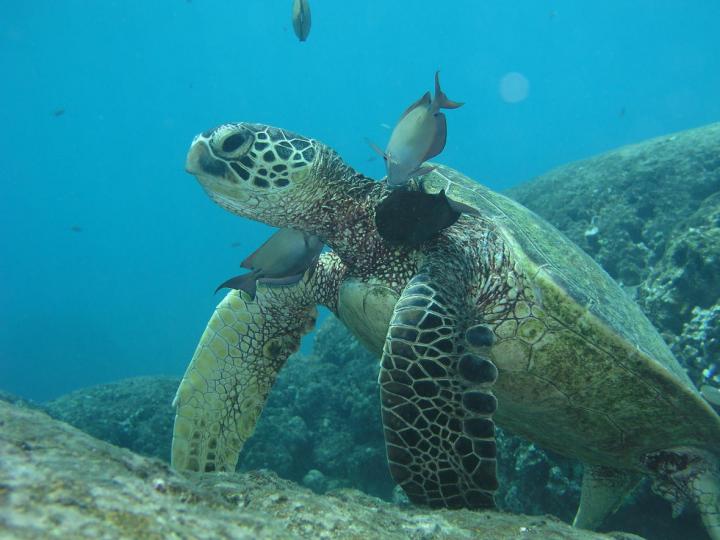
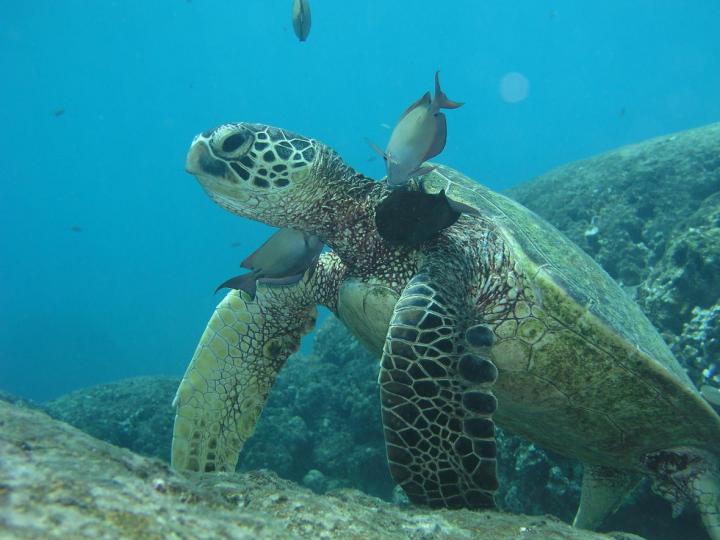
Credit: Thierry Work, USGS
Scientists recently reconstructed the skin of endangered green turtles, marking the first time that skin of a non-mammal was successfully engineered in a laboratory, according to a recently published U.S. Geological Survey study . In turn, the scientists were able to grow a tumor-associated virus to better understand certain tumor diseases.
In an international collaboration, scientists engineered turtle skin in order to grow a virus called chelonid herpesvirus 5, or ChHV5. ChHV5 is associated with fibropapillomatosis, known as FP, a tumor disease affecting green turtles worldwide but particularly those in Hawaii, Florida and Brazil. FP in turtles causes disfiguring tumors on the skin, eyes and mouth as well as internal tumors. The virus also harms turtles' immune systems, leading to secondary infections, emaciation and often death.
Examining how ChHV5 grows in turtle skin brings researchers closer to fighting viral diseases that threaten imperiled species.
"Fibropapillomatosis is the most common infectious disease affecting endangered green turtles," said Thierry Work, a USGS scientist and the lead author of the study. "Our findings provide a significant advancement in studying FP, and may eventually help scientists better understand other herpes virus-induced tumor diseases, including those of humans."
The scientists used cells from tumors and normal skin from turtles to reconstruct the complex three-dimensional structure of turtle skin, allowing growth of ChHV5 in the lab. Growing the virus gave scientists an opportunity to observe virus replication in unprecedented detail, revealing bizarre systems such as sun-shaped virus replication centers where the viruses form within cells.
Although the existence of ChHV5 has been known for more than 20 years, the inability to grow the virus in the laboratory hampered understanding of how it causes tumors and the development of blood tests to detect the virus.
"Examining viruses within the complex three-dimensional structure of engineered skin is exciting, because virus replication in such a system is likely much closer to reality than traditional laboratory techniques," Work said. "This method could be a powerful tool for answering broader questions about virus-induced tumors in reptiles and herpes virus replication in general."
The U.S Endangered Species Act and International Union for the Conservation of Nature list sea turtles as threatened or endangered throughout most of their range. Aside from disease, threats to green turtles include loss of nesting habitat, nest destruction and bycatch in commercial fisheries.
###
The USGS partnered with the University of Hawaii, the National Oceanic and Atmospheric Administration and the University of Zurich on the new study.
For more information about wildlife disease research, please visit the USGS National Wildlife Health Center website .
Media Contact
Marisa Lubeck
[email protected]
303-526-6694
@USGS
http://www.usgs.gov
Original Source
https://www.usgs.gov/news/reptile-skin-grown-lab-first-time-helps-study-endangered-turtle-disease
############
Story Source: Materials provided by Scienmag