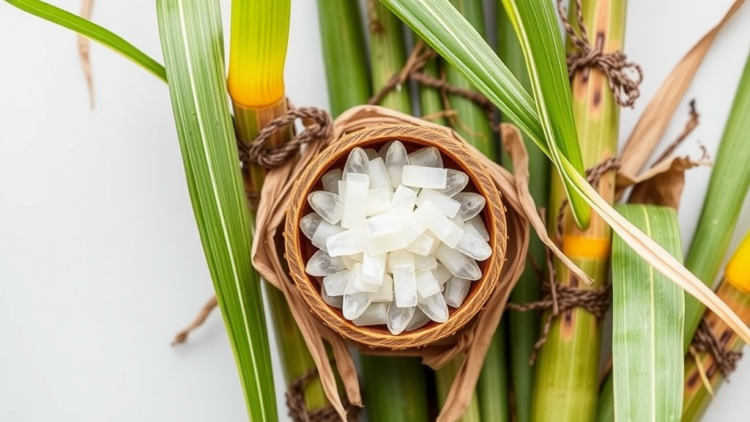
Every year, the global sugar industry generates well over a billion tonnes of sugarcane, and with it a mountain of fibrous residue known as sugarcane bagasse. Roughly 280 kilograms of this dry, lignocellulosic waste is produced for every tonne of cane crushed, adding up to hundreds of millions of tonnes worldwide, with India, Brazil and China among the largest contributors. A new review published in Discover Green Chemistry argues that this abundant, troublesome by-product could become the feedstock of choice for one of biotechnology’s most versatile products: rhamnolipid biosurfactants, microbial molecules that can replace petroleum-derived surfactants in industries ranging from cosmetics to oil recovery.
The review, led by Aditya Thapliyal, Aishwary Purohit, Souvik Kumar Paul and Amar Jyoti Das, critically assesses the microbial conversion of sugarcane bagasse into rhamnolipids within circular bioeconomy frameworks. Its central message is that turning bagasse into biosurfactants is not merely an environmental nicety but a technically plausible route to cheaper, more sustainable surfactant production, provided that the right combination of pretreatment, microbial strain engineering, fermentation strategy and downstream processing can be assembled at scale. The authors frame the work explicitly against United Nations Sustainable Development Goal 9 on industry, innovation and infrastructure, and SDG 12 on responsible consumption and production.
The environmental case begins with the waste problem itself. Bagasse that is not burned for energy is frequently dumped or left in the open, where wind disperses it and open burning releases ash, greenhouse gases, particulate matter, nitrogen oxides and carbon monoxide. Inhaled bagasse ash can penetrate deep into the respiratory tract, while landfilling and open dumping generate leachate and harbour pathogens and pests. These hazards have prompted strict regulation: India’s Air Act of 1981 and its 1987 amendment prohibit open burning of agricultural residues, while Brazil has legislated the phased elimination of pre-harvest cane burning under State Law No. 11,241/2002 and the Green Ethanol Agreement, and the United States regulates bagasse combustion under the Clean Air Act. Redirecting bagasse into bioprocesses thus addresses both a pollution problem and a resource opportunity.
Chemically, bagasse is well suited to microbial upgrading. Roughly half of its mass is cellulose, about a quarter hemicellulose and a quarter lignin, with a notably low ash content compared with residues such as rice straw or wheat straw. The cellulose and hemicellulose fractions can be hydrolysed into fermentable sugars, chiefly glucose and xylose, that microorganisms can convert into rhamnolipids. Because bagasse is generated continuously and centrally at sugar mills, it offers a consistent, scalable and inexpensive carbon source, in sharp contrast to the refined glucose, glycerol and vegetable oils that dominate conventional rhamnolipid fermentation and drive up costs.
Rhamnolipids themselves are glycolipid biosurfactants composed of one or two rhamnose sugar units linked to beta-hydroxy fatty acid chains. This amphiphilic architecture lets them cut the surface tension of water from about 72 millinewtons per metre to roughly 25 to 30, and they do so at low critical micelle concentrations, meaning small amounts are effective. They remain stable across wide ranges of pH, temperature and salinity, and they are readily biodegradable and far less toxic than synthetic surfactants. These properties underpin their use in bioremediation, microbial enhanced oil recovery, anti-biofilm pharmaceutical applications, cosmetics, food processing and agriculture as biocontrol agents and formulation stabilizers.
The dominant natural producer, however, is a problem. Pseudomonas aeruginosa synthesizes rhamnolipids through the rhlA, rhlB and rhlC enzymes, regulated by quorum sensing, but it is an opportunistic pathogen classified at biosafety level 2 and is not on the US FDA’s GRAS list, forcing costly containment and purification for food, cosmetic and pharmaceutical uses. The review highlights how metabolic engineering is mitigating this. Replacing the native rhlAB promoter with the stronger constitutive poprL promoter in engineered strain WJPAB raised yields to 57.83 grams per litre, a 91 percent increase over wild type, while systematic gene deletions in strain 8D lifted production from 8.567 to 14.53 grams per litre. Heterologous expression of the rhlAB operon in safe hosts such as Pseudomonas putida KT2440 has produced 40.2 grams per litre in optimized fed-batch fermentation, and non-pathogenic producers including Pseudomonas chlororaphis, Acinetobacter calcoaceticus and Burkholderia thailandensis offer further regulatory advantages, albeit often at lower native yields.
Getting the sugars out of bagasse is the first technical hurdle. Pretreatment options include physical milling, steam explosion, chemical methods using dilute sulphuric acid to hydrolyse hemicellulose or alkali treatments with sodium hydroxide and lime to remove lignin, and biological delignification with fungi such as Trametes versicolor and Phanerochaete chrysosporium. Each approach involves trade-offs: chemical pretreatments can generate fermentation inhibitors, steam explosion is energy intensive, and biological methods are slow. Once sugars are released, fermentation can proceed in batch, fed-batch or continuous modes, with fed-batch generally preferred because it sustains high cell density and supports secondary metabolite production. Carbon catabolite repression, in which glucose suppresses xylose utilization through the Crc/Hfq regulatory system, and careful optimization of the carbon-to-nitrogen ratio, with a ratio of around 22 reported as optimal for one Pseudomonas strain, are key determinants of yield.
Practical demonstrations of the concept are encouraging. Camilios-Neto and colleagues achieved 45 grams per litre of rhamnolipids from Pseudomonas aeruginosa UFPEDA 614 grown on a solid mixture of bagasse and corn bran supplemented with glycerol and soybean oil. El-Housseiny’s gamma-irradiated P. aeruginosa mutant produced 46.85 grams per litre over ten days on bagasse and sunflower seed meal with glycerol, roughly 5.5 times more than submerged fermentation. A co-culture of P. aeruginosa and Saccharomyces cerevisiae on steam-exploded bagasse simultaneously yielded 9.1 grams per litre of rhamnolipids and 8.4 grams per litre of ethanol. Downstream, recovery relies on acid precipitation at low pH, solvent extraction with ethyl acetate, foam fractionation that exploits the molecules’ own surface activity, and membrane ultrafiltration, each balancing cost, purity and environmental burden.
The review insists that neither economic viability nor sustainability claims can rest on substrate choice alone, and it makes a strong case for integrating techno-economic analysis and life cycle assessment. Reported production costs vary almost a hundredfold, from about 7.64 US dollars per kilogram for digestate-based processes to 600 dollars per kilogram in some simulated scenarios, while glucose-based production can reach 56 dollars per kilogram. Fermentation consistently emerges as the dominant environmental hotspot, contributing roughly 76 percent of the global warming potential in one assessment, driven by aeration, mixing and thermal energy demands, while purification steps such as acetone precipitation or solvent extraction account for 35 to 43 percent of the environmental burden in others. Because substrate substitution alone shifts these numbers relatively little, the authors argue that process intensification, energy recovery from residual biomass, solvent recycling and industrial symbiosis with sugar mills offer the greatest sustainability gains.
The market context makes the timing compelling. The global biosurfactant market, in which rhamnolipids are a major component, is projected to grow from about 14.15 kilotons in 2026 to nearly 71 kilotons by 2031, a compound annual growth rate of over 38 percent, driven by consumer demand for eco-friendly ingredients in personal care, agriculture, food and bioremediation. If metabolic engineering, tailored pretreatment, co-product biorefineries and rigorous life cycle assessment continue to converge, the review concludes, sugarcane bagasse could shift from a burning liability to the foundation of economically and environmentally resilient bio-based surfactant production, turning one of agriculture’s largest waste streams into a cornerstone of the circular bioeconomy.
Subject of Research: Microbial production of rhamnolipid biosurfactants from sugarcane bagasse waste in circular bioeconomy frameworks
Article Title: From waste to rhamnolipid biosurfactant production using sugar industry waste in circular bioeconomy frameworks
Article References: Thapliyal, A., Purohit, A., Paul, S. K., & Das, A. J. (2026). From waste to rhamnolipid biosurfactant production using sugar industry waste in circular bioeconomy frameworks. Discover Green Chemistry, 1(1), Article 31. https://doi.org/10.1007/s44509-026-00030-2
Image Credits: AI Generated
DOI: 10.1007/s44509-026-00030-2
Keywords: sugarcane bagasse, rhamnolipids, biosurfactants, circular economy, fermentation, Pseudomonas aeruginosa, lignocellulosic biorefinery, metabolic engineering, life cycle assessment, techno-economic analysis, waste valorization, sustainable development goals
Cite Scienmag News
APA MLA Chicago
Morgan Morrow. (September 12, 2026). Sugar Cane Waste Turned Into Microbial Rhamnolipid Biosurfactants for a Circular Bioeconomy. Scienmag. https://scienmag.com/sugar-cane-waste-turned-into-microbial-rhamnolipid-biosurfactants-for-a-circular-bioeconomy/
Morgan Morrow. “Sugar Cane Waste Turned Into Microbial Rhamnolipid Biosurfactants for a Circular Bioeconomy.” Scienmag, 12 September 2026, https://scienmag.com/sugar-cane-waste-turned-into-microbial-rhamnolipid-biosurfactants-for-a-circular-bioeconomy/. Accessed 12 September 2026.
Morgan Morrow. “Sugar Cane Waste Turned Into Microbial Rhamnolipid Biosurfactants for a Circular Bioeconomy.” Scienmag. September 12, 2026. https://scienmag.com/sugar-cane-waste-turned-into-microbial-rhamnolipid-biosurfactants-for-a-circular-bioeconomy/
Copy citation Download RIS
Tags: bioconversion of agricultural by-productsbioeconomy strategies for sugar industry residuesbiosurfactantscircular bioeconomy in bioproductsCircular economyenvironmentally friendly surfactant manufacturingfermentationgreen chemistry approaches to surfactant productionLife Cycle Assessmentlignocellulosic biorefinerymetabolic engineeringmicrobial biosurfactant production from agricultural wastemicrobial engineering for biosurfactant synthesismicrobial fermentation of sugarcane wastePseudomonas aeruginosarhamnolipid biosurfactants from lignocellulosic biomassrhamnolipidssugarcane bagassesugarcane bagasse valorizationsustainable development goalssustainable surfactant alternativesTechno-economic analysiswaste valorization