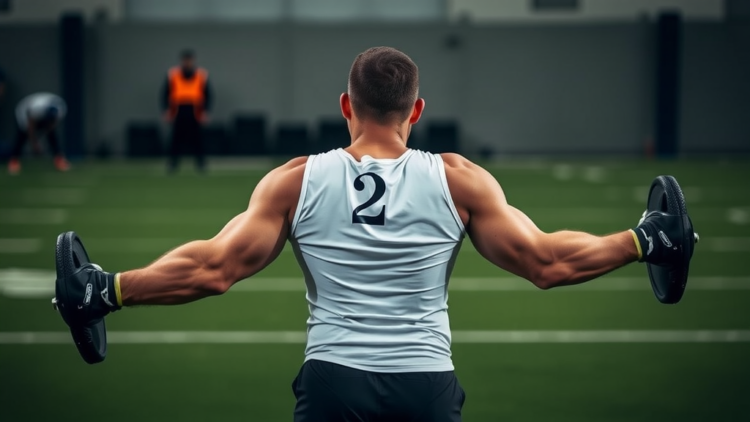
Every morning before an Australian Rules football training session, players at one elite club file into the gym and pull against a hook or squeeze two padded plates with everything they have. Those few seconds of maximal effort, recorded by handheld dynamometry devices, have quietly become one of the most revealing windows into how the athletes will perform hours later on the training track. A new prospective longitudinal study published in Sports Medicine – Open has now quantified exactly what those brief strength tests foretell, tracking 42 professional players across a full 12-week preseason and linking minute-by-minute strength fluctuations to satellite-derived running and change-of-direction data. The findings offer some of the clearest evidence yet that localized neuromuscular fatigue measured before training shares a genuine feedforward relationship with what players actually produce afterward.
The research team, led by Ethan J. Grimmond of the University of New South Wales alongside colleagues from the club and the university’s School of Mathematics and Statistics, set out to answer a question that has long nagged sports scientists: do the neuromuscular assessments practitioners administer every day actually capture changes in muscle function that meaningfully alter subsequent physical output? The countermovement jump has long been the default measure of whole-body neuromuscular fatigue in team sports, but it has a known blind spot. Because jump performance relies on coordinated contribution from many muscle groups, fatigue isolated in one muscle can be masked by compensatory strategies elsewhere. Targeted isometric tests of individual muscle groups, by contrast, can expose fatigue that a global jump test would never detect.
The researchers focused on two assessments with particular relevance to Australian Rules football, a collision-heavy invasion sport with a high prevalence of hamstring and groin injuries. The first, labeled KNEEFLEX, measured isometric knee flexor strength using a NordBord dynamometer, with players in a kneeling plank position at 30 degrees of knee flexion, pulling their heels as hard as possible against the hook apparatus. This position was chosen deliberately because the lengthened hamstring and the hip and knee angles approximate the running gait during the foot-strike phase. The second, HIPADD, assessed long-lever isometric hip adductor strength on a ForceFrame, with players lying supine and squeezing their medial malleoli against force transducers. Before each test, players completed warm-up contractions at roughly 40, 60 and 80 percent of perceived maximum effort, followed by a set of three maximal three-to-five-second contractions, with the highest total force value retained for analysis.
Strength testing took place in the penultimate hour before each of three weekly on-field sessions across the 2023/2024 preseason, generating 746 individual player-session observations across 22 training days. On the training track, physical output was captured using Vector S7 global navigation satellite system devices with integrated triaxial accelerometers, each player wearing the same individually assigned unit throughout to minimize inter-device variability. The satellite units quantified running distances and intensities across absolute and relative velocity bands, while inertial movement analysis algorithms derived change-of-direction effort counts in both the mediolateral and anteroposterior planes at low, medium and high magnitude thresholds. The researchers then built linear mixed models that related each player’s percentage change in strength from his rolling seasonal average to subsequent training outputs, while statistically accounting for session, week, playing position and individual player identity.
The headline result concerned the knee flexors. Changes in pretraining knee flexor strength from baseline were significantly associated with subsequent running intensity measured in meters per minute at velocities exceeding 70 percent of each player’s relative maximum velocity. Notably, this was the only running variable that showed a significant association: neither absolute high-speed running thresholds nor very high-speed or sprint distances, nor acceleration and deceleration counts, tracked with pretraining hamstring strength. The authors had hypothesized that the strongest associations would appear at the very highest intensities, given that hamstring activation increases in proportion to running velocity, but the data told a different story. Average running intensity at velocities above 25.2 kilometers per hour was a mere 0.79 meters per minute, and above 80 percent relative maximum velocity just 0.46 meters per minute, so scores clustered near zero left little variance for fatigue to explain at those extremes.
The second major finding concerned the hip adductors, and it came with a number attached. Declines in pretraining hip adduction strength were significantly associated with subsequent change-of-direction outputs at low and medium magnitude thresholds, but not at high magnitudes. The summated variables told an even stronger story, with the greatest association observed for combined low-to-medium efforts per minute. Translated into practical terms, decreases of 10, 15 and 20 percent in pretraining hip adductor strength corresponded to estimated reductions of roughly 2.49, 3.76 and 5.04 percent in change-of-direction efforts per minute, respectively. Such strength decrements were not rare curiosities: the club recorded drops below minus 15 percent on 38 occasions and below minus 20 percent on 20 occasions across the preseason, representing 5.2 and 2.8 percent of all hip adductor measurements.
The absence of associations at the highest thresholds carried its own important message about measurement technology. The manufacturer’s high-magnitude change-of-direction threshold of greater than 3.5 meters per second registered only 0.39 efforts per minute on average, a scarcity the authors argue likely reflects collision-based positional changes rather than the agile, preplanned and reactive cuts that define football movement. Elite soccer studies using lower high-intensity thresholds have found better agreement with video-coded explosive changes of direction, and tackle quantification research in Australian football shows collision-driven movements occur at far greater magnitudes than agility cuts. If the high threshold primarily captures collisions, then the low and medium bands are where agility genuinely lives, and those were precisely the bands most sensitive to adductor fatigue.
The findings also fuel a broader debate about absolute versus relative speed zones in team sport monitoring. Only the relative running threshold, expressed as a percentage of each player’s own maximum velocity, proved sensitive to neuromuscular state, while fixed absolute thresholds did not. This aligns with a growing body of criticism that arbitrary absolute cutoffs overestimate high-velocity running for faster players and underestimate it for slower ones, potentially misinforming decisions about readiness and load. For practitioners, the implication is that individualized velocity bands, paired with localized strength screening, provide a more physiologically faithful picture of the stress each athlete is actually absorbing.
The authors are careful to frame the study as observational, and they acknowledge its limitations. The data came from a single club during a single preseason, adherence to maximal effort in testing cannot be fully guaranteed despite athlete familiarization, and the use of a rolling seasonal average as the baseline means early-season scores may have been skewed by familiarization effects. Yet the practical implications are tangible. A strength drop exceeding 15 percent could serve as a triage flag, prompting medical staff to review a player before training or match play, and the estimated output reductions allow coaches to anticipate whether planned session demands can be tolerated or should be scaled to facilitate recovery. Rather than replacing the countermovement jump, the knee flexor and hip adductor tests appear to measure largely independent qualities, strengthening the case for a diverse neuromuscular battery. As accumulated neuromuscular fatigue is linked to elevated injury risk and degraded performance, a 90-second squeeze and a heel pull may become indispensable tools for deciding, before the first whistle of the day, exactly how hard a footballer’s body is ready to work.
Subject of Research: Pretraining lower-limb isometric strength changes and subsequent physical training outputs in elite Australian Rules football players
Article Title: Examining the Relationship Between Changes in Lower-Limb Isometric Strength and Subsequent Physical Training Outputs in Elite Australian Rules Football Players
Article References: Grimmond, E. J., Stindl, T. J., Engel, A. C., Maros, T. M., Lehane, S., & Borges, N. R. (2026). Examining the Relationship Between Changes in Lower-Limb Isometric Strength and Subsequent Physical Training Outputs in Elite Australian Rules Football Players. Sports Medicine – Open, 12(1), Article 132. https://doi.org/10.1186/s40798-026-01105-x
Image Credits: AI Generated
DOI: 10.1186/s40798-026-01105-x
Keywords: neuromuscular fatigue, isometric strength, Australian Rules football, player readiness, knee flexor strength, hip adductor strength, change of direction, GNSS tracking, training load monitoring, relative maximum velocity, dynamometry, preseason training
Cite Scienmag News
APA MLA Chicago
Ophelia Keating. (September 12, 2026). Two Quick Strength Tests Predict How Hard Elite Footballers Will Train That Day. Scienmag. https://scienmag.com/two-quick-strength-tests-predict-how-hard-elite-footballers-will-train-that-day/
Ophelia Keating. “Two Quick Strength Tests Predict How Hard Elite Footballers Will Train That Day.” Scienmag, 12 September 2026, https://scienmag.com/two-quick-strength-tests-predict-how-hard-elite-footballers-will-train-that-day/. Accessed 12 September 2026.
Ophelia Keating. “Two Quick Strength Tests Predict How Hard Elite Footballers Will Train That Day.” Scienmag. September 12, 2026. https://scienmag.com/two-quick-strength-tests-predict-how-hard-elite-footballers-will-train-that-day/
Copy citation Download RIS
Tags: athletic performance predictionAustralian Rules footballchange of directiondynamometryelite football trainingfootball training load monitoringGNSS trackinghandheld dynamometry in athleteship adductor strengthisometric strengthknee flexor strengthlocalized muscle fatigueneuromuscular fatigueneuromuscular fatigue assessmentneuromuscular function and training outcomesplayer readinesspredictive markers for sports performancepreseason athletic performancepreseason trainingrelative maximum velocitysatellite tracking of athlete movementsports science researchstrength testing in sportstraining load monitoring