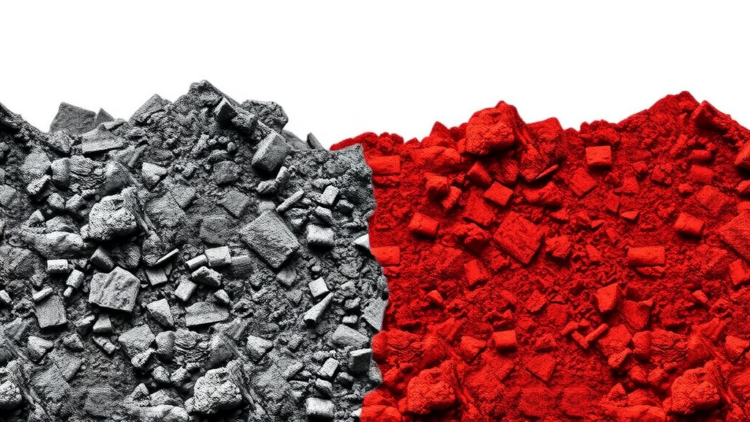
Every year, the global aluminium industry churns out more than 150 million tonnes of red mud, a highly alkaline sludge left over when bauxite ore is processed into alumina. Stockpiles around the world have now swelled to an estimated 7 to 8 billion tonnes, yet fewer than 5 percent of this waste is ever reused. Rainwater percolating through open-air ponds produces leachate with a pH between 10 and 12.5, threatening soil and groundwater on a massive scale. A new study published in Case Studies in Construction Materials offers a strikingly simple remedy: sprinkle in a tiny amount of nano-silica and red mud can become a high-performance ingredient of cement itself, rather than an environmental liability.
The research team, led by Yifan Li and colleagues at institutions working with Bayer-process red mud from Wenshan in Yunnan, China, set out to solve the two problems that have long prevented red mud from replacing ordinary Portland cement at scale. The first is its intrinsically low reactivity: red mud contains almost none of the highly reactive calcium silicate clinker minerals that give cement its binding power, so substituting it for cement simply dilutes the mixture and weakens the resulting concrete. The second is its high alkalinity, which interferes with the delicate chemistry of cement hydration. Previous remedies, such as thermal treatment, aggressive grinding, or full alkali activation, tend to be expensive, energy-hungry, or only partially effective.
Nano-silica offered a chemically elegant alternative. Because it consists almost entirely of amorphous silicon dioxide, the same chemical family as the calcium-silicate-hydrate gel that cements everything together, it can participate directly in the pozzolanic reaction, consuming calcium hydroxide released by cement hydration and converting it into additional binding gel. Its particles, averaging just 30 nanometres with a specific surface area of roughly 200 square metres per gram, also serve as thousands of microscopic nucleation platforms onto which early hydration products can precipitate. The question was whether these benefits would survive in the hostile, chemically complex environment that red mud creates.
To find out, the researchers prepared nine paste formulations, combining red mud replacement levels of 0, 10 and 20 percent with nano-silica dosages of 0, 1 and 3 percent, all at a fixed water-to-binder ratio of 0.3. The red mud, milled for 15 minutes in a planetary ball mill, was remarkably fine, with a median particle size of 3.06 micrometres, about a quarter that of the cement, and a specific surface area more than twice as high. Nano-silica was dispersed ultrasonically in the mixing water before blending. Specimens were cured at 20 degrees Celsius and 98 percent relative humidity and tested at 3, 7 and 28 days for compressive strength, with six replicates per mixture analysed statistically using two-way analysis of variance.
The results were unambiguous. Adding red mud alone reduced strength at every age, and the penalty grew worse as the replacement level rose: at 20 percent substitution, the 28-day strength fell from 59.3 megapascals for the plain paste to 48.9 megapascals. But nano-silica clawed much of that loss back. At 20 percent red mud, the 3 percent nano-silica mix reached 54.9 megapascals at 28 days, a statistically significant gain of 6 megapascals over the red-mud-only mix, with adjusted p-values below 0.001 at all three curing ages. More telling was the cement-normalised strength, which divides measured strength by the actual cement content to strip out the dilution effect. By this measure, the 20 percent red mud plus 3 percent nano-silica blend used its cement 34.58 percent more efficiently than plain paste at 3 days and 20.23 percent more efficiently at 28 days, evidence that the combination genuinely improves the chemistry rather than merely offsetting dilution.
The microscopic evidence explains why. X-ray diffraction and thermogravimetric analysis showed no new crystalline phases, but revealed steady consumption of calcium hydroxide in the nano-silica mixes, the fingerprint of ongoing pozzolanic reaction. The 3 percent dosage cut calcium hydroxide content by roughly 17 to 20 percent relative to the red-mud-only system at 3 and 28 days, while mass loss associated with hydrate gels rose 8.2 percent at early age, confirming accelerated product formation. Low-field nuclear magnetic resonance, which maps pore sizes through hydrogen relaxation times, showed that nano-silica shifted the pore network decisively toward harmless gel pores: at 3 days the harmless pore volume nearly doubled or more, and by 28 days the higher dosage produced the densest structure of all, as secondary gel generated by sustained pozzolanic reaction filled the voids left by early hydration.
Isothermal calorimetry and the Krstulovic-Dabic kinetic model added a dynamic picture. Red mud alone lowered the peak heat release and extended the induction period, symptoms of its dilution and low reactivity, and delayed the secondary aluminate-related exotherm to about 20 hours as reactive aluminium and silicon species dissolved slowly from the mud. Nano-silica reversed these trends, raising the nucleation-and-growth rate constant and the interfacial reaction constant while slightly lowering the diffusion constant, a signature of a matrix so dense that water and ions struggle to move through it. Backscattered electron microscopy with energy-dispersive spectroscopy confirmed the visual outcome: after 28 days, the nano-silica-modified blend showed a more continuous, homogeneous matrix, with residual iron- and titanium-rich red mud particles embedded in a Ca-Si-Al hydrate gel whose calcium-to-silicon ratio had drifted slightly downward, exactly as expected when reactive silica joins the reaction.
Environmental safety, often the Achilles heel of red mud reuse, also held up. Leaching tests on 28-day specimens following the Chinese HJ/T 299-2007 protocol showed arsenic, lead and nickel below detection limits in both mixes, chromium at just 3.8 micrograms per litre, and copper falling from 3.6 micrograms per litre to below detection once nano-silica was added. Every measured element sat comfortably beneath Class III groundwater quality limits, indicating that the mechanical upgrades did not come at the cost of mobilising hazardous elements from the waste.
Economics remain the honest caveat. Replacing 20 percent of cement with red mud cut the direct binder cost by 10.5 percent, to 285.29 yuan per tonne, even after including transport and milling expenses. But the 3 percent nano-silica addition drove the total to 1701.79 yuan per tonne, with the nanomaterial alone accounting for roughly 1404 yuan, so the additive only makes sense where its strength gains are genuinely needed or where nano-silica prices fall with scale. The authors also note limitations: workability and setting behaviour were not measured, phase analysis remained qualitative, and long-term durability tests such as freeze-thaw and sulfate exposure are still to come. Even so, the study delivers a compelling proof of concept that a cheap industrial nuisance and a well-chosen nanomaterial can team up to make cement stronger, denser and cleaner, turning one of the world’s largest waste streams into part of the solution rather than part of the problem.
Subject of Research: Nano-silica modification of red mud-cement composite binders to improve mechanical properties and hydration kinetics
Article Title: Effect of nano-silica on the mechanical properties and hydration kinetics of red mud-cement based composite cementitious materials
Article References: Li, Y., Guo, R., Pan, T., Zhu, Y., Tang, X., Fu, C., & Li, Y. (2026). Effect of nano-silica on the mechanical properties and hydration kinetics of red mud-cement based composite cementitious materials. Case Studies in Construction Materials, 25, Article e06502. https://doi.org/10.1016/j.cscm.2026.e06502
Image Credits: AI Generated
DOI: 10.1016/j.cscm.2026.e06502
Keywords: red mud, nano-silica, cement, hydration kinetics, compressive strength, pore structure, pozzolanic reaction, solid waste recycling, supplementary cementitious materials, sustainable construction, Effect, mechanical
Cite Scienmag News
APA MLA Chicago
Denise Maddox. (September 12, 2026). Nano-silica turns industrial red mud waste into stronger, greener cement. Scienmag. https://scienmag.com/nano-silica-turns-industrial-red-mud-waste-into-stronger-greener-cement/
Denise Maddox. “Nano-silica turns industrial red mud waste into stronger, greener cement.” Scienmag, 12 September 2026, https://scienmag.com/nano-silica-turns-industrial-red-mud-waste-into-stronger-greener-cement/. Accessed 12 September 2026.
Denise Maddox. “Nano-silica turns industrial red mud waste into stronger, greener cement.” Scienmag. September 12, 2026. https://scienmag.com/nano-silica-turns-industrial-red-mud-waste-into-stronger-greener-cement/
Copy citation Download RIS
Tags: alkaline waste treatmentaluminum industry waste managementcementcompressive strengtheco-friendly cement additivesEffectgreen building materialshydration kineticsindustrial waste valorizationinnovative cement productionMechanicalnano-silicanano-silica in cementpore structurepozzolanic reactionred mudred mud environmental impactred mud reusesolid waste recyclingstrengthening concrete with nano-silicasupplementary cementitious materialssustainable constructionsustainable construction materialswaste-to-resource conversion