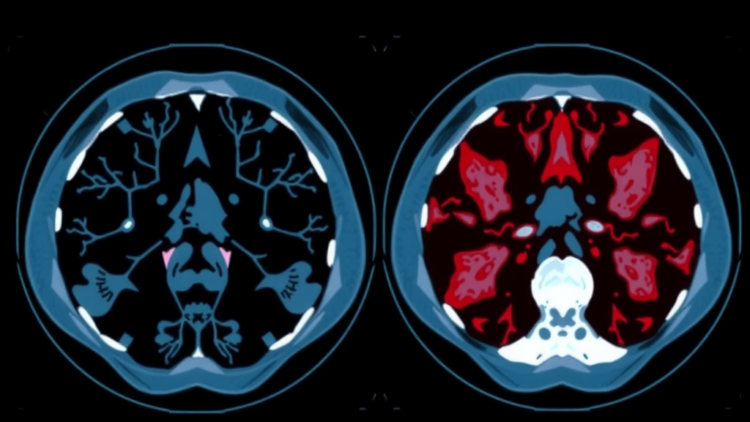
Triple-negative breast cancer remains one of the most feared diagnoses in oncology. Lacking the estrogen, progesterone, and HER2 receptors that make other breast cancers vulnerable to targeted drugs, it tends to relapse early, spread aggressively, and resist conventional chemotherapy. For patients whose disease has returned or metastasized, clinicians have long relied on FDG PET/CT, a scan that lights up tumors based on their glucose appetite. But glucose metabolism is a blunt instrument: inflamed tissue, healing wounds, and infections can all glow on an FDG scan, and some metabolically quiet tumors escape detection entirely. A new study published in the European Journal of Nuclear Medicine and Molecular Imaging suggests that a fundamentally different imaging strategy, one that reads a molecular signature on the tumor cell surface rather than the cell’s metabolic activity, could change how these patients are scanned, staged, and ultimately selected for treatment.
The tracer at the center of the research is called [68Ga]Ga-FZ-NR-1, a gallium-68-labeled radioligand designed to bind specifically to Nectin-4, a cell adhesion molecule that has emerged as one of the most compelling targets in modern oncology. Nectin-4 sits on the surface of cells and is largely silenced in healthy adult tissue, but it is overexpressed in a wide range of malignancies, including triple-negative breast cancer, where it has been linked to proliferation, metastasis, and poor prognosis. Its clinical importance has been underscored by the success of enfortumab vedotin, a Nectin-4-directed antibody-drug conjugate approved for urothelial carcinoma, and by a growing pipeline of next-generation Nectin-4-targeted agents now being tested across solid tumors. If a tracer could map where Nectin-4 is expressed throughout a patient’s body, physicians would gain a non-invasive window into which tumors might respond to these drugs.
That is precisely what a team at Fudan University Shanghai Cancer Center set out to test. In a clinical translational study, the researchers enrolled 40 patients with recurrent or metastatic triple-negative breast cancer, each of whom underwent both [68Ga]Ga-FZ-NR-1 PET/CT and conventional FDG PET/CT within a single week. This head-to-head design allowed a direct comparison of the two tracers on the same patients, same lesions, and same time points, eliminating many of the confounders that plague cross-study comparisons. Diagnostic performance was assessed against a reference standard and compared statistically using the McNemar test, while survival outcomes were analyzed with Kaplan-Meier methods to determine whether imaging features could predict how long patients remained free of progression or alive.
The first striking finding concerned heterogeneity. When the researchers examined Nectin-4 expression across all lesions within a single patient, they found remarkable spatial variability: the median inter-lesion fold difference in uptake was 3.10, and the median coefficient of variation reached 31.70 percent. In practical terms, one metastatic deposit in a patient might light up intensely on the Nectin-4 scan while another lesion in the same body barely registered. This kind of whole-body mapping of molecular heterogeneity is something a single biopsy can never provide, and it carries real therapeutic consequences. Antibody-drug conjugates depend on target expression at every disease site; a tumor clone that has downregulated Nectin-4 could survive treatment and seed relapse, even when the primary lesion shows abundant target. The scan essentially renders this invisible biology visible.
On raw signal intensity, FDG still held an advantage. The study found that FDG achieved higher maximum standardized uptake values, or SUVmax, reflecting the intense glucose consumption typical of aggressive cancers. But raw uptake is not the whole story, because a tracer is only as useful as its contrast between tumor and surrounding tissue. Here the new agent excelled: [68Ga]Ga-FZ-NR-1 delivered a significantly higher tumor-to-background ratio across a variety of metastatic sites. Because Nectin-4 is minimally expressed in normal adult tissues, the tracer paints tumors in sharp relief against a quiet background, whereas FDG competes with the physiological glucose uptake of the brain, heart, bowel, and inflamed tissue. High contrast translates directly into clinical confidence, allowing radiologists to distinguish true lesions from ambiguous uptake with far less uncertainty.
The diagnostic numbers bore this out decisively. [68Ga]Ga-FZ-NR-1 PET/CT detected more lesions overall than FDG PET/CT and achieved a sensitivity of 98.13 percent compared with 93.46 percent for FDG, meaning it missed fewer true tumor deposits. The gap in specificity was even more dramatic: 68.63 percent for the Nectin-4 tracer versus just 27.45 percent for FDG. In other words, when the Nectin-4 scan showed uptake, it was far more likely to represent genuine malignancy rather than a benign mimic. For patients with recurrent disease, where scar tissue from prior surgery and radiation can confound interpretation, that difference in specificity could spare patients from unnecessary biopsies, inappropriate treatment changes, and the psychological toll of false alarms.
Beyond diagnosis, the study delivered something arguably more valuable: prognostic power. The researchers measured volumetric and heterogeneity parameters from the baseline Nectin-4 scans, including metabolic tumor volume at a 40 percent threshold (MTV40) and a heterogeneity index (HI). Patients with a high baseline mean MTV40 on the Nectin-4 scan had significantly shorter progression-free survival, with a P value of 0.009, while a high heterogeneity index predicted significantly shorter overall survival, with a P value of 0.008. These associations suggest that the sheer burden of Nectin-4-expressing disease and the unevenness of its expression are not merely visual curiosities but quantitative signals of aggressive biology. A single pretreatment scan could therefore help stratify patients into risk groups before a single dose of therapy is given.
The implications extend naturally into the era of Nectin-4-targeted therapeutics. Companion diagnostics have become essential as antibody-drug conjugates multiply, because these expensive and sometimes toxic drugs work best in patients whose tumors actually express the target. Immunohistochemistry on a biopsy sample offers only a local, single-site answer, and studies in urothelial carcinoma have shown that Nectin-4 expression can decrease during metastatic spread, contributing to resistance against enfortumab vedotin. A whole-body PET tracer like [68Ga]Ga-FZ-NR-1 offers a complementary, dynamic view: it can confirm target expression across every known lesion, quantify heterogeneity, and potentially identify patients most likely to benefit from Nectin-4-directed treatment. The authors describe their findings as hypothesis-generating, an appropriately cautious framing, but the direction of travel is clear.
Several caveats temper the enthusiasm. The study involved 40 patients at a single institution, and the survival analyses, while statistically significant, require validation in larger, multicenter cohorts before they can guide clinical decision-making. The comparison also reflects the specific tracer and imaging protocols used, and questions remain about optimal timing, dosimetry, and how Nectin-4 PET findings should be integrated with existing staging tools. Cost and availability of gallium-68 radiopharmaceutical production will also shape adoption, although generator-based production and the growing network of radiopharmacies are steadily lowering those barriers. None of these caveats, however, diminishes the central achievement of the study: demonstrating, in a rigorous head-to-head comparison, that a molecularly targeted tracer can outperform the workhorse of oncologic imaging in one of the hardest cancers to image and treat.
For patients with recurrent or metastatic triple-negative breast cancer, the study offers a glimpse of a more precise future. Instead of asking simply whether a tumor is metabolically active, clinicians could soon ask whether it expresses the specific molecule their next drug is designed to attack, and how uniformly that expression is distributed across the entire disease burden. The Fudan team’s work positions [68Ga]Ga-FZ-NR-1 as both a diagnostic upgrade and a prognostic instrument, a dual role that mirrors the theranostic philosophy transforming nuclear medicine. As Nectin-4-targeted antibody-drug conjugates advance through clinical trials in breast cancer and beyond, the ability to see the target before committing to therapy could become as routine as receptor testing is today. This study is an early but persuasive step toward that goal, and it signals that the next generation of cancer imaging will speak the molecular language of the tumor itself.
Subject of Research: Nectin-4-targeted [68Ga]Ga-FZ-NR-1 PET/CT imaging for diagnosis and prognosis in recurrent or metastatic triple-negative breast cancer
Article Title: Prognostic value and diagnostic performance of nectin-4-targeted [68Ga]Ga-FZ-NR-1 PET/CT versus [18F]FDG in recurrent or metastatic triple-negative breast cancer
Article References: Li, Y., Sun, Y., Sun, L., Wang, D., Pan, X., Xu, X., & Song, S. (2026). Prognostic value and diagnostic performance of nectin-4-targeted [68Ga]Ga-FZ-NR-1 PET/CT versus [18F]FDG in recurrent or metastatic triple-negative breast cancer. European Journal of Nuclear Medicine and Molecular Imaging. https://doi.org/10.1007/s00259-026-08177-7
Image Credits: AI Generated
DOI: 10.1007/s00259-026-08177-7
Keywords: Nectin-4, triple-negative breast cancer, PET/CT, [68Ga]Ga-FZ-NR-1, FDG PET, molecular imaging, antibody-drug conjugates, tumor heterogeneity, prognosis, radiotracer, nuclear medicine, survival prediction
Cite Scienmag News
APA MLA Chicago
Nathaniel Bowman. (September 12, 2026). New Nectin-4-Targeted PET Scan Outperforms FDG in Aggressive Breast Cancer. Scienmag. https://scienmag.com/new-nectin-4-targeted-pet-scan-outperforms-fdg-in-aggressive-breast-cancer/
Nathaniel Bowman. “New Nectin-4-Targeted PET Scan Outperforms FDG in Aggressive Breast Cancer.” Scienmag, 12 September 2026, https://scienmag.com/new-nectin-4-targeted-pet-scan-outperforms-fdg-in-aggressive-breast-cancer/. Accessed 12 September 2026.
Nathaniel Bowman. “New Nectin-4-Targeted PET Scan Outperforms FDG in Aggressive Breast Cancer.” Scienmag. September 12, 2026. https://scienmag.com/new-nectin-4-targeted-pet-scan-outperforms-fdg-in-aggressive-breast-cancer/
Copy citation Download RIS
Tags: [68Ga]Ga-FZ-NR-1advancements in breast cancer imaging techniquesantibody-drug conjugatesearly detection and staging of metastasisFDG PETFDG PET/CT in breast cancergallium-68 radioligand in cancer detectionimproved imaging for aggressive breast tumorsmolecular imagingmolecular imaging in oncologyNectin-4Nectin-4 as cancer biomarkerNectin-4 targeted PET scannuclear medicinePET/CTprognosisradiotracerreceptor-specific PET imagingsurvival predictiontargeted radiotracers in cancer diagnosistriple-negative breast cancertriple-negative breast cancer imagingtumor heterogeneitytumor surface molecular signature