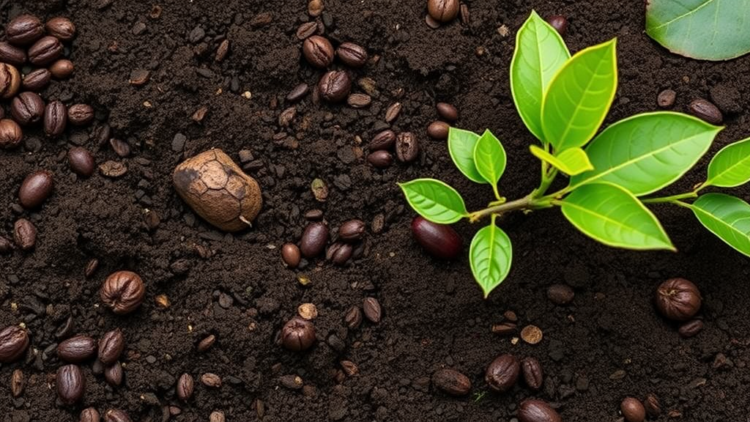
Deep in the soils of Brazil’s coffee heartland, a quiet revolution is brewing. Researchers at the Federal University of Viçosa and the Federal Institute of Espírito Santo have recovered dozens of native bacterial strains from Arabica coffee farms that can fix atmospheric nitrogen, dissolve insoluble phosphorus, and produce natural plant hormones—three traits that together could one day replace a substantial share of the synthetic fertilizers on which the world’s largest coffee producer currently depends. The study, published in the journal International Microbiology, offers one of the most detailed portraits yet of the cultivable bacterial fraction living in coffee soils managed under two very different fertilization philosophies.
Brazil cultivates coffee across approximately 2.25 million hectares, and the crop’s famously high productivity rests on heavy applications of mineral fertilizers, particularly nitrogen. Nitrogen is the engine of plant metabolism, forming the structural backbone of proteins, nucleic acids, and chlorophyll, and coffee plants grown in full-sun monocultures demand enormous quantities of it during vegetative growth, flowering, and fruit filling. But synthetic nitrogen inputs are notoriously inefficient: a large fraction is lost to leaching, volatilization, and denitrification before the plant can use it, driving up production costs while polluting waterways and warming the atmosphere. That inefficiency has pushed scientists to look beneath their feet for alternatives.
The research team focused on two adjacent coffee-producing areas in the municipality of Araponga, in the state of Minas Gerais, both planted with the Catuaí Vermelho variety at roughly 900 meters altitude and both cultivated for more than fifteen years. One farm followed conventional mineral fertilization, receiving 1,250 kilograms per hectare of NPK fertilizer split into two doses, along with lime. The other practiced organic fertilization, applying 400 kilograms per hectare of urea together with 6,000 kilograms per hectare of composted chicken litter. Soil samples were collected in November 2023 during the flowering stage, with ten composite samples gathered per farm from bulk soil around the tree trunks.
To coax out bacteria capable of living without fixed nitrogen, the team plated soil dilutions onto two nitrogen-free culture media, LGI and JMV, traditionally used to enrich diazotrophic bacteria. In total, thirty-eight morphologically distinct bacterial isolates were purified—nineteen from each farm—and identified by Sanger sequencing of the 16S rRNA gene, the standard molecular barcode for bacteria. The isolates spanned four phyla and fifteen genera, with members of Pseudomonadota and Actinomycetota dominating both farms. Intriguingly, isolates from the phyla Bacillota and Bacteroidota emerged exclusively from the organically fertilized soil, hinting that compost inputs had opened ecological niches that mineral fertilizer alone could not.
Only three genera—Pseudomonas, Streptomyces, and Acinetobacter—were shared between the two management systems. The organic farm exclusively yielded Paraburkholderia, Priestia, Flavobacterium, Curtobacterium, and Dyella, while the conventional farm alone harbored Burkholderia, Ralstonia, Luteibacter, Kosakonia, and Rhizobium. The researchers attribute these management-specific profiles to differences in carbon inputs and nutrient dynamics, noting that organic amendments generally increase soil organic carbon and niche heterogeneity, whereas mineral fertilization favors fast-growing copiotrophic microbes that exploit sudden nutrient pulses. The recovery of Rhizobium and Luteibacter under conventional fertilization was particularly noteworthy, expanding knowledge of these genera’s distribution in coffee agroecosystems.
The functional screening was where the study’s biotechnological promise crystallized. Eleven isolates from the organic farm and nine from the conventional farm grew in nitrogen-free semi-solid NFb medium, forming the subsurface microaerophilic pellicles and alkalinizing the indicator dye that signal a putative diazotrophic phenotype—the ability to convert atmospheric nitrogen into biologically usable forms. Even more striking, every single isolate recovered from the organically fertilized soil could solubilize tricalcium phosphate in vitro, dissolving an otherwise inaccessible mineral pool of phosphorus into forms plants can absorb. Standout performers included Streptomyces, Bacillus, Flavobacterium, and Acinetobacter strains with solubilization indices above 3, the threshold for classification as high-efficiency solubilizers.
Phytohormone production added a third dimension to the isolates’ toolkit. Quantified spectrophotometrically after growth in tryptophan-supplemented medium, indole-3-acetic acid—the principal auxin that stimulates root development—was produced by isolates from both farms, with no statistically significant difference between the two management systems. The most prolific producers included Priestia, Dyella, Paraburkholderia, and Bacillus from the organic soil, and Streptomyces and Luteibacter from the conventional soil. One Streptomyces isolate reached concentrations of up to 68.82 micrograms per milliliter, exceeding values previously reported for well-characterized plant growth-promoting Streptomyces strains, a result the authors describe as reinforcing the biotechnological potential of these genera.
What makes these findings compelling is the convergence of multiple traits within single isolates. A bacterium that simultaneously fixes nitrogen, unlocks phosphorus, and secretes auxins is a candidate for multifunctional microbial inoculants—living fertilizers that could reduce the environmental footprint of coffee cultivation while lowering input costs for farmers. The authors caution that their assays represent an initial in vitro screening. Confirming true diazotrophy will require quantitative nitrogen fixation assays such as acetylene reduction or nitrogen-15 isotope dilution, molecular detection of nitrogenase genes like nifH, and ultimately greenhouse and field inoculation trials to verify agronomic performance under real conditions.
Nevertheless, the study fills an important gap. While culture-independent metagenomic studies have catalogued the vast microbial diversity of coffee plantations across Latin America, cultivable isolates remain indispensable for experimentally validating microbial functions and translating ecological knowledge into practical agricultural products. By demonstrating that both organic and conventionally managed coffee soils harbor a resilient core microbiota alongside management-specific taxa with valuable plant growth-promoting traits, the research establishes a foundation for developing microbial consortia adapted to local edaphoclimatic conditions. For an industry confronting rising fertilizer prices, nitrogen losses, and mounting environmental scrutiny, the humble bacteria of Minas Gerais may prove to be coffee’s most valuable untapped resource.
Subject of Research: Cultivable plant growth-promoting bacteria in Brazilian Coffea arabica soils under organic and conventional mineral fertilization
Article Title: Cultivable diversity and plant growth-promoting traits of free-living bacteria from coffee soils under contrasting fertilization systems
Article References: Guimarães, C. V., Velozo, T. G. R., da Luz, J. M. R., Públio, G. C., da Silva, J. P. T., Pereira, L. L., & de Cássia Soares da Silva, M. (2026). Cultivable diversity and plant growth-promoting traits of free-living bacteria from coffee soils under contrasting fertilization systems. International Microbiology. https://doi.org/10.1007/s10123-026-00893-2
Image Credits: AI Generated
DOI: 10.1007/s10123-026-00893-2
Keywords: coffee, plant growth-promoting bacteria, nitrogen fixation, phosphate solubilization, indole-3-acetic acid, soil microbiome, organic fertilization, mineral fertilization, Coffea arabica, microbial inoculants, Brazil, sustainable agriculture
Cite Scienmag News
APA MLA Chicago
Morgan Morrow. (September 12, 2026). Hidden Bacteria in Brazilian Coffee Soils Could Replace Synthetic Fertilizers. Scienmag. https://scienmag.com/hidden-bacteria-in-brazilian-coffee-soils-could-replace-synthetic-fertilizers/
Morgan Morrow. “Hidden Bacteria in Brazilian Coffee Soils Could Replace Synthetic Fertilizers.” Scienmag, 12 September 2026, https://scienmag.com/hidden-bacteria-in-brazilian-coffee-soils-could-replace-synthetic-fertilizers/. Accessed 12 September 2026.
Morgan Morrow. “Hidden Bacteria in Brazilian Coffee Soils Could Replace Synthetic Fertilizers.” Scienmag. September 12, 2026. https://scienmag.com/hidden-bacteria-in-brazilian-coffee-soils-could-replace-synthetic-fertilizers/
Copy citation Download RIS
Tags: biofertilizers for coffee cropsBrazilBrazilian coffee soil bacteriaCoffea arabicacoffeeenvironmental impact of fertilizer use in coffee farmingindole-3-acetic acidmicrobial inoculantsmicrobial solutions for nitrogen and phosphorus availabilitymicrobial strains for sustainable agriculturemineral fertilizationnative bacteria in coffee soilsnatural plant hormone productionnitrogen fixationnitrogen fixation in coffee farmsOrganic fertilizationphosphate solubilizationplant growth-promoting bacteriareducing fertilizer dependency in Brazilian coffee productionreplacing synthetic fertilizers in coffee cultivationsoil microbiomesoil microbiome in coffee plantationssustainable agriculturesustainable coffee farming practices