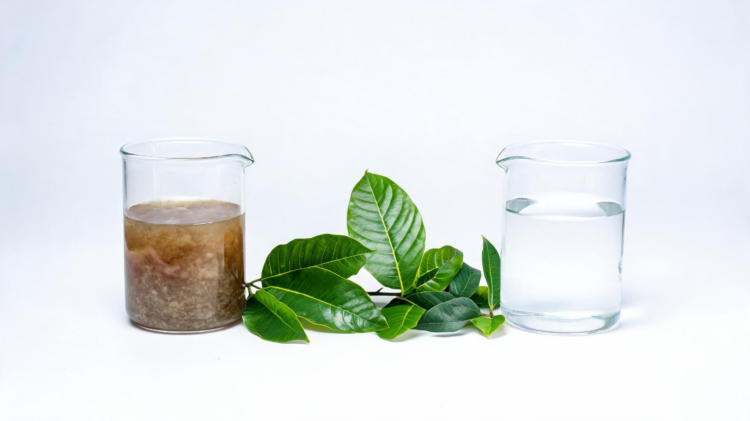
In a finding that could reshape how low-resource communities purify their drinking water, researchers in Nigeria have demonstrated that ordinary leaves from two familiar tropical trees—the soursop (Annona muricata) and the avocado pear (Persea americana)—can act as remarkably effective natural coagulants, clouding contaminants out of polluted river water without the need for synthetic chemicals. The study, published in the journal Discover Green Chemistry, reports turbidity reductions of roughly 56 percent, complete elimination of iron, and near-total removal of copper from raw surface water, all while leaving the water’s pH comfortably within World Health Organization guidelines.
The research was driven by a persistent and growing global problem. Across much of the developing world, rapid population growth, urbanization, industrial expansion, and intensified agriculture have multiplied the discharge of untreated wastewater into rivers and streams. Suspended solids, organic matter, pathogenic microorganisms, and toxic metals accumulate in these waters, degrading ecosystems and raising the risk of waterborne disease. Conventional treatment plants rely heavily on chemical coagulants—typically aluminium and iron salts—which excel at clumping suspended particles together so they can settle out. But these chemicals carry well-documented downsides: they generate chemically complex sludge that does not biodegrade, they can disturb the delicate pH balance of treated water, they add cost, and they leave behind residual metal species that have been linked in some studies to neurological harm.
Scientists have long sought greener alternatives, and plant-derived coagulants have emerged as front-runners. Seed extracts of Moringa oleifera, for example, have achieved turbidity removal of 80 to 99 percent in prior research, while papaya seed extracts and watermelon seed preparations have delivered removal efficiencies of 70 to 90 percent for suspended solids. The active ingredients in these plants—proteins, polysaccharides, and polyphenols—work through charge neutralization, adsorption, and inter-particle bridging, destabilizing colloidal particles so that they aggregate into settleable flocs. What has been largely overlooked, however, are plant leaves, despite being chemically rich in tannins, flavonoids, alkaloids, and saponins, compounds known for their metal-chelating and adsorptive properties. Soursop and avocado leaves, both abundant and widely available across the tropics, seemed ideal but untested candidates.
To test that hypothesis, a team led by S. M. Ajiboye of Bamidele Olumilua University of Education, Science and Technology, in Ekiti State, Nigeria, collected fresh leaves from trees in Ado-Ekiti, washed them repeatedly in distilled water, sun-dried them for five to seven days until crisp, and ground them into a fine powder. The powder was sieved into precise fractions between 0.144 and 0.145 microns using a rotary sieve shaker and stored in airtight containers. The test water itself came from the Ureje River, a surface freshwater body that receives runoff from surrounding residential, commercial, and agricultural activities. Samples were collected during the rainy season, when surface runoff drives suspended particle levels and turbidity to their highest, providing a realistic and demanding medium for evaluating coagulation performance.
The experimental design was straightforward but rigorous. Dried leaf powders were applied to raw water samples at dosages ranging from 0.1 to 0.4 grams, after which the researchers measured a full panel of physicochemical parameters using standard analytical methods. Turbidity was quantified with a HACH 2100P nephelometer, pH with a calibrated digital meter, total hardness by EDTA titration with Eriochrome Black T indicator, total suspended solids by filtration and gravimetric drying, and electrical conductivity, salinity, temperature, and total dissolved solids with calibrated meters and probes. Heavy metals—chromium, copper, and iron—were digested in concentrated nitric acid and analyzed with a HACH DR 1900 spectrophotometer following APHA Method 3111 B. All results were reported as means with standard deviations, and differences among treatment groups were tested statistically using analysis of variance with Duncan’s multiple range post hoc test at the 0.05 significance level.
The results revealed a clear dose-dependent pattern with an important twist: less proved to be more. The best contaminant removal occurred at the lowest dosages of 0.1 to 0.2 grams, where charge neutralization and floc formation were most efficient. Turbidity fell by approximately 56 percent in soursop-treated water and 51 percent with avocado leaf powder, with values dropping from an initial range of 2.59 to 5.90 NTU. Color removal followed a similar trajectory, reaching about 56 percent for soursop and 47 percent for avocado, as humic substances and other chromophoric compounds adsorbed onto the surfaces of the bio-coagulant flocs. At higher dosages, however, performance degraded: turbidity and color crept back up, a phenomenon the researchers attribute to overdosing effects that restabilize colloids, and to the leaching of fine organic particles and natural pigments from the plant material itself—a cautionary signal that dosage optimization is essential to avoid secondary contamination.
Perhaps the most striking results involved heavy metals, where the leaf extracts outperformed expectations. Chromium concentrations dropped by up to 87.5 percent, copper by 97.6 percent, and iron was removed almost entirely—approaching 100 percent—under optimal conditions. The researchers attribute this exceptional metal capture to adsorption, complexation, and co-precipitation mechanisms, in which dissolved metal ions bind to functional groups such as hydroxyl, carboxyl, and phenolic moieties abundant in the leaves’ bioactive constituents. Notably, these removal efficiencies are comparable to those reported for Moringa oleifera, the most celebrated of plant-based coagulants, which achieves up to 90 percent removal for certain metals. The finding positions soursop and avocado leaves as serious contenders in the biocoagulant arena, particularly for treating metal-contaminated surface water in settings that cannot afford advanced treatment infrastructure.
Equally significant was what the natural coagulants did not do: they did not destabilize the water’s chemistry. Treated water maintained pH values between 6.5 and 8.5 throughout the experiments, squarely within the WHO’s recommended range. This contrasts sharply with conventional chemical coagulants, which often require pH adjustment before or after dosing and can leave treated water too acidic or too alkaline. The researchers suggest the pH stability stems from the buffering capacity of hydroxyl and carboxyl functional groups in the extracts. Meanwhile, total dissolved solids and electrical conductivity showed moderate reductions at optimal dosages, total hardness declined through partial removal of calcium and magnesium ions, and total suspended and total solids fell measurably, improving both water clarity and aesthetic quality. Slight increases in dissolved solids at high dosages likely reflect the dissolution of soluble organic compounds from the leaf powders themselves.
The broader implications are considerable. Both plant species grow abundantly across tropical regions, their leaves require only washing, sun-drying, and grinding to become active treatment agents, and the resulting coagulants are fully biodegradable and low in toxicity. For communities and small industries that depend on rivers degraded by urban runoff, agricultural activity, and wastewater discharge, the study points toward a treatment approach that is simultaneously cheap, sustainable, and locally sourced. The authors are careful to frame their work as a foundation rather than a finish line. They recommend further research into optimizing extraction methods, evaluating microbial removal efficiency, and assessing the long-term stability and scalability of the leaf coagulants in real-world treatment systems, along with direct comparative trials against conventional chemical coagulants. But the core message is clear: two trees that millions of people pass every day may hold an accessible, green answer to one of the world’s most pressing public health challenges, transforming fallen leaves into a first line of defense for cleaner water.
Beyond the headline removal efficiencies, the study offers practical lessons for how plant-based coagulants behave under real-world conditions. The observation that lower doses outperformed higher ones mirrors a well-known feature of coagulation chemistry: particle destabilization depends on achieving the right balance of surface charge, and excess coagulant can actually coat particles and restore their repulsive forces. For operators considering leaf-derived treatments, this suggests that small, carefully calibrated additions—not generous handfuls—are the key to both performance and avoiding the secondary contamination that can arise when organic material from the plant powder dissolves into the water.
The choice of test water also strengthens the findings. Because the Ureje River samples were collected during the rainy season, when runoff carries peak loads of suspended sediment, the coagulants were evaluated against genuinely challenging conditions rather than artificially prepared turbid water. This matters for communities in tropical regions, where seasonal rains routinely push surface water beyond the capacity of simple sedimentation or cloth filtration, and where a locally harvestable treatment aid could bridge the gap until conventional infrastructure arrives.
Another advantage worth emphasizing is the nature of the waste stream. Conventional alum and iron salt treatment produces sludge laden with hydroxide precipitates that resists degradation and complicates disposal. Flocs formed from leaf extracts, by contrast, are predominantly organic and should decompose far more readily, reducing the environmental burden of sludge handling—a significant ongoing cost for small treatment facilities.
The researchers also note that the leaves’ rich content of tannins, flavonoids, alkaloids, and saponins likely underpins both the coagulation and the metal-binding behavior, since these compound classes carry functional groups capable of chelating dissolved ions. Future work, the authors suggest, should isolate which biomolecules drive performance, verify microbial removal, and confirm that treated water is safe for long-term consumption—steps needed before leaf powders can move from promising laboratory results to routine household or industrial practice.
Subject of Research: Plant-based natural coagulants derived from soursop and avocado leaves for sustainable water treatment
Article Title: Performance of Annona muricata (Soursop) and Persea americana (Avocado pear) Leaves as Natural coagulants in water treatment
Article References: Ajiboye, S. M., Aduloju, M. O., & Pii, B. T. (2026). Performance of Annona muricata (Soursop) and Persea americana (Avocado pear) Leaves as Natural coagulants in water treatment. Discover Green Chemistry, 1(1), Article 24. https://doi.org/10.1007/s44509-026-00026-y
Image Credits: AI Generated
DOI: 10.1007/s44509-026-00026-y
Keywords: natural coagulants, water treatment, Annona muricata, Persea americana, turbidity removal, heavy metals, green chemistry, sustainable technology, surface water, biocoagulation, Performance, Annona
Cite Scienmag News
APA MLA Chicago
Bethany Barker. (September 11, 2026). Soursop and Avocado Leaves Show Powerful Potential as Natural Water Purifiers. Scienmag. https://scienmag.com/soursop-and-avocado-leaves-show-powerful-potential-as-natural-water-purifiers/
Bethany Barker. “Soursop and Avocado Leaves Show Powerful Potential as Natural Water Purifiers.” Scienmag, 11 September 2026, https://scienmag.com/soursop-and-avocado-leaves-show-powerful-potential-as-natural-water-purifiers/. Accessed 11 September 2026.
Bethany Barker. “Soursop and Avocado Leaves Show Powerful Potential as Natural Water Purifiers.” Scienmag. September 11, 2026. https://scienmag.com/soursop-and-avocado-leaves-show-powerful-potential-as-natural-water-purifiers/
Copy citation Download RIS
Tags: AnnonaAnnona muricataavocado leaf extractbiocoagulationcombating water pollution with natural agentseco-friendly water purification methodsgreen chemistryheavy metalslow-resource community water solutionsnatural coagulantsNatural water purificationorganic water treatment alternativesperformancePersea americanaplant-based coagulantsremoval of heavy metals from watersoursop leaf extractsurface waterSustainable Technologysustainable water treatmentturbidity reductionturbidity removalWater treatmentWHO-compliant drinking water purification