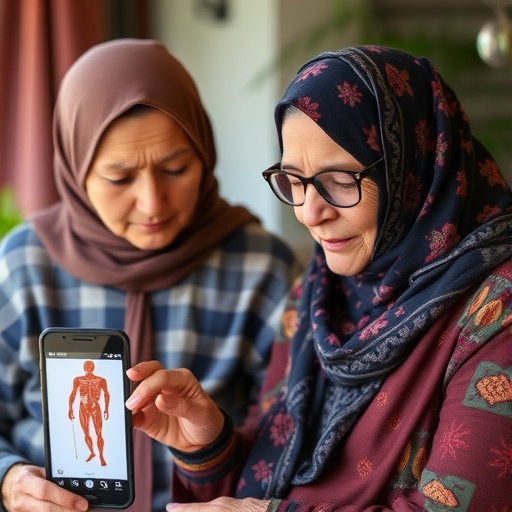
Mobile health applications promise to transform the way older adults manage chronic disease, yet a persistent puzzle has haunted digital health researchers for years: why do so many seniors abandon these tools almost as soon as they download them? Studies suggest that up to 43 percent of adults aged 70 and older stop using mobile health applications within the first two weeks, often citing poor usability and designs that seem to ignore the realities of aging eyes, hands, and digital experience. Now, an international team of researchers has taken a substantial step toward solving this problem for one of the most underappreciated chronic diseases of aging: osteoporosis. In a study published in Archives of Osteoporosis, investigators led by Golaleh Karbasi of the Malaysian Research Institute on Ageing at Universiti Putra Malaysia, together with colleagues from Iran and Malaysia, developed and validated a culturally adapted Persian-language questionnaire designed to measure exactly what determines whether Iranian adults over 50 will embrace mobile health technology for bone health management.
The stakes of the research are considerable. Osteoporosis is the fourth most common chronic disease in older adults, affecting an estimated 200 million people worldwide, and its burden in Iran is particularly heavy. Age-standardized prevalence among Iranians over 60 has been estimated at 24.6 percent in men and a striking 62.7 percent in women. Yet disease-specific knowledge remains limited, and support for self-management is inadequate both in Iran and globally. The research team reasoned that if mobile health tools could support osteoporosis self-management, the first prerequisite would be a rigorous instrument to measure adoption determinants in the local language and cultural context. Prior instruments, they noted, have mostly focused on app usability rather than the broader behavioral and psychological factors that shape whether an older adult decides to adopt a health technology in the first place.
The new instrument is firmly anchored in established theory. Its architecture draws on the Unified Theory of Acceptance and Use of Technology, or UTAUT, which proposes that technology acceptance is driven by performance expectancy, effort expectancy, social influence, and facilitating conditions. The researchers layered on the Health Belief Model, capturing perceived susceptibility to osteoporosis complications and perceived severity of outcomes, and then added three constructs that have proven crucial in aging populations: self-efficacy, digital literacy, and technology anxiety. Each construct was operationalized through multiple questionnaire items rated on a five-point Likert scale from strongly disagree to strongly agree, with subscale scores ranging from 1 to 5. For readiness-oriented constructs such as performance expectancy, self-efficacy, and digital literacy, higher scores indicate greater readiness to adopt mobile health, while higher technology anxiety scores reflect greater concern about using technology.
Building the questionnaire was a two-phase endeavor demanding both linguistic precision and statistical rigor. In the first phase, the team followed established ISPOR guidelines for cross-cultural adaptation: two translators produced forward translations from English into Persian, a core team of six faculty members in gerontology, medicine, and public health reached consensus on a single Persian version, and two independent bilingual experts back-translated it to verify conceptual alignment. Face and content validity were then assessed by a panel of six experts, five from Iran and one from Malaysia, who rated each item for relevance and clarity on four-point scales. Agreement was quantified using the Content Validity Index and modified Kappa coefficient, with items retained only if they achieved a CVI of at least 0.80 and Kappa of at least 0.70. Fourteen items failed these thresholds and were removed, spanning constructs from effort expectancy to technology anxiety, and nine more were revised for clarity. Cognitive debriefing with ten older adult volunteers confirmed that nearly all items were well understood; one effort expectancy item was dropped after participants misunderstood it.
The second phase put the surviving 57-item draft through psychometric testing with real respondents. Data were collected between February and April 2023 from Iranian community-dwelling adults aged 50 and older, using both online and in-person administration. The sample was split into two datasets: the first, comprising 111 respondents, was used for exploratory factor analysis, while a larger dataset of 500 participants supported confirmatory factor analysis conducted in SmartPLS version 4. In the exploratory stage, sampling adequacy was verified with the Kaiser–Meyer–Olkin test, with values ranging from 0.731 to 0.899 across construct blocks, and Bartlett’s tests of sphericity were significant in every case. Using principal component analysis with Varimax rotation, the team retained factors based on eigenvalues greater than 1.0, inspection of the scree plot, and conceptual interpretability, while removing any item with a communality below 0.30 or a factor loading below 0.50.
The factor analyses revealed a coherent structure. Within the UTAUT block, five components emerged, with performance expectancy alone accounting for 45.58 percent of the variance, followed by intention to adopt at 11.77 percent, social influence at 9.11 percent, effort expectancy at 6.65 percent, and facilitating conditions at 5.37 percent. The Health Belief Model items resolved into two clean factors: perceived susceptibility, explaining 38.11 percent of variance, and perceived severity, explaining 24.06 percent. Self-efficacy formed a single factor explaining 57.02 percent of variance after one weakly loading item was discarded. Digital literacy, measured by 11 items, initially split into two components, but two items compromised unidimensionality and were removed, leaving a robust nine-item solution that explained 72.32 percent of the variance. Technology anxiety proved more complicated: the seven items initially suggested two subdimensions, general anxiety and specific concerns such as privacy and errors, but confirmatory factor analysis in the larger sample showed substantial overlap and insufficient discriminant validity, so the researchers merged them into a single second-order construct in the final measurement model.
The confirmatory stage delivered the strongest evidence for the instrument’s quality. On the second dataset of 500 participants, all item loadings exceeded 0.5, ranging from 0.641 to 0.928, with a single exception that was excluded. Average variance extracted, a measure of convergent validity indicating how much variance a construct captures relative to measurement error, ranged from 0.608 to 0.833, comfortably above the 0.50 benchmark. Composite reliability ranged from 0.866 to 0.950, and Cronbach’s alpha from 0.781 to 0.938, both indicating strong internal consistency. Discriminant validity, the requirement that constructs be genuinely distinct from one another, was confirmed using the Fornell–Larcker criterion, cross-loadings, and the heterotrait–monotrait ratio. All HTMT values fell below the accepted 0.90 threshold, though the value between effort expectancy and facilitating conditions, at 0.829, came close, and digital literacy showed a notably high average variance extracted of 0.833 alongside a moderate HTMT correlation of 0.759 with self-efficacy.
Beyond the psychometrics, the study offers a telling portrait of what actually drives digital health engagement among older Iranians. Performance expectancy, self-efficacy, digital literacy, and perceived severity emerged as the key determinants of mHealth adoption. Perhaps more interesting are the constructs that played a smaller role than theory would predict. Social influence, often a strong predictor in collectivist societies, showed a limited role here, which the authors attribute to the fact that family members and healthcare providers in Iran have not yet actively promoted digital health solutions for osteoporosis. Similarly, facilitating conditions appeared less critical, possibly because growing smartphone penetration in urban Tehran has reduced infrastructure barriers, and technology anxiety may fade when younger relatives assist older users, a common pattern of intergenerational support. Gender differences also surfaced: male participants, who made up 62.16 percent of the exploratory sample, rated mHealth tools as more useful for managing osteoporosis, echoing findings from studies in Bangladesh and Malaysia. Criterion validity testing against the well-established eHealth Literacy Scale showed significant positive correlations for 25 of the 54 final items, concentrated in performance expectancy, social influence, effort expectancy, self-efficacy, and digital literacy.
The clinical and policy implications could extend well beyond osteoporosis. The authors suggest that clinicians could administer the questionnaire before enrolling older adults in a mobile health program, identifying individuals at risk of low digital engagement and offering pre-intervention support in digital literacy or self-efficacy training. At the policy level, the instrument could help map readiness gaps among aging populations and guide national digital health strategies, informing the design of user-friendly platforms and educational programs focused on bone health. Such applications are especially relevant in resource-limited settings, where cost, staffing shortages, and mobility problems often keep older adults from accessing conventional care, and where the World Health Organization reports that roughly 90 percent of people worldwide nonetheless have access to wireless and mobile devices. With more than 350,000 health apps now available, understanding who will and will not adopt them has become a central question for health systems worldwide.
The study is not without limitations. Its cross-sectional design cannot establish causal relationships among the constructs, and although Tehran’s population is relatively diverse, findings may not generalize to older adults in rural or less technologically developed regions. The measures were self-reported, introducing the possibility of response bias, and the study captured intention to adopt rather than actual sustained usage behavior. The 54-item length, while comprehensive, may also limit routine clinical use, prompting the authors to propose developing a shortened screening version in future work. Longitudinal studies with larger and more varied samples will be needed to test whether these determinants translate into real-world engagement.
Even so, the validated questionnaire represents a meaningful advance for inclusive digital health. As the population of older adults grows rapidly, particularly in low- and middle-income regions where chronic disease burdens are climbing, tools like this one allow researchers, clinicians, and policymakers to measure precisely where the barriers lie. The message from Tehran is clear: if digital health is to serve the fastest-growing segment of the world’s population, interventions must be culturally tailored and grounded in what older adults actually believe, feel, and can do, rather than in assumptions imported from younger, digitally native cohorts.
Subject of Research: Development and validation of a culturally adapted Persian questionnaire measuring mHealth adoption determinants for osteoporosis management among Iranian older adults aged 50 and above
Subject of Research: Medicine
Article Title: Validation of an mHealth adoption questionnaire for osteoporosis management in Iranian older adults at risk
Article References: Karbasi, G., Ahmad, S. A., Moradi, G., Danaee, M., Ishak, N. H., Kunasekaran, P., & Mohtar, M. N. (2026). Validation of an mHealth adoption questionnaire for osteoporosis management in Iranian older adults at risk. Archives of Osteoporosis, 21(1), Article 103. https://doi.org/10.1007/s11657-026-01741-6
Image Credits: AI Generated
DOI: 10.1007/s11657-026-01741-6
Keywords: mHealth adoption, Osteoporosis, Questionnaire validation, Older adults, Digital literacy, Self-efficacy, UTAUT, Health Belief Model, Technology anxiety, Cross-cultural adaptation, Psychometric validation
Cite Scienmag News
APA MLA Chicago
Beatrice Stafford. (September 10, 2026). Validated questionnaire measures mobile health adoption for osteoporosis care in older Iranians. Scienmag. https://scienmag.com/validated-questionnaire-measures-mobile-health-adoption-for-osteoporosis-care-in-older-iranians/
Beatrice Stafford. “Validated questionnaire measures mobile health adoption for osteoporosis care in older Iranians.” Scienmag, 10 September 2026, https://scienmag.com/validated-questionnaire-measures-mobile-health-adoption-for-osteoporosis-care-in-older-iranians/. Accessed 10 September 2026.
Beatrice Stafford. “Validated questionnaire measures mobile health adoption for osteoporosis care in older Iranians.” Scienmag. September 10, 2026. https://scienmag.com/validated-questionnaire-measures-mobile-health-adoption-for-osteoporosis-care-in-older-iranians/
Copy citation Download RIS
Tags: aging and digital health accessibilityaging and technology acceptancebarriers to mobile health use among seniorschronic disease management in older Iranianschronic disease management through mobile appsculturally adapted health questionnairesdigital health barriers for seniorsdigital health usability for aging populationsgeriatric digital health interventionshealth behavior measurement in aging populationshealth technology validation in diverse populationsinternational collaboration in mHealth researchMobile health adoption in older adultsmobile health application abandonment factorsosteoporosis management in Iranosteoporosis management in seniorsosteoporosis prevalence in IranPersian-language mHealth assessment toolstechnology acceptance among older populationsusability challenges in digital health for seniorsvalidation of health assessment tools