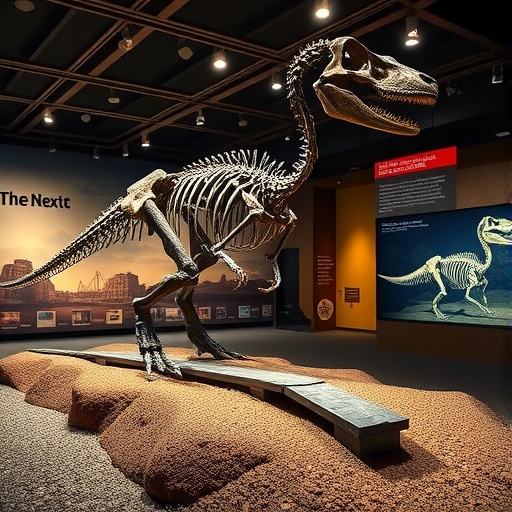
In a discovery that reads like the closing frames of a blockbuster film, scientists have documented what they believe is the first-ever trackway left by an adult Tyrannosaurus rex — a sequence of colossal, three-toed footprints pressed into mud roughly 66.5 million years ago, in the final twilight of the dinosaurs’ reign.
The trackway, described this week in the Journal of Vertebrate Paleontology by researchers from the Denver Museum of Nature & Science and Liverpool John Moores University, stretches approximately 23 feet across the landscape of the Hell Creek Formation in southwestern North Dakota. It consists of four footprints, each measuring roughly three feet in length, arranged in an alternating pattern of two left and two right steps that together capture a single, unhurried walk by one of the largest predatory animals ever to roam North America.
While isolated footprints attributed to adult T. rex have surfaced before, paleontologists have never before described a sequence of tracks — a trackway — likely made by this most iconic of carnivores. The distinction matters more than it might seem. A single footprint records that an animal stood somewhere, once. A trackway records behavior: how the animal moved, how fast, and in what direction. It transforms a static fossil record into a brief, frozen moment of life.
“Bones tell us an enormous amount about these animals, but footprints capture a moment of behavior,” said Tyler Lyson, senior curator of vertebrate paleontology at the Denver Museum of Nature & Science, who led the fieldwork. “With a trackway, we can actually follow an animal as it moved across the landscape. That is incredibly rare for T. rex.”
The footprints were found in 2025 on federal land administered by the U.S. Forest Service near the small town of Marmarth, North Dakota, a locale that has become one of the most productive windows into the final chapters of the Cretaceous period. The Hell Creek Formation preserves ecosystems from the very end of the age of dinosaurs, ending at the boundary marked by the asteroid impact 66 million years ago that wiped out all non-avian dinosaurs. The trackway’s age — approximately 66.5 million years — places it just a geological heartbeat before that catastrophe.
Identifying the trackmaker required careful inference, because footprints do not come with name tags. The research team, led by Peter Falkingham, a professor of palaeobiology at Liverpool John Moores University and a specialist in dinosaur tracks, based their attribution on a convergence of evidence. First, there is sheer size: footprints three feet long belong to a very large animal, and in the Hell Creek ecosystem only one animal of that scale fits the profile of a large, bipedal, three-toed theropod. Second, the prints display the narrow, slender shape of the toes characteristic of tyrannosaurs, distinguishing them from the broader, blunter prints that might be expected from other large animals. Third, and perhaps most practically, T. rex fossils are abundantly represented in the surrounding rock units, making it by far the most plausible candidate for a giant predatory dinosaur walking through the region at that time.
The stride preserved in the trackway tells its own story. The distance between successive footprints of the trackway measures approximately 13 feet, a spacing that allowed the researchers to estimate the animal’s speed of travel. Their calculation suggests the T. rex was walking at roughly 3.5 to 4.5 miles per hour — a pace that would feel familiar to any human on a brisk walk. There is something almost disarming in that image: the most fearsome predator of its world, a six-ton carnivore, plodding across a floodplain at a speed a commuter could match on foot, presumably with no particular urgency, in a world that still belonged entirely to it.
The researchers caution that the speed estimate carries caveats. The footprints are heavily weathered, their edges softened and blurred by the tens of millions of years that elapsed between the animal’s passage and its discovery. Weathering degrades the precision of the measurements that feed into stride-based speed calculations, so the figures should be understood as approximate rather than exact. Even so, the general picture — a slow walk rather than a run — is consistent with what trackways of other large theropods have suggested: that these animals, like most large animals today, spent the majority of their time moving at economical walking speeds.
The discovery itself carries a story of everyday curiosity rewarded. Kent M. Hups, a teacher at Northglenn High School in Colorado and a co-author of the study, came across the site during fieldwork. “As a teacher, I’m always telling my students that science starts with curiosity, passion and careful observation,” Hups said. “I never imagined that could lead me to a discovery like this.” His find now stands alongside the most significant trace-fossil discoveries of the decade, a reminder that major paleontological breakthroughs still hinge on sharp eyes in the field.
Documentation of the site relied on modern digital techniques that have transformed how paleontologists study trace fossils. Evan Tamez-Galvan of the Denver Museum conducted high-resolution 3D surface scanning of each footprint and the full trackway, producing detailed digital models that preserve the geometry of the tracks regardless of what happens to the original site, which sits on exposed rock subject to erosion and weather.
In a striking illustration of how those tools are reshaping the discipline, Falkingham — the study’s lead author — never saw the tracks in person. Working an ocean away in England, he analyzed the scans transmitted from North Dakota, visualizing the data on his computer and in virtual reality. “The technology we’re able to apply in the digital age means my colleagues could scan the tracks in the field and then send the 3D information over to me to visualize on my computer and in VR, enabling me to take as close a look as they did in person,” he said. The digital models also make it possible to produce physical 3D reproductions of the footprints, meaning that researchers, students and museum visitors will be able to study and handle replicas of prints that no human eye saw being made.
The collaboration across continents and the participation of a high school teacher underscore a broader truth about modern paleontology: discovery is increasingly distributed, with digital data flowing across borders and contributions coming from beyond the walls of universities. Alongside Lyson, Falkingham, Hups and Tamez-Galvan, the research team included Antoine Bercovici of the Denver Museum.
The physical tracks themselves are not staying in the badlands indefinitely. Three of the four footprints are expected to be recovered by helicopter this fall — an operation necessitated by the scale and weight of the rock blocks containing the prints — and transported to the Denver Museum of Nature & Science, where they will eventually be available for study and display. The museum plans to share updates on the recovery with guests this winter, offering the public a rare, real-time glimpse of a paleontological rescue operation.
The scientific significance of the find extends beyond its celebrity trackmaker. Trackways offer data that skeletal remains cannot: locomotion, gait, speed, and sometimes evidence of social behavior when multiple animals leave tracks together. For T. rex, a genus known overwhelmingly from bones and teeth, the addition of a locomotor record is a rare and valuable data point in long-running debates about how these animals moved, hunted, and lived. Every well-documented trackway helps constrain reconstructions of theropod biomechanics, informing models of posture, weight distribution and gait that currently rely heavily on skeletal anatomy and engineering inference.
It also speaks to the unmatched fossil record of the Hell Creek Formation, where dense sampling of the final million years of the Cretaceous has produced not only skeletons but the traces of living behavior. That a 66.5-million-year-old walk by the world’s most famous dinosaur survived weathering, erosion, burial and uplift to be spotted by a schoolteacher on a hillside in North Dakota is itself a story about the improbable persistence of evidence — and about the moment a moment in deep time becomes, once again, something we can follow.
Subject of Research: Animals
Subject of Research: Biology
Article Title: A LARGE TRIDACTYL TRACKWAY FROM THE UPPER CRETACEOUS HELL CREEK FORMATION OF NORTH DAKOTA, LIKELY ATTRIBUTABLE TO AN ADULT TYRANNOSAURUS REX
Article References: Falkingham, P. L., Hups, K. M., Tamez-Galvan, E. M., Bercovici, A. D., & Lyson, T. R. (2026). A large tridactyl trackway from the Upper Cretaceous Hell Creek Formation of North Dakota, likely attributable to an adult Tyrannosaurus rex. Journal of Vertebrate Paleontology, Article e2706201. https://doi.org/10.1080/02724634.2026.2706201
Image Credits: AI Generated
DOI: 10.1080/02724634.2026.2706201
Keywords: Tyrannosaurus rex, trackway, footprints, Hell Creek Formation, North Dakota, paleontology, dinosaur tracks, 3D scanning, Journal of Vertebrate Paleontology, Cretaceous, locomotion, Denver Museum of Nature & Science
Cite Scienmag News
APA MLA Chicago
Drew Townsend. (September 8, 2026). Denver museum uncovers first adult T. rex trackway ever found. Scienmag. https://scienmag.com/denver-museum-uncovers-first-adult-t-rex-trackway-ever-found/
Drew Townsend. “Denver museum uncovers first adult T. rex trackway ever found.” Scienmag, 8 September 2026, https://scienmag.com/denver-museum-uncovers-first-adult-t-rex-trackway-ever-found/. Accessed 8 September 2026.
Drew Townsend. “Denver museum uncovers first adult T. rex trackway ever found.” Scienmag. September 8, 2026. https://scienmag.com/denver-museum-uncovers-first-adult-t-rex-trackway-ever-found/
Copy citation Download RIS
Tags: adult dinosaur footprintsadult Tyrannosaurus rex footprintsdinosaur behavior reconstructiondinosaur locomotion researchdinosaur trackway analysisdinosaur trackway significancefirst T. rex track sequencefossilized dinosaur footprintsfossilized dinosaur movement patternsHell Creek Formation fossil findHell Creek Formation fossilsimplications for dinosaur biomechanicsJurassic period dinosaur evidencelarge predator trackslate Cretaceous dinosaur tracksNorth Dakota dinosaur discoveriesNorth Dakota paleontology discoverypaleontology research on T. rexprehistoric predator movementT. rex trackway discoveryTyrannosaurus rex behavior studyTyrannosaurus rex locomotion