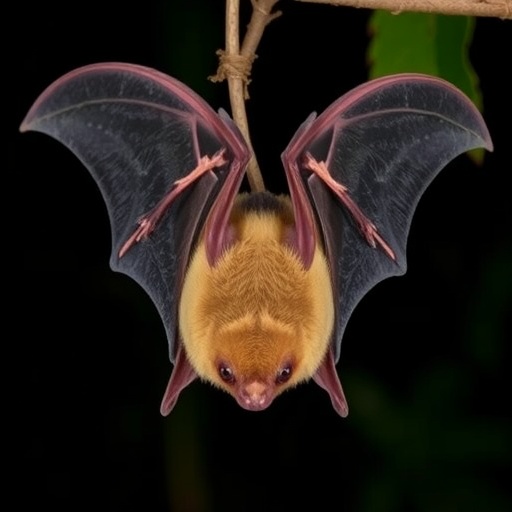
In the shadowed forest fragments threading through the city of Rio Branco, in the western Brazilian Amazon, a team of Brazilian researchers has quietly uncovered evidence of parasitic roundworms circulating in the blood of urban bats — including one lineage so genetically distinct that it may represent a genus, or even a species, never before characterized by science. The study, published in the journal Acta Parasitologica, combined classical parasitology with DNA barcoding to probe the hidden world of filarioid nematodes, a group of threadlike parasites that includes some of medicine’s most notorious worms. What the researchers found in just ninety bats offers a striking glimpse of how much parasite diversity remains undocumented even in the middle of a growing Amazonian city, and why urban wildlife deserves a place on the map of infectious disease surveillance.
Filarioid nematodes of the family Onchocercidae are a biologically remarkable group. They are the worms responsible for human diseases such as onchocerciasis — river blindness — and lymphatic filariasis, but the vast majority of described species infect wildlife, particularly mammals, and circulate in obscurity. These parasites rely on arthropod vectors such as mites, mosquitoes, and flies to move between hosts, and their microscopic larvae, called microfilariae, swim in the bloodstream of infected animals awaiting pickup by a feeding vector. In bats, two genera dominate the known records: Litomosa and Litomosoides, whose adults typically dwell in the thoracic and abdominal cavities of their mammalian hosts. Despite their prevalence, the diversity, host specificity, and geographic ranges of bat-associated filarioids remain poorly resolved, and tropical ecosystems — the Amazon above all — are among the most under-sampled regions on Earth for these parasites.
The motivation for the new survey stemmed from a growing recognition that environmental change in the Amazon is reshaping the contact patterns between wildlife hosts and the vectors that carry their parasites. Deforestation and fragmentation alter bat–ectoparasite interactions, while urbanization restructures entire bat assemblages. Because recent reports have documented Litomosoides microfilariae in urban bats and their ectoparasites — including mites and bat flies — the research team, led by Jhonatan Henrique Lima da Rocha and colleagues at institutions including the Federal University of Acre, argued that urban and peri-urban forest fragments are not ecological backwaters but genuine hotspots worth surveying. Brazil, after all, harbors one of the richest bat faunas in the world, with 186 recognized species across nine families, and the Brazilian Amazon alone accounts for 144 of those species across 63 genera.
Between December 2022 and October 2023, the team worked five forest fragments scattered across urban and peri-urban Rio Branco, deploying seven mist nets — each measuring twelve meters by two and a half meters — at sunset and keeping them open for six hours per night. The nets were inspected every thirty minutes to minimize stress and prevent prolonged entanglement, a welfare consideration codified in the study’s ethical approvals from the Brazilian Biodiversity Authorization and Information System and the Federal University of Acre’s Animal Use Ethics Committee. Captured bats were placed in clean cotton bags, measured, and identified to species using morphological and morphometric taxonomic keys for Neotropical bats. In total, the effort yielded ninety bats representing twenty species, thirteen genera, and four families — a respectable sample of the chiropteran diversity that persists within the city’s green fabric.
Blood collection was carried out under full anesthesia. Each bat was sedated with intramuscular ketamine hydrochloride at a dose of 50 milligrams per kilogram, and once an adequate anesthetic plane was confirmed, blood was drawn by cardiac puncture using sterile one-milliliter syringes, with up to one milliliter collected per individual when feasible. The blood was immediately transferred to tubes containing the anticoagulant K₂-EDTA to prevent clotting. Screening for microfilariae then proceeded along two independent classical routes. First, thin blood smears were stained with a rapid Romanowsky-type stain and scanned systematically under light microscopy at 40× and 100× magnification. Second, the researchers used the microhematocrit — or Woo — method, in which blood loaded into capillary tubes is centrifuged and the layer adjacent to the buffy coat, where parasite density concentrates, is examined microscopically. Using both techniques in parallel increases sensitivity, since microfilariae can appear sporadically in peripheral blood.
The microscopic screen returned positives in only two of the ninety bats, a prevalence of 2.2 percent. One infected animal was Artibeus planirostris, a common frugivorous bat in the family Phyllostomidae and a recurrent host for Litomosoides in earlier studies. The other was Tonatia maresi, an insectivorous species whose filarioid infections had been far less frequently documented. Sample identifiers UDV06 and HF17 were assigned to these two infections, and both proceeded to the molecular stage of the investigation — where the real surprises awaited.
For molecular detection, genomic DNA was extracted from whole blood using a phenol-free in-house protocol involving lysis with 20 percent sodium dodecyl sulfate at 65 degrees Celsius, organic extraction with chloroform, protein precipitation, and ethanol-based DNA recovery. The team then amplified an approximately 330-base-pair fragment of the mitochondrial 12S ribosomal RNA gene, a workhorse marker for filarioid nematode identification, using the primer pair Fila12S-F and Fila12S-R originally described by Otranto and colleagues. Polymerase chain reaction cycling involved an initial denaturation at 95 degrees Celsius for three minutes, thirty-five cycles of denaturation, annealing at 60 degrees Celsius, and extension at 72 degrees Celsius, followed by a final extension. Amplicons were visualized on two percent agarose gels, purified with ExoSAP-IT, quantified by spectrophotometry, and sequenced bidirectionally by Sanger chemistry on an ABI PRISM genetic analyzer. After quality trimming and assembly in Geneious Prime, two consensus sequences emerged: Contig-UDV 06, 324 base pairs long, from A. planirostris, and Contig-HF 17, 323 base pairs long, from T. maresi. Both were deposited in GenBank.
To assign taxonomic identities, the researchers queried each sequence against the NCBI nucleotide collection using BLASTn, and simultaneously built a comparative dataset of eighteen 12S rRNA sequences representing Litomosoides species and related filarial taxa, including Litomosa chiropterorum, with Acanthocheilonema reconditum serving as the outgroup. Sequences were aligned in MEGA v12 using ClustalW, trimmed to remove poorly aligned terminal regions, and standardized to 300 nucleotide positions. Pairwise divergence was estimated using the p-distance model, and evolutionary relationships were inferred by maximum-likelihood phylogenetics under the HKY plus gamma model of nucleotide substitution, with node support assessed through 1,000 bootstrap replicates.
The results split cleanly into two stories. The sequence from Artibeus planirostris, UDV06, showed approximately 98 to 99 percent nucleotide identity to known Litomosoides sequences in the database, with complete query coverage and low divergence, and it clustered firmly within the Litomosoides clade in the phylogenetic tree. This allowed the team to assign it conservatively to the genus Litomosoides, adding a molecularly confirmed record from the western Brazilian Amazon. The second sequence, HF17, told a very different tale. It shared only about 87 to 88 percent identity with the nearest available Litomosoides sequences — a gap far too wide to justify genus-level assignment, given that congeneric filarioids typically diverge by only a few percent at this marker — and its phylogenetic position was markedly separated from known lineages. The researchers concluded that HF17 represents an unresolved member of the family Onchocercidae: a filarioid lineage likely new at some taxonomic level, but one that cannot be responsibly named on 12S data alone.
That caveat points to the study’s central methodological lesson. Mitochondrial 12S rRNA is powerful for detecting filarioid DNA and placing sequences in a family context, but resolving genus and species boundaries demands additional markers, particularly the mitochondrial cytochrome c oxidase subunit I gene — the standard animal DNA barcode — and complementary nuclear loci. The team’s recommendation is straightforward: integrative approaches combining morphology of adult worms, multiple genetic markers, and host and vector data are needed to turn cryptic sequence variants into formally described biodiversity. In the meantime, both sequences are publicly available in GenBank, providing reference points for future surveys across the Neotropics.
The broader significance of the work extends beyond taxonomy. Rio Branco’s forest fragments are precisely the kind of modified landscapes where host–vector–parasite dynamics are being rewritten, and the detection of a highly divergent filarioid lineage within a city’s boundaries is a reminder that parasite diversity does not vanish with urbanization — it persists, often unseen, in resilient wildlife reservoirs such as bats. Because some filarioids are capable of host-switching, and because vectors such as dermanyssoid mites thrive in bat roosts that increasingly abut human dwellings, baseline surveys like this one serve as early-warning infrastructure. The 2.2 percent prevalence recorded here is low, but the genetic novelty embedded in that small number suggests that the true filarioid diversity of Amazonian bats — urban, peri-urban, and deep-forest alike — is only beginning to come into focus.
Subject of Research: Molecular detection and characterization of filarioid nematodes (Onchocercidae) in bats from urban and peri-urban forest fragments in Rio Branco, Acre, western Brazilian Amazon
Subject of Research: Biology
Article Title: Molecular Detection of Filarioid Nematodes in Bats from the Western Brazilian Amazon
Article References: da Rocha, J. H. L., dos Santos, P. Z. L., de Araújo, C. S., Reckziegel, G. H., da Silva, D. K. A., Veras, L. K. T., de Aguiar Silva, S. C., Luz, S. L. B., & da Silva, T. I. B. (2026). Molecular Detection of Filarioid Nematodes in Bats from the Western Brazilian Amazon. Acta Parasitologica, 71(5), Article 198. https://doi.org/10.1007/s11686-026-01398-8
Image Credits: AI Generated
DOI: 10.1007/s11686-026-01398-8
Keywords: filarioid nematodes, Onchocercidae, Litomosoides, bats, Amazon, Rio Branco, Acre, 12S rRNA, microfilariae, molecular detection
Cite Scienmag News
APA MLA Chicago
Margaret Porter. (September 8, 2026). Filarioid Nematodes Detected Molecularly in Western Amazonian Bats. Scienmag. https://scienmag.com/filarioid-nematodes-detected-molecularly-in-western-amazonian-bats/
Margaret Porter. “Filarioid Nematodes Detected Molecularly in Western Amazonian Bats.” Scienmag, 8 September 2026, https://scienmag.com/filarioid-nematodes-detected-molecularly-in-western-amazonian-bats/. Accessed 8 September 2026.
Margaret Porter. “Filarioid Nematodes Detected Molecularly in Western Amazonian Bats.” Scienmag. September 8, 2026. https://scienmag.com/filarioid-nematodes-detected-molecularly-in-western-amazonian-bats/
Copy citation Download RIS
Tags: Amazonian urban ecology and parasitesbiodiversity of parasites in Brazilian Amazondiscovery of new parasite lineagesDNA barcoding in parasitologyDNA barcoding of filarioidsfilarial nematodes and disease transmissionFilarioid nematodes in Amazonian batsmolecular detection of parasitic wormsnovel parasite lineages in BrazilOnchocercidae family in mammalsOnchocercidae family parasitesparasite diversity in Brazilian Amazonparasitic diversity in Amazon rainforestparasitic roundworms in batsurban wildlife parasitologyvector-borne parasitic infectionsvector-borne parasitic wormswildlife disease surveillance in urban areaswildlife infectious disease surveillancezoonotic potential of filarioid worms