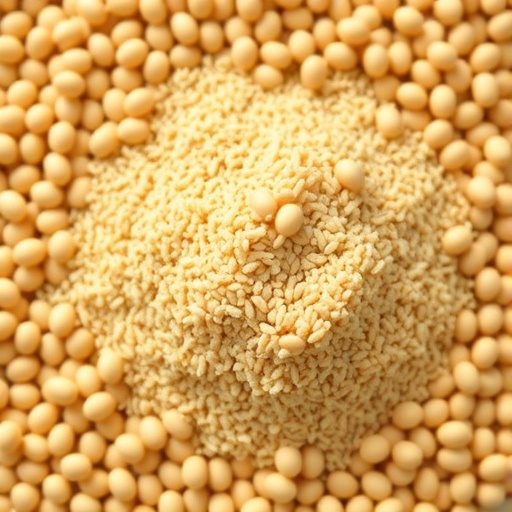
Soybean meal, the protein-rich byproduct left behind after soybean oil extraction, has long occupied an awkward position in the global food system. It is abundant, with worldwide production exceeding 250 million metric tons annually, and its amino acid profile is respectable. Yet the vast majority of this material is consigned to animal feed at low value, because its proteins are locked inside structurally rigid storage bodies that digestive enzymes struggle to penetrate, and because the meal harbors anti-nutritional factors such as trypsin inhibitors, antigenic proteins, and non-starch polysaccharides that blunt digestibility. A new open-access study published in Food Chemistry: X now offers a detailed molecular account of how three bacterial strains can dismantle these barriers, transforming soybean meal into a nutritionally superior ingredient with markedly enhanced bioactivity. The research, led by Xiaoyan Zhu and colleagues, demonstrates that solid-state fermentation with carefully selected Bacillus species can increase soluble protein content nearly sevenfold, cut trypsin inhibitor activity by more than 90 percent, and elevate essential amino acid levels to degrees rarely reported in the literature.
The research team worked with three laboratory strains, Bacillus subtilis Z1, Bacillus velezensis Z2, and Bacillus amyloliquefaciens Z3, which had been isolated and characterized in earlier work on rapeseed meal and palm kernel meal. Each strain was screened first for proteolytic activity on skim milk agar and then for its ability to boost peptide content in fermented soybean meal. For the fermentation itself, bacterial cells were grown overnight, harvested by centrifugation, washed, and resuspended to a concentration of 10^8 colony-forming units per milliliter. This suspension was inoculated into fresh soybean meal at an initial density of 10^7 CFU per gram of dry substrate, with moisture adjusted to 50 percent, and incubated at 37 degrees Celsius for just 24 hours. The choice of solid-state fermentation over submerged approaches is deliberate and carries practical weight. It requires less water, less energy, and simpler equipment, while also minimizing foam formation and improving oxygen transfer. The researchers note that previous comparative analyses have shown solid-state fermentation to outperform physical, chemical, enzymatic, and submerged methods for protein recovery from related substrates, underscoring its economic and environmental advantages.
The results of this single day of microbial activity were striking. Soluble protein content, measured with a bicinchoninic acid assay and expressed per gram of dry weight, rose from 50.38 milligrams per gram in unfermented meal to 347.63 milligrams per gram in material fermented with B. velezensis Z2, a 6.90-fold increase. Fermentation with B. amyloliquefaciens Z3 and B. subtilis Z1 yielded values of 306.77 and 296.22 milligrams per gram, corresponding to 6.09-fold and 5.88-fold increases. Peptide content followed a similar trajectory, reaching 149.38, 171.61, and 181.35 milligrams per gram in the three fermented products, which represents 5.22-, 5.99-, and 6.33-fold increases over the starting material. Alpha-amino nitrogen, a classical indicator of protein hydrolysis, climbed from a mere 0.08 percent in raw meal to 1.02, 1.56, and 1.96 percent, representing increases of 12.72, 19.54, and 24.54 times respectively, with the B. amyloliquefaciens Z3 product showing the strongest proteolytic conversion. Total free amino acids, measured by high-performance liquid chromatography, surged from 290.59 milligrams per 100 grams to as much as 3496.26 milligrams per 100 grams, a twelvefold increase achieved by the B. velezensis Z2 fermentation.
Perhaps most consequential for nutritional applications was the reshaping of the essential amino acid profile. The proportion of essential amino acids among total free amino acids rose from 17.38 percent in raw soybean meal to 33.84, 29.27, and 47.52 percent in the three fermented products, with the B. amyloliquefaciens Z3 material achieving a 173.42 percent relative increase. Absolute essential amino acid content climbed from 50.51 milligrams per 100 grams to as much as 1314.37 milligrams per 100 grams. Lysine, methionine, and leucine, three amino acids that limit protein quality in many plant-based foods, were enriched 30- to 63-fold depending on strain and amino acid. Glycine and proline showed even more dramatic elevations, exceeding fiftyfold in some cases. Principal component analysis of the amino acid data revealed tight clustering by treatment, with the total variance explained reaching 98.1 percent for non-essential and 90.3 percent for essential amino acids, confirming that the choice of Bacillus strain was the primary determinant of the resulting profile. Given that commercial essential amino acid supplements can cost upward of 8500 dollars per ton, the fermented meal represents a cost-effective alternative source of highly digestible nitrogen for both human and animal nutrition.
Structural analysis illuminated the mechanism behind these transformations. Sodium dodecyl sulfate polyacrylamide gel electrophoresis revealed that the characteristic bands of β-conglycinin, with subunits at approximately 76, 72, and 53 kilodaltons, and of glycinin, with acidic and basic subunits near 37 and 20 kilodaltons, were markedly weakened or nearly disappeared after fermentation. The 30-kilodalton allergen Gly m Bd 30, one of the major soybean allergens, also faded dramatically. In its place, the low-molecular-weight region below 25 kilodaltons filled with intense, diffuse smearing, indicating extensive hydrolysis into small peptides and free amino acids. Fourier transform infrared spectroscopy added complementary evidence at the level of protein secondary structure. The amide I band, sensitive to hydrogen bonding and backbone conformation, shifted from 1651.49 per centimeter in raw meal to lower wavenumbers in all fermented samples, and deconvolution showed that β-sheet content, the most ordered and enzymatically resistant secondary structure, fell from 47.74 percent to between 37.38 and 41.86 percent. Corresponding increases in α-helix, β-turn, and random coil content signal a progressive loosening of the protein network into more accessible, disordered conformations.
High-performance size-exclusion chromatography tracked the shift in peptide molecular weight distribution with precision. In phosphate buffer extracts, the fraction of peptides between 0.2 and 2 kilodaltons rose from 26.37 percent in raw meal to 42.19, 46.96, and 47.40 percent in the three fermented products, while the proportion of large fractions above 3 kilodaltons declined. This matters because peptides below 3 kilodaltons are consistently associated with enhanced bioactivity, including antioxidant and angiotensin-converting enzyme inhibitory effects, and with improved absorption efficiency in biological systems. The differences observed between phosphate buffer and distilled water extracts also highlighted that extraction strategy itself shapes the recoverable peptide profile, a practical consideration for manufacturers seeking specific functional fractions.
Beyond protein chemistry, the fermentation fundamentally altered the nutritional composition of the meal. Crude protein increased from 43.44 percent to as high as 52.68 percent, while crude fat simultaneously dropped from 8.58 percent to as low as 2.26 percent, a pattern consistent with lipid metabolites being diverted into microbial protein synthesis. Crude fiber, a major contributor to poor digestibility in monogastric animals, was reduced by 76.35, 83.95, and 27.70 percent in the three fermented products, an outcome the researchers attribute to the secretion of cellulases, xylanases, and mannanases that disrupt the structural polysaccharide matrix. Total phenolic content, which reflects the release of bound phenolics from cell wall complexes, increased roughly sixfold, and total flavonoid content rose by 59 to 86 percent. Trypsin inhibitor activity, the anti-nutritional factor that most directly limits soybean protein utilization, plummeted from 11.08 milligrams per gram to just 0.91 milligrams per gram in the B. amyloliquefaciens Z3 product, a reduction of 91.82 percent.
Functional bioactivity measurements confirmed that these compositional changes translate into tangible physiological potential. DPPH radical scavenging activity of aqueous extracts rose from 20.88 percent in raw meal to between 48.47 and 64.04 percent after fermentation, while ferric reducing antioxidant power increased approximately three- to fourfold across both aqueous and ethanolic fractions. Metal chelation assays revealed that calcium-binding activity reached 82.23 milligrams per gram in the B. velezensis Z2 product, 2.92 times that of raw meal, and iron-binding capacity also improved significantly across all treatments. These activities are attributed to the liberation of low-molecular-weight peptides bearing amino and carboxyl groups that coordinate divalent metal ions, thereby inhibiting metal-catalyzed oxidation. Even the physical functional properties improved, with water holding capacity rising from 3.86 to as high as 6.56 grams per gram, and oil absorption capacity climbing from 3.55 to 6.28 grams per gram, changes that carry direct relevance for food formulation and texture engineering.
Correlation analysis wove these threads together, revealing that peptide content, free amino acid levels, and low-molecular-weight peptide fractions were strongly and positively associated with antioxidant activity and metal chelation, with correlation coefficients frequently exceeding 0.95. Conversely, β-sheet content showed strong negative correlations with soluble protein, free amino acids, and calcium chelation, suggesting that the compact ordered structure of native soybean proteins actively constrains enzymatic accessibility and functional group exposure. The study thereby builds a coherent mechanistic narrative, in which microbial enzymes break down the physical and chemical barriers of the soybean meal matrix, releasing bioavailable nutrients and bioactive compounds in the process. The researchers conclude that solid-state fermentation with these three Bacillus strains offers a feasible, efficient, and strain-selectable strategy for converting a low-value agricultural byproduct into a value-added ingredient suitable for both food and feed applications, providing a theoretical and practical foundation for future development of fermented plant protein products.
Subject of Research: Solid-state fermentation of soybean meal with Bacillus subtilis Z1, Bacillus velezensis Z2, and Bacillus amyloliquefaciens Z3 to enhance protein hydrolysis, nutritional quality, and bioactivity.
Subject of Research: Chemistry
Article Title: Value-adding soybean meal via solid-state fermentation with Bacillus species: Protein hydrolysis, nutritional enhancement, and bioactivity improvement
Article References: Zhu, X., Lv, L., Wang, Q., Shi, X., Ouyang, B., Zhou, J., Jin, S., He, S., & Li, X. (2026). Value-adding soybean meal via solid-state fermentation with Bacillus species: Protein hydrolysis, nutritional enhancement, and bioactivity improvement. Food Chemistry: X, 39, Article 104323. https://doi.org/10.1016/j.fochx.2026.104323
Image Credits: AI Generated
DOI: 10.1016/j.fochx.2026.104323
Keywords: soybean meal, solid-state fermentation, Bacillus, protein hydrolysis, bioactive peptides, free amino acids, trypsin inhibitors, antioxidant activity, metal chelation, FTIR, nutritional enhancement
Cite Scienmag News
APA MLA Chicago
Bethany Barker. (September 7, 2026). Fermenting soybean meal with Bacillus boosts protein quality and bioactivity. Scienmag. https://scienmag.com/fermenting-soybean-meal-with-bacillus-boosts-protein-quality-and-bioactivity/
Bethany Barker. “Fermenting soybean meal with Bacillus boosts protein quality and bioactivity.” Scienmag, 7 September 2026, https://scienmag.com/fermenting-soybean-meal-with-bacillus-boosts-protein-quality-and-bioactivity/. Accessed 7 September 2026.
Bethany Barker. “Fermenting soybean meal with Bacillus boosts protein quality and bioactivity.” Scienmag. September 7, 2026. https://scienmag.com/fermenting-soybean-meal-with-bacillus-boosts-protein-quality-and-bioactivity/
Copy citation Download RIS
Tags: amino acid profile improvementanti-nutritional factor reductionBacillus speciesbioactive soybean mealmicrobial enzyme applicationmolecular mechanisms of fermentationnutritional quality of soybean productsprotein enhancementsolid state fermentationSoybean meal fermentationsustainable animal feed ingredientstrypsin inhibitor degradation