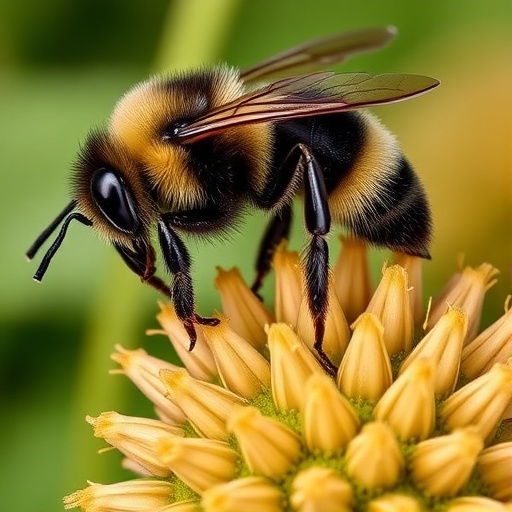
In a finding that overturns a long-standing assumption about who the clever ones are in a bumblebee colony, researchers at the University of Chester and their collaborators have shown that male bumblebees are not the lazy, freeloading drones they are often portrayed to be. When tested in the laboratory, males explored a novel environment far more actively than their female worker nestmates and, more strikingly, outperformed the workers on a classic test of behavioural flexibility. The study, published open access in the journal Animal Cognition, suggests that the solitary life a male leads after leaving the nest places unexpected cognitive demands on him — demands that appear to have shaped his behaviour and his brain.
Bumblebee colonies are famously organised around a division of labour. Female workers do virtually all of the foraging, brood care and nest maintenance, while males, which lack the pollen baskets that workers use to haul food home, contribute almost nothing to colony life before they disperse. Once they leave, however, the picture changes dramatically. Males rarely return to their nest. They become solitary foragers, flying long distances in search of nectar and, above all, in search of queens to mate with. Males of the buff-tailed bumblebee, Bombus terrestris, are known to fly farther and longer than workers, dispersing in effectively random directions from their natal nest and later patrolling fixed scent-marked routes to attract mates. The research team reasoned that this abrupt shift from pampered nest resident to independent explorer should favour individuals that are highly active and quick to change their behaviour when circumstances change.
To test this idea, the team, led by Pizza Ka Yee Chow of the Division of Psychology at the University of Chester, together with Théo Robert, Sophie Donnelly and Kevin D. Hochard, ran a two-part laboratory experiment on 69 individually tagged bees drawn from five commercial colonies. The first task was designed to capture what happens the moment a bee steps out of the nest for the very first time. Each bee was placed alone at one end of a long rectangular “activity box” divided into ten equally sized compartments, its floor covered in a random red-and-white checkerboard pattern to present an unfamiliar visual world. Holes in the dividers, normally blocked by shutters, allowed the bee to wander freely from one compartment to the next. The researchers filmed every session and measured total active time — the sum of the time spent moving in each compartment — as well as the frequency and duration of visits, from the moment the bee’s full body entered the box until it left at the far end. Sessions were terminated if a bee sat motionless for fifteen minutes, and any sucrose the bee drank afterwards was recorded as a check on motivation and thirst.
The results of the activity task were unambiguous. Males spent significantly longer being active in the novel environment than females: the median total active time for males was eleven minutes, roughly double the five-minute median for females, and the variation among males was wider too. Males also lingered longer in each individual compartment, but the detail that caught the researchers’ attention lay in how they used the space. When active time was broken down per visit, males and females turned out to spend comparable amounts of time per stop; the difference came from males simply visiting compartments more often. This pattern — many equally long visits rather than a few prolonged ones — is characteristic of exploratory sampling rather than anxious freezing or aimless high-speed movement, and it aligns neatly with what is known about male dispersal and pre-mating patrolling behaviour in the wild.
Crucially, the sex difference in activity could not be explained away by obvious confounds. Males and females in the sample were statistically indistinguishable in body size, measured as the inter-tegular span between the wing bases with digital callipers, and they consumed comparable amounts of sucrose after the task. Within-sex analyses reinforced the picture: for females, but not males, higher activity was actually associated with drinking less sucrose, hinting at a genuine motivational or temperamental difference in how the two sexes approach novelty rather than a simple energy-driven effect.
The second half of the experiment probed cognition. After a two-session training phase to familiarise the bees with the procedure and confirm their motivation, bees entered a discrimination learning phase in a second ten-compartment box. In each compartment they faced a pair of artificial flowers, one blue and one yellow, presented horizontally on opposite sides to suit the visual processing of walking bumblebees. One colour concealed a tiny drop of 50 percent sucrose solution, less than a millimetre across, so small that a bee had to approach closely and use its antennae to determine what it had found; the other colour held only water. Each bee completed ten such choices per session, with flower positions pseudo-randomised to prevent side biases, and a bee was deemed to have learned the association once it chose correctly in at least eight of ten first choices across two consecutive sessions — a stringent 80 percent criterion. The next day came the real test: in the reversal phase, the reward contingency was flipped, so the colour that had paid off now delivered only water, and vice versa. Success in the reversal phase requires more than learning; it requires inhibiting a previously rewarded habit and updating it, the standard laboratory proxy for behavioural flexibility.
On basic associative learning, the sexes were evenly matched, confirming earlier work by other groups that had found no sex difference in how well male and female bumblebees learn flower colours. Both sexes initially perseverated, overwhelmingly choosing the previously rewarded colour in the first reversal session, and both made more errors in the reversal than in the original learning — evidence that the bees had genuinely acquired the association and were not simply tracking the sugar. But when it came to abandoning the outdated rule, the males pulled ahead. Across the whole cohort, males made significantly fewer errors than females before reaching the reversal criterion, a result that held under several alternative statistical treatments, including analyses restricted to bees meeting the strictest criterion and sensitivity checks excluding an outlier female. The difference again could not be attributed to body size, sucrose consumption or prior activity levels.
The study also revealed subtler patterns within each sex. Among females, those that had been more active in the novelty task made fewer errors during the original learning phase, echoing previous findings linking exploration tendency to learning speed in bumblebee workers — a trait that benefits colonies when workers must quickly exploit newly discovered food sources. Among the females that completed reversal learning, however, larger body size predicted poorer flexibility, which the authors interpret through the lens of division of labour: larger workers tend to invest heavily in learning highly rewarding flowers and may therefore have formed stronger, harder-to-break colour-reward associations. Among males, larger individuals were more likely to persist with the learning task to completion, but no measured factor predicted their reversal performance, suggesting their flexibility advantage may be a general feature of male cognition rather than a by-product of size or appetite.
The authors interpret their findings through the lens of sex-specific selection pressures. For a worker, an error at a flower is cushioned by the safety net of the colony’s stores, and sticking stubbornly to a profitable flower type — the well-documented phenomenon of flower constancy — is often the adaptive strategy. For a male, there is no safety net. A drone that cannot abandon a depleted flower patch, or that fails to update his search image as floral rewards shift, loses both energy and precious mating time. Enhanced flexibility may also mesh with the male’s distinctive reproductive strategy: after dispersing far from the nest, males lay down pheromone marks at scattered locations and patrol them repeatedly, a behaviour that demands both sustained activity and the capacity to adjust to changing conditions. Recent field work, cited by the authors, indicates that male bumblebees do indeed adapt their foraging to environmental conditions to sustain mate-seeking efforts, lending ecological plausibility to the laboratory results.
The findings carry broader implications for a field in which male insects have been chronically understudied. Most research on bee cognition focuses on workers, the obvious foragers, and the authors argue this bias has left half the story untold. Because male bumblebees do contribute to pollination during their solitary foraging, and because their behaviour may influence gene flow and population structure through their long dispersal flights, understanding what makes a successful male could matter for conservation in fragmented landscapes. The team calls for wider assessments of ecologically important traits across the sexes — including serial reversal learning to test whether males truly lack flower constancy — and notes that age, which could not be controlled in this study, should be measured in future work since activity declines with age in female bumblebees. For now, the message is clear: the seemingly idle male bumblebee, given his first taste of the world outside the nest, is an avid explorer and a surprisingly nimble learner, and his lifestyle as an independent, mate-seeking forager appears to have sharpened exactly the mental tools he needs to survive it.
Subject of Research: Sex differences in activity level, associative learning and behavioural flexibility between male and female bumblebees (Bombus terrestris)
Subject of Research: Biology
Article Title: Male bumblebees (Bombus terrestris) are more active and behaviourally flexible than workers
Article References: Chow, P. K. Y., Robert, T., Donnelly, S., & Hochard, K. D. (2026). Male bumblebees (Bombus terrestris) are more active and behaviourally flexible than workers. Animal Cognition, 29(1), Article 41. https://doi.org/10.1007/s10071-026-02061-5
Image Credits: AI Generated
DOI: 10.1007/s10071-026-02061-5
Keywords: bumblebees, Bombus terrestris, behavioural flexibility, reversal learning, associative learning, exploration, sex differences, activity level, pollinator cognition, foraging behaviour, drones, workers
Cite Scienmag News
APA MLA Chicago
Gavin Prescott. (September 5, 2026). Male bumblebees show greater activity and behavioural flexibility than workers. Scienmag. https://scienmag.com/male-bumblebees-show-greater-activity-and-behavioural-flexibility-than-workers/
Gavin Prescott. “Male bumblebees show greater activity and behavioural flexibility than workers.” Scienmag, 5 September 2026, https://scienmag.com/male-bumblebees-show-greater-activity-and-behavioural-flexibility-than-workers/. Accessed 5 September 2026.
Gavin Prescott. “Male bumblebees show greater activity and behavioural flexibility than workers.” Scienmag. September 5, 2026. https://scienmag.com/male-bumblebees-show-greater-activity-and-behavioural-flexibility-than-workers/
Copy citation Download RIS
Tags: animal cognition research in insectsanimal cognition studies on bumblebeesbehavioral differences between male and female bumblebeesbehavioural adaptation in bumblebeesBumblebee behavioural flexibilitybumblebee colony role and social structureBumblebee male behaviorcognitive demands of male bumblebeescognitive demands on male bumblebeescognitive flexibility in bumblebeescolony organization and division of labordivision of labor in bumblebee coloniesexploration and environmental novelty in beesimpact of solitary life on bumblebee brainimpact of solitary lifestyle on bumblebee cognitionlong-distance nectar foraging in male bumblebeesmale bumblebee exploration and environmental adaptationmale versus female bumblebee activitymale versus worker bumblebee activityreproductive roles of male bumblebeessolitary foraging in male bumblebeessolitary male bumblebee foraging behavior