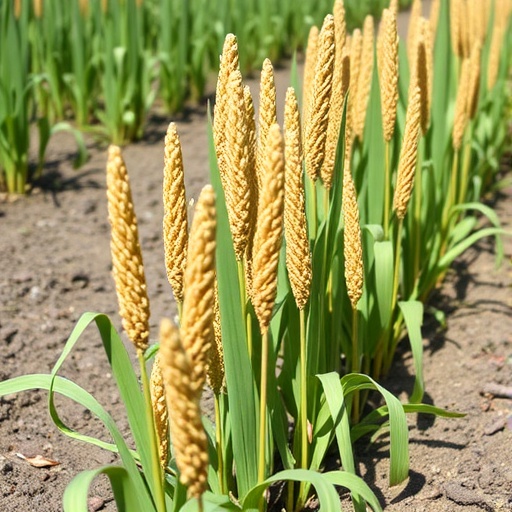
Cold stress remains one of the most stubborn barriers standing between sorghum and the temperate farmland it could otherwise transform. A major new genetic study, published open access in Theoretical and Applied Genetics, has now mapped, at unprecedented resolution, how tolerance to low temperatures is wired into the sorghum genome across the entire life of the plant, from the first frost-exposed days after sowing through seedling growth to flowering and grain filling. The results overturn the assumption that “cold tolerance” is a single, selectable property, showing instead that it is stitched together from stage-specific and shared genetic components, with measurable trade-offs that breeders will need to navigate deliberately.
The research team, led by Mohamed Mosalam and Kai P. Voss-Fels of Hochschule Geisenheim University together with colleagues at Justus Liebig University Giessen, including Steffen Windpassinger and Rod J. Snowdon, analysed a diversity panel of 394 Sorghum bicolor accessions. The panel spanned all five botanical races of sorghum, lines from 24 countries, temperate-adapted material and German breeding lines for grain, silage and dual-purpose use. All lines were genotyped with DArTseq, yielding 26,286 SNP markers, and were evaluated across ten environments in Germany and high-altitude Mexico, covering three developmental stages and seven traits: frost survival, seedling vigour, days to flowering, plant height, seed yield, seed number and panicle harvest index.
The experimental design was deliberately ambitious. Frost survival was scored in an open-field trial at Gross-Gerau in 2021, where sowing was pushed four weeks earlier than recommended to subject emerging seedlings to prolonged and variable freezing, and in two semi-controlled trials at Giessen in 2022 and 2023. Reproductive-stage performance was tested in seven environments, four in Germany and three at roughly 2000–2200 metres altitude in San Juan del Río and Texcoco, Mexico, where chilling conditions during flowering and grain filling are a recurring constraint. In total, the analysis spanned environments ranging from warm controls to genuinely cold-stressed sites, allowing the researchers to model genotype-by-environment interaction with an unstructured genomic covariance framework rather than treating environments as interchangeable.
Technically, the team applied restricted maximum likelihood mixed models implemented in ASReml-R, using a genomic relationship matrix following VanRaden’s method and modelling genotype-by-environment and genotype-by-time interactions as Kronecker products of unstructured covariance matrices with the genomic relationship matrix. Principal component analysis of Roger’s genetic distances divided the panel into three subpopulations, which were included as fixed covariates to control for population structure. Heritabilities were estimated with Cullis’ method, and genotype BLUPs were de-regressed with reliability weighting before cross-stage genetic correlations were computed in MTG2. This allowed the researchers to ask, quantitatively, how much of the genetic control of cold response is shared between stages and environments and how much is confined to a single context.
The answer was clear and, in places, surprising. Genetic correlations were high within developmental stages, for example reaching 0.69 to 0.96 among phenology and yield traits within environment clusters, but weak to moderate between early-stage and reproductive-stage traits, ranging only from −0.13 to 0.41. In plain terms, a genotype that survives frost well as a seedling cannot be assumed to fill grain well under chilling conditions at flowering. Cross-environment correlations for the same trait were high for flowering time, plant height, panicle harvest index, seed number and seed yield, but markedly lower for frost survival, at 0.44, indicating strong re-ranking of genotypes across environments for the earliest cold-response trait. Heritability likewise told a stage-dependent story: days to flowering, plant height and seed yield showed moderate to high heritabilities of roughly 0.66 to 0.79, while seedling vigour had the lowest estimate at 0.25, reflecting strong environmental sensitivity and measurement difficulty during the growth phase.
The genomic core of the study was a haplotype-based dissection rather than a conventional single-marker scan. Based on genome-wide linkage disequilibrium decay, the genome was partitioned into 380 haplotype blocks within fixed 3-centimorgan windows, and SNP effects were back-solved from genotype BLUPs to compute local genomic estimated breeding values. A block-level variance statistic, BlockVar, captured how strongly each haplotype block differentiates genotypes for each trait. The approach proved biologically meaningful: of 57 SNP associations previously reported for the same diversity panel in independent GWAS studies, roughly half to nearly 58 percent fell within the top 100 highest-BlockVar blocks, with several plant-height SNPs mapping to the very highest-ranked blocks. Haplotype-level variance, the authors argue, captures the combined contribution of linked variants that single-marker analyses can underestimate.
One of the most striking findings is the mosaic of stability and specificity. Days to flowering showed complete overlap of high-contribution blocks between the two environmental clusters, with all 146 blocks shared, pointing to a highly stable genetic architecture. Frost survival and panicle harvest index, in contrast, were strongly environment-specific, each retaining dozens of blocks unique to one environment cluster. Haplotype effect stability followed a similar pattern: seed number and seed yield were the most stable, with 317 and 313 stable blocks respectively, whereas panicle harvest index showed the strongest environment-dependent behaviour, with 104 environment-specific blocks. Nineteen high-variance blocks were common to all three developmental stages, but the reproductive stage carried by far the largest stage-specific component, with 53 unique blocks, reinforcing that reproductive cold resilience cannot be inferred from seedling assays.
The team then pushed the analysis from description to prediction through in silico haplotype stacking. For nine recipient genotypes drawn from the three subpopulations, favourable block effects were sequentially replaced with those of donor genotypes, and predicted phenotypes were recalculated at each step. Gains for early-stage cold tolerance rose steeply at low stacking levels and then showed diminishing returns: stacking just 5 to 10 percent of blocks captured the majority of achievable improvement for frost survival and seedling vigour, consistent with an oligogenic-to-moderately polygenic architecture. At 100 percent stacking, predicted gains reached several hundred percent relative to baseline, although the authors caution that such magnitudes are modelling artefacts, since the additive model imposes no biological ceiling, and the results should be read for their patterns rather than their absolute values. Encouragingly, the strongest donor haplotypes were dispersed across all three subpopulations rather than concentrated in a few elite lines, which means the practical challenge for breeders lies in designing efficient crossing schemes to combine widely scattered favourable haplotypes, a problem aligned with recent genomic mating and optimal cross-selection theory.
The trade-off findings may prove the most consequential for breeding programmes. Correlated responses in yield-related traits to stacking for early-stage cold tolerance were generally positive, with seed yield and panicle harvest index improving alongside the target traits at moderate to high stacking intensities. But one correlated response was unambiguously negative: flowering time was consistently delayed. At 10 percent stacking, predicted days to flowering increased by roughly 15 days in both environment clusters regardless of whether frost survival or seedling vigour haplotypes were stacked, and at 50 percent stacking the predicted delays grew to several weeks. The same trade-off pattern held across all three subpopulations, though with different magnitudes, suggesting partial genetic overlap or tight linkage between regions controlling early cold response and those governing phenology. Since flowering must fit within the limited growing window of temperate climates, the authors recommend that selection for early-stage tolerance be evaluated jointly with phenology, for example by excluding blocks with unfavourable flowering effects or applying multi-trait selection weights.
The study’s conclusions carry direct implications for how cold-tolerant sorghum should be bred. The two repeatable environment clusters, one warm and one cool, should be treated as distinct selection targets rather than pooled; traits with stable haplotype architectures, notably seed number, seed yield and plant height, can be selected with broad confidence, while frost survival and panicle harvest index demand environment-specific evaluation. Cold tolerance, the authors argue, is neither a single uniform target nor a set of fully independent traits, but a structured combination of shared and stage-specific genomic components with predictable trade-offs between them. The bottleneck for temperate sorghum is therefore no longer a lack of phenotypic data or genomic resolution, but the design of selection schemes that integrate information across developmental stages while accounting for correlated responses in flowering time. Developing and validating such schemes, the team concludes, is the key next step toward cultivars that can be sown earlier, establish more reliably and yield more stably in the cool-season environments where sorghum’s cultivation is currently limited by cold. With sorghum ranking as the fifth most important cereal globally and prized for its water-use efficiency, gluten-free grain and bioenergy potential, unlocking its cold tolerance could reshape its role in agriculture far beyond its traditional warm, arid heartlands.
Subject of Research: Genetic architecture of cold tolerance across developmental stages in sorghum (Sorghum bicolor), including stage-specific and shared haplotype blocks, genotype-by-environment interactions, and in silico haplotype stacking for breeding.
Subject of Research: Agriculture
Article Title: Genetic dissection of cold tolerance across developmental stages in sorghum reveals stage-specific haplotypes and potential trade-offs
Article References: Mosalam, M., Robinson, H., Windpassinger, S., Snowdon, R. J., & Voss-Fels, K. P. (2026). Genetic dissection of cold tolerance across developmental stages in sorghum reveals stage-specific haplotypes and potential trade-offs. Theoretical and Applied Genetics, 139(9), Article 258. https://doi.org/10.1007/s00122-026-05356-w
Image Credits: AI Generated
DOI: 10.1007/s00122-026-05356-w
Keywords: sorghum, cold tolerance, haplotype blocks, genotype-by-environment interaction, frost survival, seedling vigour, flowering time, panicle harvest index, genomic prediction, in silico haplotype stacking, plant breeding, trade-offs
Cite Scienmag News
APA MLA Chicago
Juliet Wilcox. (September 5, 2026). Sorghum cold tolerance genes vary by growth stage, revealing trade-offs. Scienmag. https://scienmag.com/sorghum-cold-tolerance-genes-vary-by-growth-stage-revealing-trade-offs/
Juliet Wilcox. “Sorghum cold tolerance genes vary by growth stage, revealing trade-offs.” Scienmag, 5 September 2026, https://scienmag.com/sorghum-cold-tolerance-genes-vary-by-growth-stage-revealing-trade-offs/. Accessed 5 September 2026.
Juliet Wilcox. “Sorghum cold tolerance genes vary by growth stage, revealing trade-offs.” Scienmag. September 5, 2026. https://scienmag.com/sorghum-cold-tolerance-genes-vary-by-growth-stage-revealing-trade-offs/
Copy citation Download RIS
Tags: developmental stage-dependent cold tolerance genesdiversity panel of sorghum accessionsenvironment-specific sorghum cold tolerance traitsenvironmental effects on sorghum cold resistancegenetic diversity in sorghum accessionsgenetic mapping of low-temperature tolerancegenetic mapping of sorghum frost resistancegenome analysis of sorghum cold stress genesgenotypic variation in sorghgermplasm screeningimpact of cold stress on sorghum growth stagesSNP markers in sorghum cold tolerancesorghum breeding for temperate climatessorghum breeding for temperate environmentssorghum cold tolerance geneticssorghum genome analysis for cold resiliencesorghum growth stage adaptation to low temperaturesstage-specific cold stress response in sorghumtrade-offs in sorghum breeding for cold tolerancetrade-offs in sorghum cold adaptation