When drought strikes, plants face an immediate dilemma: keep their leaf pores open to absorb carbon dioxide for photosynthesis, or seal them shut to conserve precious water. The answer lies in a sophisticated hormonal and cellular choreography that has fascinated plant biologists for decades. Now, a new study published in Plant Direct has identified a key player in that choreography—FIMBRIN2, an actin-bundling protein that helps guard cells rearrange their internal scaffolding so that stomata can close in response to the drought hormone abscisic acid, or ABA. The discovery fills a long-standing gap in the understanding of how hormonal signals are translated into physical movements of the plant cell cytoskeleton, with implications for breeding drought-resilient crops.
Stomata are microscopic pores on the surfaces of leaves and stems, each framed by a pair of specialized guard cells. By swelling and shrinking, these cells open and close the pore, regulating both gas exchange and water loss. Because stomata simultaneously govern the global water and carbon cycles, understanding the signals that control their movement has consequences well beyond basic plant physiology. When soil dries, plants synthesize ABA, which triggers a signaling cascade in guard cells that ultimately leads to pore closure and reduced transpiration. Crucially, that closure depends on rapid reorganization of actin microfilaments—thin, dynamic protein filaments that form part of the cell’s cytoskeleton and that influence ion channels, aquaporins, vacuole shape, and vesicle trafficking within guard cells.
Previous work had catalogued several actin-binding proteins, or ABPs, that participate in this process. Actin-depolymerizing factor 5 promotes closure by remodeling the cytoskeleton under ABA and drought stress, while its cousin ADF4 is phosphorylated by the kinase CKL2 to facilitate filament reassembly. A plant-specific protein called SCAB1 bundles and stabilizes actin filaments and operates within a phosphoinositide signaling pathway, and the paralogous SINE1 and SINE2 proteins interact with both SCAB1 and the ARP2/3 complex to fine-tune actin dynamics. Yet the full roster of ABPs involved, and the precise mechanisms by which ABA signaling reshapes the microfilament array, remained incompletely understood. Fimbrins were an obvious family to examine: each fimbrin carries two actin-binding domains in a single polypeptide chain, and their close proximity drives the formation of tightly bundled actin structures. Arabidopsis possesses five fimbrin genes, and while FIM1, FIM4, and FIM5 are known to be crucial for pollen tube growth and root development, the function of FIMBRIN2 had remained largely a mystery—despite microarray data from 2004 showing that its transcript is preferentially expressed in guard cells.
The research team, led by Rong Yu, began by testing whether FIM2 matters for drought survival. They obtained two independent T-DNA insertion mutants, fim2-1 and fim2-2, and subjected fourteen-day-old soil-grown seedlings to two weeks of water deprivation. The results were striking: mutant plants exhibited pronounced leaf desiccation and rolling, and their survival rates were significantly lower than those of wild-type counterparts. Detached-leaf water loss assays told the same story from another angle. When rosette leaves were removed and weighed every thirty minutes over two hours, the fim2 mutants lost water substantially faster than the wild type, while plants overexpressing FIM2 lost water more slowly. Infrared thermography added further confirmation: because evaporative cooling lowers leaf temperature, plants that fail to close their stomata run cooler. After three hours of ABA treatment, the leaves of both fim2 mutants were measurably cooler than wild-type leaves, indicating excessive transpiration.
The team then traced the connection to ABA signaling directly. They isolated purified protoplasts—single cells stripped of their walls—from guard cells and from mesophyll cells, the photosynthetic tissue of the leaf interior, and quantified FIM2 expression by quantitative PCR. Under ABA treatment, FIM2 expression in guard cells rose sharply, while mesophyll cells showed no significant change. This guard-cell-specific response suggests that FIM2 is not a general stress protein but a specialized component of the stomatal signaling machinery, recruited precisely where ABA must act to close pores.
Stomatal aperture assays confirmed the functional consequence. When rosette leaves were floated in buffer under light to fully open their stomata and then treated with ABA, wild-type plants and FIM2 overexpression lines closed their pores significantly within ninety minutes. The two fim2 mutants lagged behind, closing more slowly and less completely. The researchers also treated leaves with two microfilament-specific drugs: jasplakinolide, which stabilizes actin filaments, and latrunculin B, which depolymerizes them. The mutants proved more sensitive to both drugs than the wild type, a result consistent with the idea that FIM2 loss disturbs the dynamic balance of actin assembly and disassembly that stomatal movement requires.
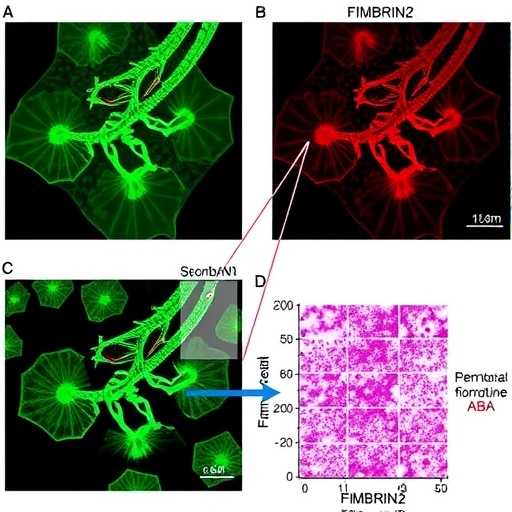
To visualize what was happening inside the guard cells, the team crossed the fim2-1 mutant with a reporter line expressing GFP fused to an actin-binding domain, allowing actin filaments to be imaged with laser-scanning confocal microscopy. In open stomata, guard cell microfilaments typically form radial arrays—short bundles radiating from the pore, designated Type I. As ABA drives closure, these disassemble into a random meshwork (Type II) and then reorganize into longitudinal arrays (Type III), long bundles aligned along the elongated axis of the now-closed stoma. In wild-type guard cells, thirty minutes of ABA treatment drove the expected shift from Type I toward Type III. In the mutants, however, most filaments remained stuck in the intermediate Type II configuration. Quantitative image analysis using ImageJ skeletonization showed that mutant guard cells had fewer visible filament bundles, reduced filament occupancy, lower skewness—a measure of bundling intensity—and altered filament angles. In short, without FIM2, actin bundles became thinner and sparser, and the crucial transition to the closed-stoma architecture failed.
Fluorescence recovery after photobleaching, or FRAP, provided a deeper measure of cytoskeletal dynamics. By bleaching a small region of fluorescently labeled filaments and tracking how quickly fluorescence returned, the researchers could gauge how fast actin was turning over. In mutant guard cells, recovery at both sixty and four hundred twenty seconds was significantly slower than in wild type, indicating that FIM2 accelerates the continuous disassembly and reassembly of filaments. This rapid turnover is thought to be essential for dismantling old radial arrays and building new longitudinal bundles in time for prompt stomatal closure.
The study also uncovered an unexpected link to hydrogen peroxide, a reactive oxygen species that serves as a critical second messenger in ABA signaling. Pharmacological experiments showed that when fim2 mutants were treated with ABA together with catalase, a hydrogen peroxide scavenger, or with diphenylene iodonium, an inhibitor of the NADPH oxidase that generates apoplastic hydrogen peroxide, stomatal closure was further suppressed—and the characteristic longitudinal realignment of actin cables was impaired more severely than in wild type. Using noninvasive micro-test technology, the team measured hydrogen peroxide flux across guard cell membranes directly: wild-type cells showed a mean influx of approximately 4.37 pmol per square centimeter per second after ABA treatment, whereas the two mutants reached only 1.16 and 1.23. H2DCF-DA fluorescence staining corroborated the finding, revealing substantially weakened peroxide accumulation in mutant guard cells. Together, these data suggest a bidirectional feedback loop: FIM2-dependent actin dynamics shape the production and distribution of hydrogen peroxide, while peroxide can, in turn, modify actin-regulating proteins—a coordination mechanism also seen in mammalian cells, where hydrogen peroxide oxidizes cofilin’s cysteine residues to modulate its severing activity.
The findings place FIM2 within a growing map of cytoskeletal regulators of stomatal behavior, a list that includes proteins controlling calcium-permeable channels in the plasma membrane, the aquaporin AtPIP2;1, vacuolar morphology, and ER–tonoplast contacts in rice. They also illuminate the evolutionary logic of the fimbrin family, in which different paralogs have been specialized for roots, pollen, and guard cells, allowing plants to coordinate actin-dependent functions across development and stress responses. By showing that ABA upregulates a guard-cell-enriched bundling protein that accelerates actin turnover and enables the transition to the closed-stoma filament architecture, the study deepens the mechanistic understanding of how plants convert a hormonal signal into a physical, water-saving response. As climate change intensifies drought pressure on agriculture, unravelling these cytoskeletal control points may point toward new strategies for engineering crops that lose less water when water is scarce.
Subject of Research: The role of the actin-bundling protein FIMBRIN2 in ABA-induced stomatal closure and drought tolerance in Arabidopsis thaliana guard cells
Article Title: FIMBRIN2 Regulates ABA-Induced Stomatal Closure by Promoting Microfilament Bundling and Turnover in Arabidopsis Guard Cells
Article References: Wang, Z., Han, Y., Wang, P., Sun, P., Hu, M., & Yu, R. (2026). FIMBRIN2 Regulates ABA‐Induced Stomatal Closure by Promoting Microfilament Bundling and Turnover in Arabidopsis Guard Cells. Plant Direct, 10(4), Article e70162. https://doi.org/10.1002/pld3.70162
Image Credits: AI Generated
DOI: 10.1002/pld3.70162
Keywords: FIMBRIN2, abscisic acid, stomatal closure, guard cells, actin cytoskeleton, microfilament bundling, actin turnover, drought tolerance, Arabidopsis thaliana, hydrogen peroxide, actin-binding proteins, FRAP