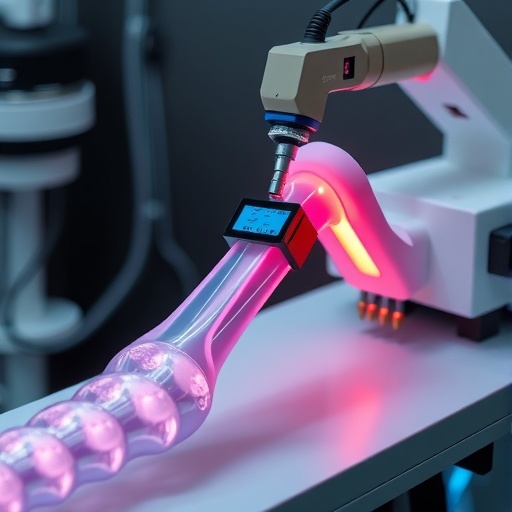
In a development that could reshape how limb-lengthening surgery is delivered in resource-constrained hospitals around the world, a team of mechatronics engineers in Peru has built and validated a low-cost automated distraction system that converts a manually operated external fixator into a micrometer-precise, computer-controlled device. The work, published in Medical & Biological Engineering & Computing, demonstrates that inexpensive off-the-shelf components—a brushless direct current motor, a rotary encoder, a worm gear and a microcontroller—can achieve the kind of accuracy traditionally reserved for motorized lengthening nails and robotic fixators that cost many times more and are rarely available outside high-income health systems.
The device targets the Aybar-type external fixator, a unilaterally mounted frame designed in Peru in the 1970s by Dr. Augusto Aybar and widely used across Latin America, Africa and other regions where imported systems such as the PRECICE internal nail or the Orthofix and Smith & Nephew rail fixators are prohibitively expensive. The Aybar fixator relies on the surgeon or patient manually turning a threaded rod to distract a bone in daily increments. That manual procedure, the researchers note, is vulnerable to human error in exactly the place where error matters most: bone distraction osteogenesis is governed by the Ilizarov tension–stress principle, which requires strict control of both the rate and frequency of lengthening to ensure that soft tissues, blood vessels and the fragile new bone regenerate adapt without tearing, cyst formation or premature consolidation. Deviations of even a fraction of a millimeter per session, accumulated over weeks of treatment, can compromise callus formation—particularly in pediatric patients, whose growing skeletons demand especially careful mechanical stimulus.
To address this, the team—Joao Marcelo Valdivia De La Gala, Andrea Sophia Valladares Chavez and Carlos Hernan Inga Espinoza of the School of Mechatronics Engineering at the Universidad Peruana de Ciencias Aplicadas in Lima—designed a retrofit module that automates the distraction screw of the Aybar frame without changing the underlying orthopedic hardware. The mechanical platform couples a high-torque, low-speed 12–24 V DC motor with a self-locking worm gear of 1.25 mm pitch, meaning that one full revolution of the output shaft advances the distraction rod by 1.25 mm. The self-locking property of the worm gear is critical: it mechanically prevents back-driving, so the weight of the patient’s limb and the substantial soft-tissue tension that builds during lengthening cannot force the screw backward when the motor is unpowered. An incremental rotary encoder, an H-bridge motor driver, a real-time clock module, an inertial measurement unit and an ESP32 microcontroller complete the system, which was prototyped largely in polylactic acid, a biocompatible and easily 3D-printed polymer that keeps manufacturing costs negligible.
The engineering heart of the study, however, lies in the control strategy. The team implemented and rigorously compared four distinct controllers for regulating displacement: a simple ON–OFF controller, a classical Proportional–Integral (PI) controller, a Linear Quadratic Integrator (LQI) state-space controller, and a Fuzzy Logic Controller (FLC). The evaluation was performed under two clinically relevant distraction regimens. The first was the conventional macro-distraction protocol of 1 mm per day delivered in four increments of 0.25 mm each. The second was a high-frequency, high-resolution micro-distraction protocol of 1 mm per day divided into sixty increments of approximately 0.0167 mm each—a regimen aligned with a growing body of literature, dating back to Ilizarov’s own animal experiments and clinical studies such as the 2002 work by Aarnes and colleagues, showing that distributing the same daily lengthening over many tiny steps improves tissue adaptation and reduces pain and complications.
The two protocols impose sharply different demands on the controller, and the experimental results revealed a clear division of labor. For coarse, 0.25 mm steps, the fuzzy logic controller delivered the best overall performance, achieving displacement accuracy and settling behavior that outperformed the classical alternatives. Fuzzy control is well suited to this regime because it encodes human expert reasoning—linguistic rules of the form “if the error is small and the error is decreasing slowly, apply a small correcting effort”—without requiring a precise mathematical model of the motor-gear-load system, whose friction and compliance are difficult to characterize exactly. For the sixty-step micro-distraction protocol, where each commanded increment is smaller than 17 micrometers, the Linear Quadratic Integrator proved superior. The LQI’s optimal state-feedback formulation, with its integral action eliminating steady-state error, handled the fine-grained, high-frequency setpoint changes with better repeatability than the fuzzy rules, which were tuned primarily for larger excursions.
Testing was carried out both under unloaded conditions and against an opposing load of up to 240 N, a figure chosen to approximate the axial forces that clinical studies have measured in the soft tissues of lower limbs during lengthening. In vivo force measurements published over the past three decades show that distraction forces in leg lengthening can rise steeply as treatment progresses, so a controller that holds accuracy only under bench conditions would be clinically meaningless. The system’s ability to maintain displacement accuracy under load—thanks in part to the encoder feedback loop closing around the actual output motion—addresses the central weakness of open-loop manual distraction, where the operator turns a handle a nominal number of clicks and has no way of knowing whether the bone has actually moved the intended distance against resisting tissue.
The clinical significance of the result is amplified by its cost profile. Motorized internal lengthening nails such as the PRECICE system have demonstrated excellent precision, but their acquisition cost places them beyond the reach of most public hospitals in developing countries, and their use in children is further constrained by implant sizing and the need for secondary removal surgeries. Robotic external systems such as the Auto Strut, described in the Journal of Child Orthop in 2021, hint at what automation can offer for external fixation but remain research-stage or similarly expensive. By contrast, the Peruvian prototype uses commodity electronics whose total cost is a small fraction of a single imported distractor, and because it retrofits onto the existing Aybar frame, hospitals that already stock the fixator can upgrade their inventory without abandoning familiar surgical technique. The authors frame this explicitly as closing a gap between affordability and clinical efficacy—a gap that currently forces surgeons in low-resource settings to choose between precision they cannot afford and affordability that compromises outcomes.
Pediatric orthopedics stands to benefit most directly. In children, distraction osteogenesis is used not only for limb-length discrepancy correction after trauma or infection but also for congenital deformities, and the quality of the regenerate depends on mechanobiological signaling that is exquisitely sensitive to the distraction schedule. Computational models of bone regeneration during distraction, such as those developed by Isaksson and colleagues, show that local tissue differentiation—whether the gap fills with bone, cartilage or fibrous tissue—is regulated by shear strain and fluid velocity in the callus, both of which are functions of how smoothly and consistently the distraction load is applied. Automating the process also removes the adherence burden from families: with a manually cranked fixator, a missed or imprecise session at home translates directly into lost millimeters or overloaded tissue, whereas a scheduled, clock-driven controller executes the prescribed regimen without relying on human memory or dexterity. The system’s real-time clock and microcontroller architecture are designed precisely for this autonomous scheduling role.
The study is careful to define its scope. The experiments were performed on a mechanical platform under controlled loading, not in patients, and the authors report that full datasets are available from the corresponding author upon reasonable request given the prototype nature of the device. The work was supported by the research directorate of the Universidad Peruana de Ciencias Aplicadas through its UPC-EXPOST-2025-1 incentive, and the authors declare no competing financial interests. No ethical approval was required because the study involved no human participants, tissues or animals. These caveats notwithstanding, the benchmarking methodology itself is a contribution: by evaluating ON–OFF, PI, LQI and fuzzy controllers head-to-head under two distraction protocols and realistic loads, the study gives biomedical engineers a practical map for matching control architecture to clinical protocol. The broader lesson echoes a recurring theme in medical device engineering—that intelligent, low-cost automation can deliver measurable safety and accuracy gains even when it cannot match the specification sheets of flagship commercial systems, provided it is engineered around the actual constraints of the clinical environment it must serve.
The next steps for the team and the field would logically involve fatigue testing, sterilizable packaging, regulatory pathway work and ultimately clinical pilot studies with pediatric patients wearing the automated Aybar fixator during real lengthening treatments. If those steps succeed, a device lineage born in Lima four decades ago—designed expressly as a “Third World option” in orthopedic trauma care—may receive a twenty-first-century upgrade, bringing the precision of motorized distraction to the patients who need it most and can least afford the alternatives. In the meantime, the study stands as a concrete demonstration that the digital divide in orthopedic hardware is not an inevitability but an engineering choice, and that with a DC motor, a worm gear and a well-tuned fuzzy controller, the choice can be made differently.
Subject of Research: Automated micrometric bone distraction system using fuzzy logic and other control strategies for a low-cost Aybar-type external fixator
Subject of Research: Technology and Engineering
Article Title: Development and implementation of an automated micrometric bone distraction system based in a fuzzy logic controller for an Aybar-type external fixator
Article References: Valdivia De La Gala, J. M., Valladares Chavez, A. S., & Inga Espinoza, C. H. (2026). Development and implementation of an automated micrometric bone distraction system based in a fuzzy logic controller for an Aybar-type external fixator. Medical & Biological Engineering & Computing. https://doi.org/10.1007/s11517-026-03665-2
Image Credits: AI Generated
DOI: 10.1007/s11517-026-03665-2
Keywords: bone distraction, Aybar-type external fixator, fuzzy logic controller, control system, limb lengthening, DC motor, pediatric orthopedics, distraction osteogenesis, low-cost medical devices
Cite Scienmag News
APA
MLA
Chicago
Denise Maddox. (September 3, 2026). Fuzzy Logic Automates Micrometric Bone Distraction in Aybar External Fixator. Scienmag. https://scienmag.com/fuzzy-logic-automates-micrometric-bone-distraction-in-aybar-external-fixator/
Denise Maddox. “Fuzzy Logic Automates Micrometric Bone Distraction in Aybar External Fixator.” Scienmag, 3 September 2026, https://scienmag.com/fuzzy-logic-automates-micrometric-bone-distraction-in-aybar-external-fixator/. Accessed 3 September 2026.
Denise Maddox. “Fuzzy Logic Automates Micrometric Bone Distraction in Aybar External Fixator.” Scienmag. September 3, 2026. https://scienmag.com/fuzzy-logic-automates-micrometric-bone-distraction-in-aybar-external-fixator/
Copy citation
Download RIS
Tags: affordable bone lengthening technologyaffordable surgical automationautomated limb-lengthening deviceAybar external fixator automationAybar external fixator enhancementbone distraction automationcomputer-controlled distraction mechanismcomputer-controlled distraction systemscost-effective alternatives to high-end orthopedic systemsfuzzy logic bone distractionfuzzy logic control in medical devicesLatin American medical innovationlow-cost external fixatorlow-cost external fixator conversionmanual to automated bone distraction conversionmechatronics engineering in orthopedicsmechatronics in orthopedic surgerymicrometer-precision limb-lengtheningmicrometric bone distraction systemoff-the-shelf components for medical devicesprecision in bone lengthening proceduresprecision orthopedic device developmentresource-constrained healthcare solutions