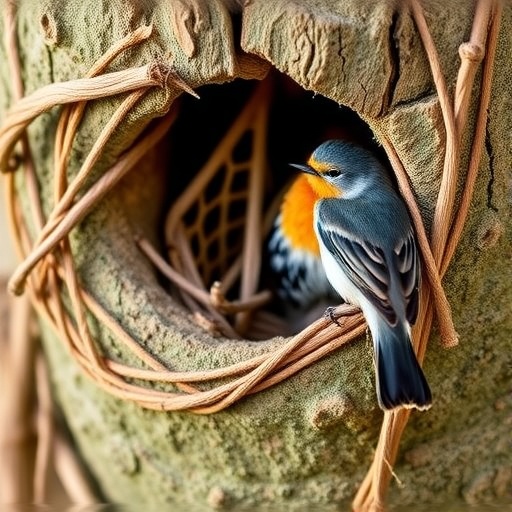
On a June morning in 2024, in a village tucked between arable fields and secondary forest in northeastern China, field researchers looked inside a Daurian redstart nest and saw something they had never recorded in seven years of daily monitoring: two common cuckoo eggs lying in the same nest. That alone was remarkable, because the common cuckoo is an evicting brood parasite whose hatchling eliminates all nestmates, making a second cuckoo egg a wasted investment. What made the discovery extraordinary was the appearance of the eggs. One was pale blue, the signature of cuckoo females that specialize on redstarts. The other was grey and finely speckled, the hallmark of a different race of cuckoo that normally parasitizes white wagtails. Two distinct females, belonging to two separate host-specific lineages known as gentes, had targeted the same nest within four days of each other. The observation, reported in the journal Ecology and Evolution, is the only case of double parasitism ever documented in this population, and it opens a rare window onto the hidden rules that decide which female cuckoos compete for the same nest, and which do not.
Brood parasitism is one of evolution’s most starkly asymmetric partnerships. Obligate parasites such as the common cuckoo (Cuculus canorus) lay all of their eggs in the nests of other species, transferring every cost of incubation and chick-rearing to unwitting hosts. The exploitation has fueled a textbook coevolutionary arms race: hosts evolve defenses such as egg recognition and ejection, and parasites answer with eggs that mimic those of their hosts. For evicting parasites, multiple parasitism — more than one female laying in the same host nest — carries uniquely high costs. The cuckoo chick hatches first and, using a sensitive depression on its bare back, heaves host eggs and nestmates out of the nest, so only a single parasite can ever fledge. A second cuckoo egg is therefore a total loss for the second female. In non-evicting parasites such as brown-headed, shiny and screaming cowbirds, several parasitic chicks routinely share a nest and multiple parasitism is common. The great spotted cuckoo is a striking exception among evictors, with multiply parasitized nests sometimes fledging more young. For the common cuckoo, however, stacking nests should be strongly maladaptive — which is exactly why the new Chinese observation demands an explanation.
Common cuckoo females are not an undifferentiated swarm of cheaters. They are divided into gentes, host-specific female lineages, each reliably producing a distinct egg type that mimics the eggs of one particular host species, and individual females typically specialize on a single host. The genetic architecture behind this egg mimicry has only recently begun to be resolved, with genomic studies showing how deeply the different egg morphs are woven into cuckoo populations. At the study site — ShuangYu, a village of roughly 300 hectares in Jilin province — two gentes occur side by side. The redstart-cuckoo lays a plain pale blue egg that closely matches the blue egg morph of the Daurian redstart (Phoenicurus auroreus), a species in which some females lay blue eggs and others pink ones. The wagtail-cuckoo lays a grey egg marked with fine speckling, mimicking the white wagtail (Motacilla alba). In principle these two sets of females have little reason to compete, because each targets a different host, whereas females of the same gens pursue the same scarce resource. Whether a cuckoo female can even recognize which gens a rival belongs to has never been demonstrated.
The rarity of the event is best appreciated against the scale of the monitoring behind it. Since 2016 the team has installed and maintained 240 artificial nest boxes across ShuangYu, spacing neighboring boxes about 50 meters apart. From 2018 through 2024, researchers checked redstart nests at least once a day through laying and early incubation, following roughly 200 breeding attempts each season, with annual totals ranging from 118 to 265 nests, more than half of them in boxes. Daurian redstarts at the site raise two clutches per year, peaking in late April and early June, with mean clutch sizes of 6.4 and 5.5 eggs respectively. Cuckoos arrive around mid-May, by which time most first clutches are too advanced to be worth parasitizing, so parasitism falls entirely within the second laying period and averages 14.3 percent. Because a female cuckoo lays only about one egg every two days, and the team occasionally recorded two or three fresh cuckoo eggs in the area on a single day — three appeared on 10 June 2019, for example — they estimate that only about 10 to 15 cuckoo females patrolled the village each year. Nests, in other words, were never swamped by parasites.
The doubly parasitized nest, catalogued as number 24034, tells its story in a handful of dates. The redstart female began laying on 19 June 2024 and started incubating a clutch of three on 21 June. On 23 June the team found the nest holding two blue host eggs and a pale blue cuckoo egg of the redstart gens. Four days later, on 27 June, a second cuckoo egg had appeared alongside the first and a single remaining host egg: grey, finely marked, unmistakably the product of a wagtail-cuckoo. The four-day interval fits two different females rather than one, since a single cuckoo lays at most one egg per nest. The epilogue came quickly. When the researchers returned the following day, the grey egg was gone, almost certainly ejected by the host female — a predictable outcome given how starkly it contrasted with her own blue eggs. The timing also doomed the intrusion on biological grounds: the nest was already six days into incubation, well past the stage at which a cuckoo hatchling could have outcompeted host embryos even if the egg had been left in place.
Across seven breeding seasons the team recorded 182 parasitism events in redstart nests. Of these, 180 involved the redstart-cuckoo and only two the wagtail-cuckoo, and the researchers never once found a nest containing two redstart-cuckoo eggs. The single double parasitism amounts to less than one percent of parasitized nests. Simple probability makes that figure puzzling. If parasitism events were independent and random, a 14.3 percent rate should produce double parasitism in roughly two percent of nests — about 26 cases over the study period rather than one. In great reed warblers, where more than 30 percent of parasitized nests contain multiple cuckoo eggs, the observed frequency of multiple parasitism does closely match the level predicted from the overall parasitism rate of 54.3 percent. The same holds for common redstarts, a closely related host in which 41 cases of multiple parasitism were documented among 353 parasitized nests over 16 years, a rate of 11.6 percent. The crucial difference, the authors argue, is overall cuckoo pressure: about a third of common redstart nests were parasitized, compared with roughly 15.6 percent in the Chinese population. Low cuckoo density, in other words, appears to keep nests from stacking.
The picture comes with caveats. The researchers did not individually mark cuckoo eggs at laying, so they cannot rule out that an incoming female sometimes removed an egg already present — a known source of undercounts — and rapid ejection by hosts before an inspection could also hide cases. Territorial structure adds another filter: the geographic pattern of cuckoo egg types across the site suggests that females held essentially non-overlapping territories, and a female does not normally lay twice in the same nest. Restricted access to nests, rather than anything peculiar to redstarts, may therefore explain why cuckoo eggs so rarely accumulate. Yet none of these caveats touches the most tantalizing detail. Given that redstart-cuckoo eggs outnumbered wagtail-cuckoo eggs in redstart nests by 180 to two, the second egg in the doubly parasitized nest should, on any reasonable expectation, have come from another redstart-cuckoo. Instead, the only double parasitism ever recorded in the population mixed the two gentes, while no nest ever held two eggs from the same gens. That combination looks less like coincidence than like the signature of a behavioral rule.
That asymmetry anchors the team’s central hypothesis. During the breeding season, female cuckoos respond aggressively to intrusions by other females into their territories, and such defense is energetically costly. Jinggang Zhang and his colleagues propose that females may be more tolerant toward females of a different gens, with whom they do not compete for host nests, or simply less effective at excluding them, than toward rivals of their own gens. The idea carries a large caveat of its own: it presupposes that cuckoo females can discriminate which gens an intruder belongs to, something never demonstrated, and the cues involved — visual, behavioral or otherwise — are unknown. A more mundane alternative is that females of different gentes simply encounter each other less often, because they differ in microhabitat use, host-searching behavior or daily activity patterns, so that reduced competition arises passively from ecological segregation rather than active recognition. Either way, the wagtail-cuckoo’s blunder reads as misdirected laying: a female that apparently failed to find a suitable wagtail nest dumped her egg into a redstart nest already deep in incubation, against a host primed to reject anything unlike her own eggs.
For now the finding rests on a single anecdote, and the authors are candid about that. But anecdotes of this kind open a door onto one of the least explored corners of cuckoo biology: the social lives of the parasites themselves, whose territorial fights, tolerance and mutual avoidance ultimately shape how parasitism is distributed across host nests. The team — Jinggang Zhang together with Peter Santema, Chenyang Zhao, Zixuan Lin, Jianqiang Li, Wenhong Deng and Bart Kempenaers, supported by the National Natural Science Foundation of China and the Max Planck Society — argues that future studies tracking the spatial and temporal overlap of females from different gentes, along with their morphology and behavior, could establish whether gens identity determines who is permitted into whose laying range. If so, the celebrated arms race between cuckoos and their hosts will turn out to have a second, hidden layer: an equally subtle negotiation among the cheats over who gets to parasitize where. In a village in northeastern China, one speckled egg laid in the wrong nest has provided the first glimpse of those rules in action.
Subject of Research: Double parasitism of a Daurian redstart nest by two different common cuckoo gentes, and the role of interactions among female cuckoos in shaping multiple brood parasitism.
Subject of Research: Biology
Article Title: Double Parasitism by Two Cuckoo Gentes in a Daurian Redstart Nest
Article References: Zhang, J., Santema, P., Zhao, C., Lin, Z., Li, J., Deng, W., & Kempenaers, B. (2026). Double Parasitism by Two Cuckoo Gentes in a Daurian Redstart Nest. Ecology and Evolution, 16(7), Article e73968. https://doi.org/10.1002/ece3.73968
Image Credits: AI Generated
DOI: 10.1002/ece3.73968
Keywords: brood parasitism, common cuckoo, Daurian redstart, cuckoo gentes, multiple parasitism, egg mimicry, egg rejection, misdirected laying, host-parasite coevolution, nest box monitoring
Cite Scienmag News
APA MLA Chicago
Drew Townsend. (August 30, 2026). Two Cuckoo Lineages Parasitize the Same Daurian Redstart Nest. Scienmag. https://scienmag.com/two-cuckoo-lineages-parasitize-the-same-daurian-redstart-nest/
Drew Townsend. “Two Cuckoo Lineages Parasitize the Same Daurian Redstart Nest.” Scienmag, 30 August 2026, https://scienmag.com/two-cuckoo-lineages-parasitize-the-same-daurian-redstart-nest/. Accessed 30 August 2026.
Drew Townsend. “Two Cuckoo Lineages Parasitize the Same Daurian Redstart Nest.” Scienmag. August 30, 2026. https://scienmag.com/two-cuckoo-lineages-parasitize-the-same-daurian-redstart-nest/
Copy citation Download RIS
Tags: avian nest competition dynamicsavian reproductive strategiesCuckoo brood parasitismcuckoo egg coloration and morphologycuckoo egg coloration and signaturescuckoo egg mimicry and differentiationDaurian redstart nestDaurian redstart nesting behaviordouble parasitism cases in bird populationsdouble parasitism in bird nestsecological implications of brood parasitismevolution of brood parasitismhost-parasite coevolutionhost-specific cuckoo lineagesmultiple cuckoo eggs in a single nestparasitic bird reproductive strategiesparasitic bird species interactionsrare avian parasitism cases