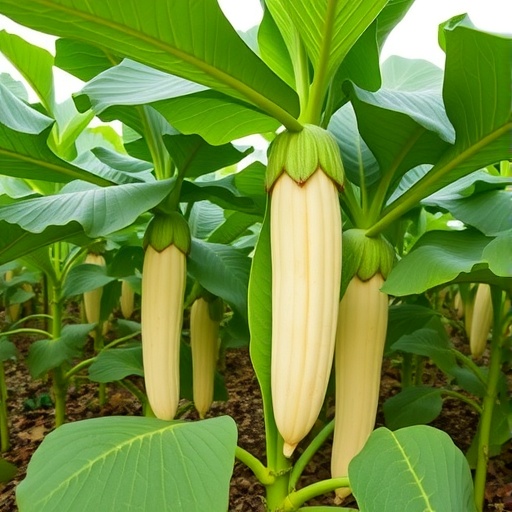
Cassava is a lifeline for millions of people across sub-Saharan Africa, but it is an imperfect lifeline. The starchy roots that anchor diets in Kenya, Uganda, Nigeria and beyond are notoriously poor sources of micronutrients, and vitamin A deficiency remains rampant in communities that depend on the crop as a staple. Biofortification—breeding cassava varieties whose roots are rich in pro-vitamin A carotenoids—has long been championed as a public health solution. Now, a team of researchers working with Kenyan and Ugandan germplasm reports a substantial leap forward in the computational machinery of that effort, showing that a smarter combination of genome-wide association studies and machine learning can predict the nutritional quality of cassava roots with unprecedented accuracy.
The core obstacle is time. Cassava takes roughly twelve months to mature, which means breeders who wait to measure carotenoid content in harvested roots must commit years to each selection cycle. Genomic prediction offers a way around this bottleneck. The idea is to build statistical models that link tens of thousands of DNA markers to measured traits, then use those models to calculate genomic estimated breeding values—predictions of an individual’s additive genetic worth as a parent. Breeders can then select the most promising progenitors at the seedling stage, months before a single root is dug from the ground, compressing the breeding cycle and accelerating genetic gain.
In a study conducted at the Kenya Agricultural and Livestock Research Organization (KALRO) in Kakamega, researchers assembled a panel of 93 pro-vitamin A cassava genotypes derived from accessions held by Uganda’s National Crop Resource Research Institute. The plants were established as seedlings in January 2023, and in January 2024 two representative roots from each genotype were harvested under low-light evening conditions—a necessary precaution, because carotenoids degrade rapidly when exposed to light. Samples were rushed to the University of Nairobi within seven hours, where high-performance liquid chromatography quantified beta-carotene content in freshly harvested tissue. The measured values ranged from 0.04 to 1.03 mg per 100 g of root, with a mean of 0.52 mg/100 g. Notably, 68 percent of the population fell below the Institute of Medicine’s recommended benchmark of 6 micrograms of beta-carotene per gram, underscoring how much work remains for breeders.
The genotyping side of the study relied on DArTseq genotyping-by-sequencing against the Manihot esculenta 671_v8.0 reference genome, yielding 54,877 single nucleotide polymorphisms. After quality control filtering for call rate, minor allele frequency and heterozygosity using the snpReady package in R, 37,419 high-quality SNPs remained for downstream analysis. Five-fold cross-validation, in which 80 percent of the data trained each model and the remaining 20 percent served as an independent test, was used to evaluate prediction performance across all models.
The researchers’ central innovation lay in how they identified trait-associated markers to feed into their prediction models. Conventional single-locus GWAS approaches, while widely used, suffer from limited statistical power in small populations—a persistent constraint in crop breeding programs. The team instead turned to multi-locus random marker effect GWAS (mr-GWAS), implemented through four algorithms in the mrMLM platform: mrMLM, FASTmrMLM, pLARmEB and ISIS EM-BLASSO. These methods treat SNP effects as random, shrinking estimates toward zero and applying a modified Bonferroni significance threshold of 0.05 divided by the effective number of markers, which corrects for multiple testing without the punishing conservatism of standard corrections. The payoff was clear: while the BLINK fixed-effect GWAS model detected only two significant SNPs for beta-carotene (on chromosomes 09 and 14) and one for flesh color on chromosome 01, the mr-GWAS pipeline uncovered five significant SNPs distributed across chromosomes 01, 03, 04, 14 and 18.
When these markers were incorporated as fixed-effect covariates into classical Bayesian genomic prediction models—Bayesian Ridge Regression, Bayesian Lasso, BayesA, BayesB and BayesC—the improvement was dramatic. Naive models struggled badly: prediction correlations on the validation set ranged from just 0.14 to 0.16 for beta-carotene. Adding the two BLINK SNPs lifted accuracy to between 0.41 and 0.43. But when all five mr-GWAS-derived SNPs were included, Bayesian Lasso reached a prediction ability of r = 0.81, with the remaining models clustered between 0.75 and 0.78. The pattern held for root flesh color as well, where a single chromosome 01 SNP boosted validation correlations from roughly 0.39–0.48 to 0.61–0.63. The lesson is that markers spanning more of the genome are more likely to be linked to the causal genes governing carotenoid accumulation, capturing a fuller share of the trait’s genetic architecture.
The study did not stop with parametric models, however. Traditional genomic prediction assumes purely additive gene action, yet real traits are shaped by dominance and epistasis—non-additive interactions that linear models systematically miss. To capture these effects, the researchers built non-parametric models using five machine learning algorithms: Random Forest, Support Vector Machine with radial kernel, Neural Networks, Extreme Gradient Boosting (XGBoost) and K-Nearest Neighbors, along with a stacked ensemble that used Random Forest as the meta-learner. Initially, these models performed modestly, with the ensemble topping out at r = 0.44 and the support vector machine limping along at r = 0.04.
The transformation came through feature selection. Using the Boruta algorithm, the team distilled 37,419 SNPs down to just 13 of the most informative predictors—a 99.97 percent reduction in dimensionality. With this streamlined marker set, performance soared: Random Forest and the ensemble model both achieved r = 0.79, while XGBoost and K-Nearest Neighbors reached r = 0.73. This result carries a practical message for computational breeders everywhere—curating the predictor set matters as much as choosing the algorithm, since removing noise variables sharpens model focus, reduces computational burden and prevents overfitting.
The distinction between the two modeling families maps directly onto breeding strategy. Genomic estimated breeding values from the parametric models reflect additive effects, the only genetic component parents reliably transmit to offspring, making them the right tool for early progenitor selection. Non-parametric machine learning models, by contrast, estimate total genomic value—additive and non-additive combined—which better predicts how a clone will actually perform as a finished variety. Together, the two approaches let breeders pick parents early and pick varieties accurately, shortening every stage of the pipeline from crossing to release.
The authors acknowledge limitations, including the modest population size of 93 genotypes and the fact that GWAS was performed on the full dataset before cross-validation, which may have introduced some optimistic bias into reported accuracies. They recommend larger datasets and nested cross-validation designs in future work. Even so, the results represent a meaningful advance for a crop that has long lagged behind maize and wheat in genomics-assisted breeding. For the millions of families whose primary food source falls short on vitamin A, faster breeding is not an abstraction—it is the difference between deficiency and health arriving sooner rather than later. With genomic prediction accuracies approaching r = 0.8 now achievable even in small breeding populations, cassava biofortification may finally be able to move at the speed the problem demands.
Subject of Research: Genomic prediction of pro-vitamin A carotenoid (beta-carotene) content in cassava roots using GWAS-informed parametric Bayesian models and machine learning ensemble approaches
Subject of Research: Biology
Article Title: Multi-locus random marker effects GWAS, ensemble models and variable selection improve genomic prediction for pro-vitamin A carotenoids in cassava
Article References: Abincha, W., Dzidzienyo, D. K., Tongoona, P., Ofori, K., Owor, B.-E., Kayondo, I. S., Ozimati, A., Mwale, S. E., & Kivuva, B. M. (2026). Multi-locus random marker effects GWAS, ensemble models and variable selection improve genomic prediction for pro-vitamin A carotenoids in cassava. Heliyon, 12(14), Article e45360. https://doi.org/10.1016/j.heliyon.2026.e45360
Image Credits: AI Generated
DOI: 10.1016/j.heliyon.2026.e45360
Keywords: cassava biofortification, genomic prediction, pro-vitamin A carotenoids, beta-carotene, multi-locus GWAS, machine learning, Random Forest, ensemble models, variable selection, vitamin A deficiency, SNP markers, plant breeding
Cite Scienmag News
APA MLA Chicago
Juliet Wilcox. (August 30, 2026). GWAS-informed ensembles boost genomic prediction of vitamin A carotenoids in cassava. Scienmag. https://scienmag.com/gwas-informed-ensembles-boost-genomic-prediction-of-vitamin-a-carotenoids-in-cassava/
Juliet Wilcox. “GWAS-informed ensembles boost genomic prediction of vitamin A carotenoids in cassava.” Scienmag, 30 August 2026, https://scienmag.com/gwas-informed-ensembles-boost-genomic-prediction-of-vitamin-a-carotenoids-in-cassava/. Accessed 30 August 2026.
Juliet Wilcox. “GWAS-informed ensembles boost genomic prediction of vitamin A carotenoids in cassava.” Scienmag. August 30, 2026. https://scienmag.com/gwas-informed-ensembles-boost-genomic-prediction-of-vitamin-a-carotenoids-in-cassava/
Copy citation Download RIS
Tags: accelerated breeding cyclesadvanced computational tools in agriculturebiofortification for public healthbiofortified cassava varietiesCassava biofortificationcomputational approaches to plant biofortificationcrop genetic diversityenhancing crop nutritional traits through genomicsgenetic markers for carotenoid contentgenome-wide association studies in crop breedinggenomic estimated breeding valuesgenomic prediction in crop breedinggenomic prediction of vitamin A contentGWAS and machine learning in plant breedingGWAS-informed machine learning modelsimproving cassava nutritional qualityimproving nutrient content in staple cropsplant genetics and genomicspublic health impact of vitamin A-rich cropsrapid cassava breeding techniquessub-Saharan Africa staple crop improvementsub-Saharan Africa staple cropsvitamin A carotenoid content in cassava