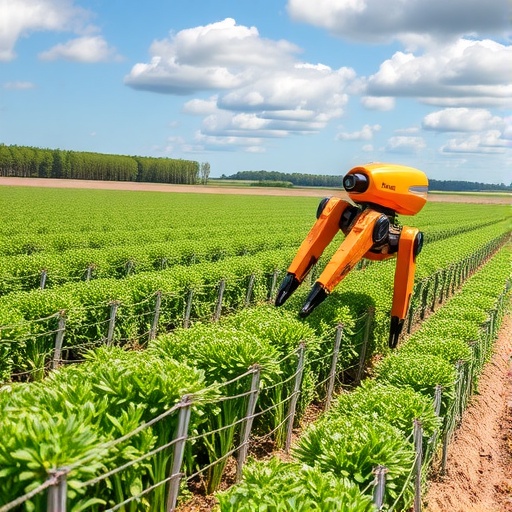
Own the Robot or Hire It? The Two Very Different Roads Leading German Farmers Toward Autonomous Agriculture
Autonomous field robots have been promised to agriculture for years: mobile machines that would prepare soil, sow seeds, weed rows, treat pests and even harvest crops under human supervision but without a human at the controls. On German arable farms, however, they remain practically invisible, with farm-level adoption estimated at anywhere from nearly zero to about five percent. A new study published in the open-access journal Smart Agricultural Technology argues that the missing ingredient is not a single feature, subsidy or breakthrough but the right combination of economic, organisational and capability-related conditions — and that this combination depends on how the robot reaches the farm. Agricultural economists Marius Michels, Fynn-Linus Leege, Constantin Widekind-Buschulte and Oliver Mußhoff show that buying a robot and hiring one as a service are not two versions of the same decision but two distinct organisational logics, each with its own recipe for success.
The potential of these machines is well documented. Because field robots are mobile, autonomous and decision-capable mechatronic systems, they could cut labour costs, reduce soil compaction, apply fertiliser and pesticides more precisely and deliver environmental benefits. They differ, however, from the milking robots and greenhouse systems already established in livestock and protected cultivation: arable farming unfolds in heterogeneous, weather-exposed and less controlled outdoor environments, and integrating an autonomous system into existing farm structures remains far from trivial. Earlier surveys have catalogued the barriers — high investment costs, demanding supervision, legal liability and data concerns, uncertain reliability, dependence on manufacturers and poor compatibility with existing machinery and routines — with economic viability repeatedly emerging as the decisive filter. A previous Bavarian survey found farmers responded far more favourably to contractor-based arrangements than to manufacturer-led services. What remained unknown was how these factors combine within each access mode, and whether the combination for buying differs from the combination for outsourcing.
To find out, the team ran two parallel, structured interview surveys in April and May 2026, each with 29 German arable farmers, for 58 face-to-face interviews in total. Every farm was conventionally managed, with arable farming as its main or a major branch. One questionnaire asked how willing farmers would be to own and operate field robots on their own land; the other presented a concrete scenario — a regional contractor delivering an autonomous weeding robot for row crops such as sugar beet, billed per hectare, with the contractor handling transport, setup, monitoring and technical operation. The farms were deliberately drawn from the upper tail of German agriculture: 87.9 percent cultivated at least 100 hectares, 72.4 percent at least 200 and half at least 500, whereas nationally roughly 71 percent of farms with arable land work less than 50 hectares and the average is about 62. The sampled farms ranged from 42 to 7,250 hectares, with a median of 504, across seven federal states, mostly in the north and east.
The analysis relied on fuzzy-set Qualitative Comparative Analysis, or fsQCA, a set-theoretic method designed for questions that average-based statistics handle poorly. Rather than estimating the isolated effect of each factor, fsQCA asks which combinations of conditions are jointly sufficient to produce an outcome. It rests on three assumptions that mirror real decision-making: conjunctural causation, meaning factors work together rather than alone; equifinality, meaning different farms can reach the same verdict by different routes; and causal asymmetry, meaning the roads to yes are not the mirror image of the roads to no. The researchers calibrated interview responses into fuzzy-set membership scores from 0 to 1 — for most seven-point scales, clear disagreement was anchored at 2, maximum ambiguity at 4 and clear agreement at 6, while the service outcome used stricter anchors of 3, 5 and 6.5 because most farmers were already enthusiastic and a laxer calibration would have made nearly everyone a member of the attractive set. The crucial scale condition was anchored at 50 hectares for full membership, with crossover points at the sample medians of 200 hectares for ownership and 120 for the service, and full non-membership at 800 and 300 hectares respectively. Truth tables covering every logical combination were then minimised with the Quine–McCluskey algorithm at a consistency threshold of 0.80, and every solution was stress-tested against alternative calibrations, stricter parameters and leave-one-item-out checks.
The ownership results overturn a popular assumption. The dominant, robust pathway to willingness to buy — supported by eight farmers at a consistency of 0.972 — combined clearly perceived advantages, high digital capability and, counterintuitively, the absence of acute labour pressure. These farmers expect robots to improve profitability, trim input use and benefit the environment, and they have the technical fluency to judge GPS guidance, sensors, software and yield maps; for them robots are an opportunity, not a rescue. A second, conditionally supported route joined perceived advantages and digital capability with a low perceived scale threshold, marking farmers convinced that ownership pays off at comparatively modest acreage — the median stated minimum was 200 hectares, though answers spanned 10 to 1,500. A third, smaller exploratory path captured two farmers under real labour pressure with strong digital skills but weak faith in the economics — willingness born of necessity. Digital capability appeared in every positive pathway, yet because it was nearly universal in the sample, necessity testing rated it trivial on its own: capability enables willingness but never produces it alone. The time-horizon pattern was equally telling — farmers averaged 2.5 on intending robots within five years, 4.5 within ten, but 5.9 in principle.
The service sub-sample faced a sharper proposition: a regional contractor bringing an autonomous, GPS-guided and camera-based weeding robot to the farm for row crops, with per-hectare billing, no investment, maintenance or repair costs, and no need for the farmer to be technically proficient. The authors distinguish this from classic Robots-as-a-Service, in which the farmer operates the machine under remote monitoring; here the contractor’s own personnel deploy and run the robot. Attractiveness scored high — a mean of 5.21 on the seven-point scale with a Cronbach’s alpha of 0.91. The robust pathway, backed by seven farmers at a consistency of 0.962, paired labour pressure with a low perceived scale threshold. Strikingly, the median area at which farmers judged the service viable was just 120 hectares, against 200 for buying — evidence that outsourcing shifts fixed costs and technical risk to the provider and visibly lowers the entry barrier. A smaller exploratory route showed three farmers with little contractor experience who still found the offer attractive, describing it as “a risk-free way to try out robot technology” — a low-commitment on-ramp for the automation-curious.
Equally revealing is what failed to predict adoption. Because fsQCA analyses the presence and absence of outcomes separately, the study could show that rejection is not acceptance inverted. Farmers slid away from buying when missing perceived advantages and missing labour pressure combined with either limited digital capability or a high perceived scale barrier — some believing robots pay off only on very large operations. Service scepticism followed a parallel pattern: farmers unattracted to the model lacked both labour pressure and contractor orientation while viewing the scale requirement as high. Crucially, the absence of labour pressure appears in both the dominant positive pathway and the negative pathways for ownership, meaning labour scarcity alone never separates willing from unwilling farmers. Reluctance, the authors conclude, is usually not hostility toward robotics but the absence of a convincing problem–solution fit — the technology neither solves a pressing problem nor clears the economic bar.
Open-ended answers gave the statistics a human face. Four interviewed farmers perceived clear advantages, felt labour relevance and held high digital capability, yet refused to buy; their reasons converged on scale — the scaling effect was too small, the field structure too fragmented with frequent relocation, and investment costs too high. On the service side, sceptics worried about timeliness in the tight hoeing window and availability at peak times, judged the robots too small and too slow for large fields, feared dependence on contractors, and warned that “a few large providers dictate prices.” Yet across both samples, sceptics rarely rejected robots as a concept. They questioned current practical relevance, citing immature technology, legal uncertainty, liability, GPS reliability, field structure, transport logistics and the need to keep replacement machinery on standby. One farmer found nothing at all against the service offer, crediting the provider’s “comprehensive handling” — a hint, the authors note, that a sufficiently complete service package can partly offset even a high perceived scale barrier.
The implications cut across the innovation system. For technology developers and service providers, the message is that lowering perceived scale barriers — through modular systems, flexible implementation, low entry requirements and transparent business cases that show profitability under specific conditions — may matter as much as improving the machines, because farmers currently disagree widely about the area at which robots break even. For advisory organisations, digital capability emerged as the hinge that converts perceived benefit into willingness to invest, arguing for training, on-farm demonstrations and structured peer exchange alongside hardware development. For policymakers, the study cautions against subsidy-only strategies: farmer concerns extend to liability, operational safety and compatibility, so clear regulatory frameworks, liability rules and demonstration projects run under genuine commercial conditions are needed. The two logics also hint at a bifurcating market — ownership recruited by perceived advantage and skill, service recruited by labour pain and economic accessibility — meaning the two business models may pull in different kinds of early adopters, with contractor-based trials potentially feeding experience into later purchase decisions.
The authors are careful about the limits of their claims. The findings rest on stated intentions rather than observed purchases, partly on a hypothetical scenario whose appeal could shift once real prices and providers appear, and on a small purposive sample of large farms concentrated in northern and eastern Germany. The two sub-samples also differed — the ownership group averaged roughly eleven years younger — so the ownership-versus-service contrast is interpretive rather than a formal test. The study is a snapshot in a fast-moving field, and the team calls for longitudinal and cross-regional replication as labour markets, regulation, service availability and technical maturity evolve. Still, its central insight looks durable: farmers do not evaluate field robots along a single line of enthusiasm. They weigh configurations of economics, capability and pressure, and they may arrive at autonomy through very different doors. The question facing agriculture may ultimately not be whether robots reach the fields, but who owns them when they do.
Subject of Research: Configurational pathways to ownership-based versus service-based adoption of autonomous field robots among German arable farmers
Subject of Research: Agriculture
Article Title: Own or outsource? Configurational pathways to field robot adoption among German arable farmers
Article References: Michels, M., Leege, F.-L., Widekind-Buschulte, C., & Mußhoff, O. (2026). Own or outsource? Configurational pathways to field robot adoption among German arable farmers. Smart Agricultural Technology, 15, Article 102494. https://doi.org/10.1016/j.atech.2026.102494
Image Credits: AI Generated
DOI: 10.1016/j.atech.2026.102494
Keywords: autonomous field robots, agricultural robotics, precision agriculture, technology adoption, fsQCA, ownership-based adoption, service-based adoption, contractor services, digital capability, arable farming, Robot-as-a-Service, German farmers
Cite Scienmag News
APA MLA Chicago
Alan Morgan. (August 30, 2026). Buy or outsource? What drives German farmers toward field robots. Scienmag. https://scienmag.com/buy-or-outsource-what-drives-german-farmers-toward-field-robots/
Alan Morgan. “Buy or outsource? What drives German farmers toward field robots.” Scienmag, 30 August 2026, https://scienmag.com/buy-or-outsource-what-drives-german-farmers-toward-field-robots/. Accessed 30 August 2026.
Alan Morgan. “Buy or outsource? What drives German farmers toward field robots.” Scienmag. August 30, 2026. https://scienmag.com/buy-or-outsource-what-drives-german-farmers-toward-field-robots/
Copy citation Download RIS
Tags: Autonomous field robots in German agriculturebarriers to autonomous agriculture in Germanybuy vs outsource agricultural robotsbuying versus outsourcing agricultural robotscapabilities required for autonomous farmingchallenges of implementing autonomous farming solutionsdecision-making processes in agricultural technologyeconomic conditions influencing farm robot useeconomic factors influencing robot adoptionenvironmental benefits of agricultural robotsenvironmental benefits of field robotsfarm automation decision-makingfarm robotics adoption barriersimpact of autonomous robots on farm labor costsimpact of subsidies on farm robot usagemechanization of crop cultivationorganizational approaches to farm automationorganizational decision-making in autonomous farmingorganizational strategies for farm automationrole of farm size and organization in automationrole of subsidies and capabilities in robot adoptiontechnological adoption in German farmingtechnology adoption in European farms