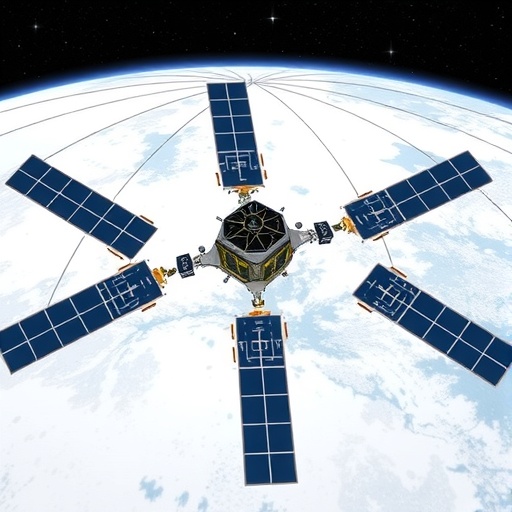
When an earthquake levels a city, the first satellite overhead may hold the only clear picture of the damage—but only if its constellation partners can agree, within minutes, on who images what, from where, and when. A study published on 28 August 2026 in the open-access Springer journal Aerospace Systems presents an artificial intelligence framework that lets fleets of Earth-observing satellites do exactly that: negotiate among themselves, divide the work, and settle their own scheduling disputes without waiting for instructions from the ground. Developed by researchers at the Shanghai Satellite Engineering Research Institute together with a collaborator at Jiangnan University in China, the algorithm—called IM-MADDPG—completed 11.1 percent more observation tasks than a genetic-algorithm scheduler in dynamic simulations, reacted to sudden emergency targets 55.9 percent faster, and cut collaborative conflicts in the schedule by 69.2 percent. Once trained, each satellite commits to a decision in under five milliseconds, fast enough to replan inside a single orbital pass.
The problem is deceptively simple to state and punishing to compute. Every move a satellite makes is dictated by orbital mechanics; its attitude maneuvers, imaging opportunities, and downlink windows all unfold under strict celestial constraints. Meanwhile, onboard resources—electrical energy, solid-state storage, and data-transmission bandwidth—are severely limited, and a single observation consumes them all at once. The result, the authors note, is a high-dimensional, nonlinear decision space in which system constraints are strongly coupled: a roll maneuver costs energy and time, an image fills memory, and memory can only be emptied through a communication window that may not open for hours. Add the operational tempo of disaster response, which demands minute-level reaction to sudden events, and a third complication appears: collaborative conflicts. Two satellites may covet the same transmission window or repeatedly image the same target, squandering propellant, battery life, and irreplaceable passes. Resolving such clashes efficiently, the researchers argue, is the difference between a coordinated constellation and an expensive flock of rivals.
Existing scheduling tools strain under exactly these conditions. The classical gold standard, mixed-integer linear programming solved with commercial engines such as Gurobi, can in principle deliver the theoretical optimum—but its computational cost explodes as satellites and tasks multiply, rendering it useless when minutes matter. Genetic algorithms, which iteratively breed candidate schedules through selection, crossover, and mutation, are a popular compromise, yet they stumble once the environment changes mid-plan. A third family of methods applies reinforcement learning but treats the whole constellation as a single giant agent; the joint state and action space then grows exponentially with every satellite added, a textbook case of the curse of dimensionality. The new study, with Zehao Zhang of the Shanghai institute as corresponding author, attacks all three weaknesses at once, combining multi-agent learning with mechanisms borrowed from auction theory and control engineering.
The mathematical foundation is a partially observable Markov decision process, or POMDP—a formal tuple comprising a global state space, local observations, a joint action space, state-transition probabilities, a reward function, and a discount factor. The global state contains the complete orbital and attitude states of every satellite, remaining onboard resources, and the spatiotemporal attributes and priorities of all tasks. But no single satellite perceives all of it: inter-satellite communication constraints mean each agent observes only its own state plus information about neighboring satellites and tasks within its line of sight or communication range. Actions are discrete choices—observe a visible task, remain idle, or conduct data transmission—while transition probabilities are supplied by the dynamics model of the commercial orbital toolkit STK. A global reward evaluates the quality of joint actions, and a discount factor balances immediate payoffs against long-term returns, all in service of autonomous collaborative optimization under centralized training with decentralized execution.
The team’s first major modification to the standard MADDPG recipe involves attention, the same mechanism behind modern language models. Instead of concatenating raw state vectors, each satellite builds a cooperative state summary by attending over its neighbors: a query derived from its own situation is matched against keys describing each neighbor, and the resulting weighted sum of their feature values captures implicit correlations between nearby satellites and pending tasks. This learned summary is concatenated with the satellite’s self-state and passed through an actor network of two fully connected hidden layers—512 and 256 neurons, with ReLU activations and batch normalization—ending in a softmax probability distribution over candidate tasks. A centralized critic network, which during training ingests the global state together with the actions of all agents, uses hidden layers of 1,024 and 512 neurons to output a single Q-value estimate of how good the joint action really is.
Learning is steered by a four-part reward function: a task-completion reward, penalty terms for violating energy and storage constraints, a collaboration reward for multi-satellite stereoscopic imaging, and a time-sensitivity penalty that rises as observation deadlines approach, scaled by a sensitivity coefficient. Observation time-window overlap penalties and hard resource constraints are written directly into the reward, so the policy internalizes physical limits rather than discovering them by crashing into them. Training stability comes from two further upgrades: prioritized experience replay, which samples stored transitions in proportion to the magnitude of their temporal-difference error, and soft target updates, which nudge the target networks’ weights by a small fraction at each step instead of replacing them outright. With these pieces in place, IM-MADDPG converges after roughly 2,000 training episodes—about 12.5 hours on a single NVIDIA RTX 3070 graphics card—and head-to-head convergence curves against mainstream multi-agent rivals including MAPPO, QMIX, and MARL-CCSA show it stabilizing with a final reward well above the field.
The second pillar is economics. When a new task is released, every satellite computes a bid as a weighted combination of its execution capability, its availability, and the expected profit from serving that task; the market mechanism allocates the job without any ground controller in the loop. Genuine clashes are settled by a physics-aware utility function: task priority multiplied by estimated imaging quality, divided by the cost of the attitude maneuver needed to resolve the conflict, which grows with slew angle and shrinks with maximum slew rate. The lower-utility satellite concedes, delaying its observation start time by an amount scaled to the ratio of required to remaining energy—so a power-starved spacecraft perceives the same angular adjustment as more expensive and yields sooner. A hybrid replanning mechanism, triggered both by events such as arriving tasks, degrading satellite health, or priority jumps, and by periodic review, then updates only the local policies of the satellites actually affected, leaving the rest of the constellation undisturbed.
To find out whether any of this survives contact with orbital reality, the researchers built a hybrid simulation pairing STK’s high-precision orbit and visibility propagation with a Python training stack built on PyTorch and Gym, and generated a standard test set from publicly available Sentinel-2 orbital parameters and globally distributed representative targets, ensuring physically authentic observation windows. Three scenarios were run: a static scenario with 100 point targets; a dynamic scenario in which tasks arrive as a Poisson process at 0.1 per minute; and an emergency scenario in which five priority-10 tasks are injected halfway through the simulation. Against three baselines—MILP solved with Gurobi, a genetic algorithm, and a single-agent reinforcement learner—evaluated over ten random seeds, IM-MADDPG came very close to the MILP optimum in the static case and pulled away whenever the clock was ticking. Task completion rose 11.1 percent above the genetic algorithm in the dynamic scenario and 8.5 percent in the emergency scenario; response times fell by 35.8 and 55.9 percent, respectively; and average conflicts stayed near zero across all scenarios, 69.2 percent below the alternatives. A paired-sample t-test placed the statistical significance of the improvements below 0.01.
Ablation experiments confirm that each innovation carries weight. The full model completes 92.4 percent of tasks; removing the attention mechanism drops completion to 88.6 percent, showing how much depends on extracting fine-grained collaborative features; removing market-based conflict resolution lowers it to 89.1 percent while average conflicts jump from 1.2 to 4.5; and disabling dynamic replanning sinks completion to 85.2 percent while response time balloons to 32.4 minutes. The team also compared Gantt charts for a stereoscopic imaging task, which demands that two satellites observe the same area within overlapping time windows. IM-MADDPG aligns its two satellites cleanly inside the overlap with no conflicts elsewhere in the schedule, while the genetic algorithm’s windows drift apart and no usable stereo image is produced. In emergency scenarios the AI constellation’s average response time was 15.6 minutes, whereas traditional genetic-algorithm replanning typically exceeds 30 minutes—long enough to miss the optimal cloud-free observation window after an earthquake. The authors frame the shift as turning post-disaster blind search into minute-level precise post-disaster guidance.
The authors are candid about the caveats. As a deep reinforcement learning method, IM-MADDPG requires thousands of environmental interactions before it earns its keep, and if a constellation swells to several hundred satellites, the rapid growth of the state space could stall training convergence. Although the simulations incorporate high-precision STK orbital data, they cannot fully reproduce onboard actuator delays, sensor noise, or the complex electromagnetic environment that degrades inter-satellite links, so real on-orbit performance may fall short of simulation. The method is also tailored to point-target observation by low-Earth-orbit optical remote sensing satellites; long-strip synthetic aperture radar mapping or continuous staring from geostationary orbit would require redesigned state and constraint models. Even so, the combination of near-optimal static performance, millisecond-level onboard inference, and self-organizing conflict resolution sketches a future in which mega-constellations are managed less like remotely piloted fleets and more like autonomous flocks that bid, concede, and cooperate in orbit while the ground simply tells them where to look. The work was funded by the National Natural Science Foundation of China and an Aerospace Science and Technology Corporation applied innovation project.
Subject of Research: Dynamic task planning for multi-satellite cooperative observation in dynamic environments using an improved multi-agent deep reinforcement learning algorithm (IM-MADDPG)
Subject of Research: Technology and Engineering
Article Title: Research on Dynamic Task Planning for Multi-Satellite Cooperative Observation Based on MADDPG
Article References: Luo, D., Tao, Y., Wang, Q., He, Y., Zhou, J., Zhang, Z., & Zhang, C. (2026). Research on Dynamic Task Planning for Multi-Satellite Cooperative Observation Based on MADDPG. Aerospace Systems. https://doi.org/10.1007/s42401-026-00516-8
Image Credits: AI Generated
DOI: 10.1007/s42401-026-00516-8
Keywords: Multi-satellite cooperative observation, Dynamic task planning, MADDPG, Multi-agent reinforcement learning, Observation scheduling, Conflict resolution, Attention mechanism, Centralized training and decentralized execution, Prioritized experience replay, Earth observation constellations
Cite Scienmag News
APA MLA Chicago
Florence R. (August 29, 2026). AI Method Enables Dynamic Task Planning for Multi-Satellite Cooperative Observation. Scienmag. https://scienmag.com/ai-method-enables-dynamic-task-planning-for-multi-satellite-cooperative-observation/
Florence R. “AI Method Enables Dynamic Task Planning for Multi-Satellite Cooperative Observation.” Scienmag, 29 August 2026, https://scienmag.com/ai-method-enables-dynamic-task-planning-for-multi-satellite-cooperative-observation/. Accessed 29 August 2026.
Florence R. “AI Method Enables Dynamic Task Planning for Multi-Satellite Cooperative Observation.” Scienmag. August 29, 2026. https://scienmag.com/ai-method-enables-dynamic-task-planning-for-multi-satellite-cooperative-observation/
Copy citation Download RIS
Tags: adaptive satellite task allocationAI-based satellite scheduling algorithmsAI-based satellite task schedulingAI-driven conflict resolution in satellite fleetsAI-driven conflict resolution in satellite networksautonomous satellite constellation coordinationautonomous satellite task negotiationcollision avoidance and resource optimization in satellite constellationsdynamic Earth observation planningdynamic satellite constellation managementemergency response satellite imagingfast decision-making in satellite constellationsfast decision-making in satellite operationsintelligent scheduling for Earth observation satellitesmachine learning for satellite cooperationmulti-satellite cooperation algorithmsMulti-satellite cooperative observation planningorbital mechanics and resource managementorbital mechanics constraints in satellite schedulingrapid satellite re-tasking in disaster scenariosreal-time satellite scheduling optimizationreal-time satellite task reallocationresource optimization in Earth observation satellites