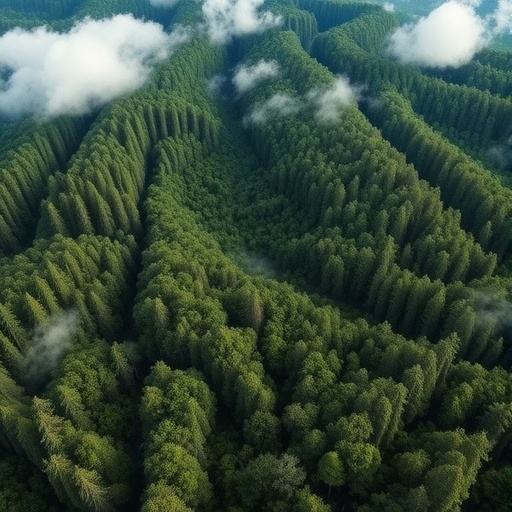
For decades, mature forests have been treated as if their ability to store additional carbon gradually fades toward a biological ceiling. Once trees fill the available space and their canopies close, conventional satellite measurements often suggest that forest biomass changes very little. A new analysis, however, indicates that this apparent stability may be partly an illusion created by the way satellites observe forests. Across the conterminous United States, mature forests continue to accumulate carbon over large areas, but much of that growth is being missed by current satellite-derived biomass estimates. The result could be a systematic underestimation of the land carbon sink, the natural process by which vegetation and soils remove carbon dioxide from the atmosphere.
The study, published in Nature Ecology & Evolution, focuses on mature forests, which account for approximately 72 percent of forested area in the conterminous United States. These ecosystems are particularly important in the global carbon cycle because they cover extensive landscapes and contain large stores of carbon in trunks, branches, roots and other living biomass. Their contribution is also scientifically difficult to measure. Young forests can show obvious changes as trees grow rapidly and canopy cover expands, but older forests may continue to gain carbon through slower increases in tree diameter, the growth of taller individuals, recruitment into larger size classes and changes in stand structure that are not easily translated into total biomass by satellite sensors.
The researchers compared several independent ways of detecting forest change, including satellite-derived biomass estimates, lidar observations, forest inventories and ecosystem models. Lidar, short for light detection and ranging, measures the time required for laser pulses to travel from an instrument to vegetation and back. By sampling the vertical arrangement of leaves, branches and stems, lidar can reveal forest structure, including canopy height and changes in the distribution of vegetation through the forest profile. Forest inventories provide another form of evidence by repeatedly measuring trees at established locations, recording characteristics such as species, diameter and height. Ecosystem models use observations and ecological relationships to estimate how carbon moves through forests over time. Together, these approaches provide a way to test whether a satellite signal reflects real biological change or simply reaches the limits of the measurement system.
The contrast between the measurements was striking. Satellite estimates indicated that biomass in mature forests had undergone nearly neutral change over recent decades, implying little overall gain or loss. Forest inventories, by comparison, estimated that mature forests were accumulating about 102 teragrams of carbon each year. A teragram is one million metric tonnes, so the estimated increase represents a substantial annual transfer of carbon into forest biomass across the United States. The agreement between inventory evidence, repeat lidar measurements and ecosystem models suggests that the apparent lack of growth in satellite records does not necessarily mean that mature forests have stopped accumulating carbon. Instead, it points to an observational gap concentrated in the forests that contain much of the country’s existing woody biomass.
That gap becomes especially clear when canopy height is considered. The analysis found that satellite estimates detected little additional biomass increase once canopy height rose above approximately 16 metres. This does not mean that forests taller than 16 metres cease to grow. Rather, it indicates that the satellite-based relationship between what the sensor observes and how much biomass is actually present becomes unreliable after forests reach a certain structural stage. Once the canopy is closed, additional carbon may be added through thickening trunks and branches, growth in large trees, understory development or subtle changes in vertical structure. Those changes can increase carbon stocks without producing a proportionate change in the broad canopy signal that many satellite biomass products rely on.
The problem is not simply that satellites are incapable of observing forests. Earth-observation systems are powerful tools for mapping forest cover, disturbance and large-scale structural differences, and they provide consistent measurements across enormous areas. The difficulty is that different forest processes leave different signatures in remotely sensed data. A forest can lose biomass through tree mortality, harvesting, fire or other disturbances, producing a detectable reduction in canopy structure. Gains in mature forests may be more gradual and distributed across many trees, making them harder to distinguish from measurement uncertainty, seasonal variation or natural differences between stands. The researchers describe this as an asymmetric bias: the observations are more likely to register losses than gains, which can make forests appear to be weaker carbon sinks than they are.
This asymmetry matters because carbon-cycle calculations depend not only on detecting dramatic changes, but also on measuring persistent, incremental accumulation. If a satellite product records a decline clearly but overlooks an equivalent or larger increase spread through mature stands, the resulting estimate will be biased downward. At continental and global scales, even a modest bias repeated across extensive forest areas can alter assessments of how much carbon terrestrial ecosystems remove from the atmosphere. The issue is particularly important for mature forests because they occupy most of the forest area examined in the study. Their growth may be slow compared with that of regenerating forests, but the carbon involved is distributed across a much larger existing stock and may continue year after year.
The findings also challenge a simplified view of forest carbon dynamics in which mature ecosystems rapidly approach saturation and then contribute little additional carbon storage. Forests are not storage tanks with a single fixed capacity that is reached when canopies close. Carbon enters through photosynthesis, as trees convert atmospheric carbon dioxide into organic matter, and it leaves through respiration, decomposition, mortality and disturbance. A mature forest’s net carbon balance depends on the difference between these processes. Even when overall canopy appearance changes very little, trees can continue to add wood, redistribute carbon among living tissues and replace carbon lost through mortality. The study does not imply that all mature forests accumulate carbon indefinitely or that their carbon stores are immune to disturbance. It shows instead that the observational tools used to estimate change may fail to capture widespread gains in structurally complex, already tall forests.
The authors’ conclusion is therefore both a warning and a roadmap for improving carbon accounting. Satellite biomass products remain essential for monitoring forests, but their estimates need to be integrated with measurements that are sensitive to structural change beyond canopy closure. Repeat lidar can help identify growth in height and vertical complexity, while inventories provide detailed ground-based evidence of changes in individual trees and stands. Ecosystem models can connect these observations to carbon fluxes and test whether estimated changes are consistent with forest ecology. Combining these sources should make it possible to distinguish genuine stability from growth that is hidden by the limitations of a particular sensor or algorithm. More accurate observations will be increasingly important as researchers assess the future of the land carbon sink and determine how forests respond to climate change, disturbance and management.
The central message is that the world’s mature forests may be quietly doing more carbon-storage work than satellite records currently acknowledge. Their canopies can look stable from above while their trunks, branches and internal structure continue to accumulate carbon. Because these forests cover such a large fraction of the US forest landscape, overlooking that growth can distort the national picture of carbon exchange and weaken estimates of the terrestrial sink. The study does not remove the uncertainty surrounding forests’ future role: warming, drought, fire, pests and other disturbances can all alter carbon balances. But it identifies a specific and correctable source of uncertainty. To understand how much carbon forests are storing, researchers must look beyond whether a canopy appears to change and measure how the entire forest structure evolves over time.
Subject of Research: Carbon accumulation and biomass change in mature forests across the conterminous United States
Subject of Research: Biology
Article Title: Widespread carbon accumulation in mature forests remains underestimated by satellite observations
Article References: Ma, L., Hurtt, G., Tang, H., Hao, D., Ciais, P., Pan, Y., Sitch, S., Friedlingstein, P., Dubayah, R., Nunes, M. H., & Wei, X. (2026). Widespread carbon accumulation in mature forests remains underestimated by satellite observations. Nature Ecology & Evolution. https://doi.org/10.1038/s41559-026-03151-w
Image Credits: AI Generated
DOI: 10.1038/s41559-026-03151-w
Keywords: mature forests, carbon accumulation, satellite observations, forest biomass, lidar, forest inventories, land carbon sink, canopy height
Cite Scienmag News
APA MLA Chicago
Lydia K. (August 29, 2026). Satellite observations underestimate widespread carbon accumulation in mature forests. Scienmag. https://scienmag.com/satellite-observations-underestimate-widespread-carbon-accumulation-in-mature-forests/
Lydia K. “Satellite observations underestimate widespread carbon accumulation in mature forests.” Scienmag, 29 August 2026, https://scienmag.com/satellite-observations-underestimate-widespread-carbon-accumulation-in-mature-forests/. Accessed 29 August 2026.
Lydia K. “Satellite observations underestimate widespread carbon accumulation in mature forests.” Scienmag. August 29, 2026. https://scienmag.com/satellite-observations-underestimate-widespread-carbon-accumulation-in-mature-forests/
Copy citation Download RIS
Tags: accuracy of satellite-based carbon estimatescarbon accumulation in mature forestscarbon accumulation in U.S. forestscarbon storage in mature forestscarbon storage in old-growth forestsclimate change impact on forest carbon dynamicsecological significance of mature forestsforest biomass measurement challengesforest biomass underestimationforest canopy closure and carbon uptakeforest carbon sequestrationglobal carbon cycle and forest ecosystemsglobal carbon cycle and mature forestsimpact of underestimating forest carbon storageland carbon sink underestimationlimitations of satellite observations in forestrymature forest carbon sequestrationremote sensing challenges in forest monitoringremote sensing of forest biomasssatellite imagery and forest biomass measurementsatellite measurement limitations in mature forestssatellite observation biasessatellite-based carbon measurement inaccuraciesunderestimated land carbon sink