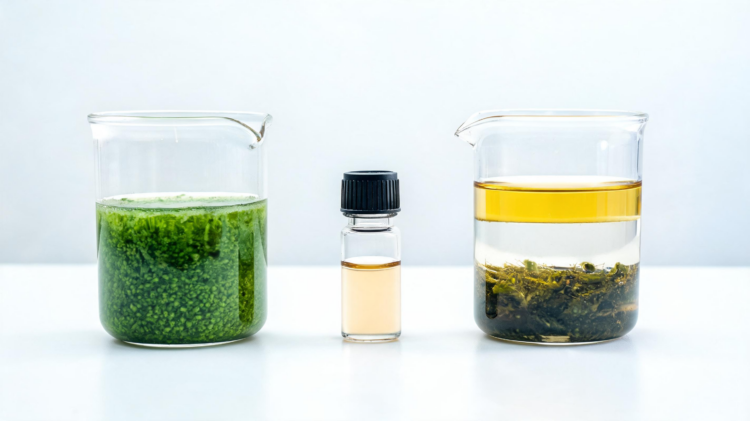
Microalgae are being investigated as compact biological factories for renewable fuels, and a new study suggests that an ionic liquid can help recover their energy-rich lipids under relatively mild processing conditions. Researchers working with the freshwater cyanobacterium Oscillatoria sp. found that tetrabutyl ammonium iodide, or TBAI, produced its highest lipid yield when the algae-to-ionic-liquid ratio was 1:2. Under those conditions, the process recovered 44.6 milligrams of lipids per gram of algal biomass, corresponding to an extraction efficiency of 4.46 percent. Chemical analyses indicated that the recovered material contained a broad mixture of fatty acids, with saturated compounds making up the largest fraction. The results do not establish a commercial fuel process, but they identify a solvent formulation and operating window that could guide further development of algal biorefineries.
Microalgae attract interest because they can grow in aquatic environments while using sunlight, water and carbon dioxide to produce carbohydrates, proteins and lipids. Unlike many terrestrial oil crops, they do not necessarily require fertile agricultural land, although large-scale cultivation still presents substantial demands for nutrients, energy and infrastructure. Their lipids can be converted into biodiesel through transesterification, a chemical reaction that turns fatty acids and related molecules into fatty acid methyl esters, or FAMEs. The overall pathway includes cultivation, harvesting, cell disruption, lipid recovery and fuel conversion. Each stage affects the economics and environmental profile of the final product, and extraction is a particularly important bottleneck because algal cells can retain lipids behind resistant cell walls. Conventional approaches may consume large amounts of energy or rely on volatile organic solvents, prompting researchers to examine alternative extraction media.
Ionic liquids are salts composed of positively and negatively charged ions that remain liquid at comparatively low temperatures. Their chemical structures can be adjusted by changing the cation or anion, allowing researchers to tune properties such as polarity, viscosity, water compatibility and affinity for particular compounds. In algal processing, an ionic liquid may weaken or disrupt the cell wall, alter its permeability, and help release intracellular biomolecules. The extracted material can then be transferred into a second solvent for separation. The approach is sometimes described as greener than traditional solvent systems because ionic liquids have low volatility and may be recoverable for reuse. However, their environmental performance depends on their toxicity, synthesis, persistence, energy requirements and successful recovery. In this experiment, TBAI was used to assist disruption and release, while hexane was still employed to collect the lipids from the treated liquid phase.
To prepare the biomass, the researchers cultivated Oscillatoria sp. in BG-11 medium, a nutrient-rich formulation widely used for freshwater algal and cyanobacterial cultures. The cultures were maintained at about 25 degrees Celsius under 3,000 lux illumination with a 16-hour light and eight-hour dark cycle and continuous aeration. After growth, the biomass was harvested by filtration, shallow-dried and ground into powder. For pretreatment, 0.5 grams of dried algae was combined with TBAI dissolved in 70 milliliters of distilled water. The suspension was stirred continuously at 80 degrees Celsius for three hours, after which centrifugation separated liquid and solid fractions. The liquid portion was acidified to pH 3 with concentrated hydrochloric acid. This step was intended to improve fatty-acid solubility in hexane before the researchers carried out three successive extractions.
During extraction, five milliliters of hexane was added to the acidified liquid, which was vortexed and centrifuged to promote phase separation. The researchers observed several layers, including an upper hexane phase, a viscous intermediate layer, an aqueous phase and algal residues. The hexane fractions were collected and combined, while the viscous material was retained for separate analysis. To determine the most effective amount of ionic liquid, the team compared algae-to-TBAI ratios of 1:1, 1:2 and 1:3. The 1:1 treatment yielded 36.4 milligrams of lipid per gram of biomass, or 3.64 percent. Increasing the amount of TBAI to the 1:2 ratio raised recovery to 44.6 milligrams per gram and 4.46 percent. A further increase to 1:3 reduced the yield to 29.4 milligrams per gram, or 2.94 percent, showing that more ionic liquid did not automatically improve extraction.
The researchers also tested whether reducing the amount of water would change TBAI performance. With the optimal 1:2 ratio, they dissolved the ionic liquid in 30 milliliters rather than 70 milliliters of water. The yield declined modestly to 36.6 milligrams per gram, equivalent to approximately 3.66 percent extraction efficiency. The relatively small reduction led the researchers to conclude that water content did not strongly impair TBAI-assisted extraction under their conditions. That observation differs from some earlier reports in which higher water content reduced lipid recovery, underscoring that the influence of water depends on the ionic liquid, algal species, biomass state and operating conditions. Because ionic liquids can be viscous, water may affect mixing, mass transfer and the movement of lipids between phases. It can also change interactions between the solvent and the algal cell wall, making water content an important variable for process design.
Several analytical methods were used to identify the recovered compounds. Preliminary phytochemical tests indicated steroids in the hexane fraction, while high-performance thin-layer chromatography compared the sample with stigmasterol and beta-sitosterol standards. The sample spot had a migration behavior consistent with beta-sitosterol, although the result was described as a possible identification rather than definitive structural proof. Fourier-transform infrared spectroscopy provided additional evidence that lipids were present. Peaks at 2,873.50 and 2,925.17 inverse centimeters were associated with methyl groups in free fatty acids and methylene stretching in lipid chains, respectively. A signal at 1,379.34 inverse centimeters was assigned to symmetric methyl bending. These spectral signatures are useful for confirming major chemical groups, but they do not by themselves establish the complete composition of a complex extract.
For more detailed compositional information, portions of the extract were converted into FAMEs and examined by gas chromatography-mass spectrometry. The 1:2 treatment, which generated the greatest total lipid recovery, produced a fatty-acid profile containing approximately 67.79 percent saturated fatty acids. The remaining 32.21 percent was unsaturated, including 14.42 percent monounsaturated fatty acids and 8.79 percent polyunsaturated fatty acids. Tridecanoic acid, designated C13:0, was the most abundant saturated fatty acid in this sample. By comparison, material from the 1:3 treatment contained about 51.06 percent saturated fatty acids after transesterification, with 16.65 percent monounsaturated and 32.29 percent polyunsaturated compounds. Before transesterification, the 1:3 extract contained approximately 56.89 percent saturated fatty acids, and dodecanoic acid, or C12:0, was the dominant saturated component. The analyses also detected a range of chain lengths, extending from shorter fatty acids to compounds around C28.
The dominance of saturated fatty acids may be relevant to fuel behavior because saturation generally improves oxidative stability and can support favorable combustion and storage properties in biodiesel. At the same time, fuel quality involves several competing characteristics: highly saturated esters may perform well in stability and ignition-related measures but can have poorer low-temperature flow properties than more unsaturated compounds. The study therefore supports a possible fuel advantage without demonstrating the performance of a finished biodiesel in an engine or standardized fuel test. It also highlights how extraction chemistry can influence which lipid classes and fatty acids are recovered. Results from other algal species and ionic liquids have varied widely, with some studies reporting higher yields after cell-wall disruption, different biomass loadings, organic co-solvents, microwave treatment or longer pretreatment periods. Such comparisons are informative but cannot be treated as direct rankings because species, solvent formulations and analytical procedures differ.
The reported maximum yield is consequently best viewed as an initial laboratory benchmark for TBAI and Oscillatoria sp., rather than evidence that the method is ready for industrial deployment. The process still uses heating, centrifugation, acidification and hexane, and the study did not yet establish how effectively TBAI can be recovered, purified and reused across repeated extraction cycles. Those questions are central to both cost and environmental assessment. Loss of ionic liquid into waste streams, solvent replacement, energy consumption and the handling of acid and hexane would all need to be quantified in a life-cycle analysis. The researchers identify TBAI recyclability and improved extraction efficiency as priorities for future work. Further experiments could also examine wet biomass, higher solids concentrations, alternative separation strategies and the fuel properties of the resulting FAMEs. For now, the findings show that carefully balancing ionic-liquid concentration and water content can shape the recovery and composition of microalgal lipids, offering a technically defined starting point for more sustainable biofuel research.
The reported mass should be interpreted as crude extract recovery rather than as a direct measure of biodiesel yield. The analytical results indicate that the extract included several chemical classes, including fatty acids and sterol material, with beta-sitosterol identified as a possible component by comparison with standards. Consequently, the fraction ultimately convertible to fatty-acid esters may differ from the gravimetrically measured lipid mass. This distinction matters when comparing extraction treatments: a condition that recovers more total material may not recover the same proportion of fuel-relevant fatty acids.
The separation sequence also provides important clues for future process optimization. Acidification, repeated hexane contact and centrifugation were used to move target compounds away from the aqueous and residual biomass fractions, but these operations create several streams that would require characterization in a larger process. Measuring lipid losses in the solid, aqueous and viscous layers would help establish a fuller mass balance and clarify whether incomplete cell disruption or phase-transfer limitations constrain recovery. Likewise, the reported infrared peaks confirm characteristic lipid-associated chemical groups, whereas chromatographic analysis is needed to resolve individual fatty acids. A stronger assessment would therefore combine recovery, composition, ionic-liquid recycling and energy demand rather than relying on yield alone. Such measurements could show whether TBAI’s extraction benefit remains meaningful after accounting for pretreatment and downstream separation requirements.
Subject of Research: TBAI-assisted lipid extraction from microalgal biomass for biofuel research
Article Title: Ionic liquids assisted microalgal lipids extraction and characterization
Article References: MubarakAli, D., Jeno Andro Nicus, X., Mohamed Idris, M. E., Sangeetha, K., & Nooruddin, T. (2026). Ionic liquids assisted microalgal lipids extraction and characterization. Blue Biotechnology, 3(1), Article 10. https://doi.org/10.1186/s44315-026-00060-2
Image Credits: AI Generated
DOI: 10.1186/s44315-026-00060-2
Keywords: microalgae, ionic liquids, TBAI, lipid extraction, biofuels, Oscillatoria, fatty acids, biodiesel, Ionic, liquids, assisted, microalgal
Cite Scienmag News
APA MLA Chicago
Scienmag. (August 29, 2026). Ionic Liquid Boosts Microalgal Lipid Extraction for Biofuel Research. https://scienmag.com/ionic-liquid-boosts-microalgal-lipid-extraction-for-biofuel-research/
Scienmag. “Ionic Liquid Boosts Microalgal Lipid Extraction for Biofuel Research.” Scienmag, 29 August 2026, https://scienmag.com/ionic-liquid-boosts-microalgal-lipid-extraction-for-biofuel-research/. Accessed 29 August 2026.
Scienmag. “Ionic Liquid Boosts Microalgal Lipid Extraction for Biofuel Research.” Scienmag. August 29, 2026. https://scienmag.com/ionic-liquid-boosts-microalgal-lipid-extraction-for-biofuel-research/
Copy citation Download RIS
Tags: algae-to-biofuel process optimizationassistedbiodieselbiofuelscyanobacteria lipid recoveryfatty acid profile in microalgaefatty acidsfreshwater cyanobacterium lipid yieldIonicionic liquid biofuel productionionic liquidsionic liquids in bioenergy applicationslipid extractionliquidsMicroalgaemicroalgae cultivation for biodieselmicroalgalmicroalgal lipid extractionOscillatoriarenewable algae-based fuelsscalable microalgal biorefinery techniquessolvent-assisted microalgae lipid extractionsustainable biofuel feedstockTBAI