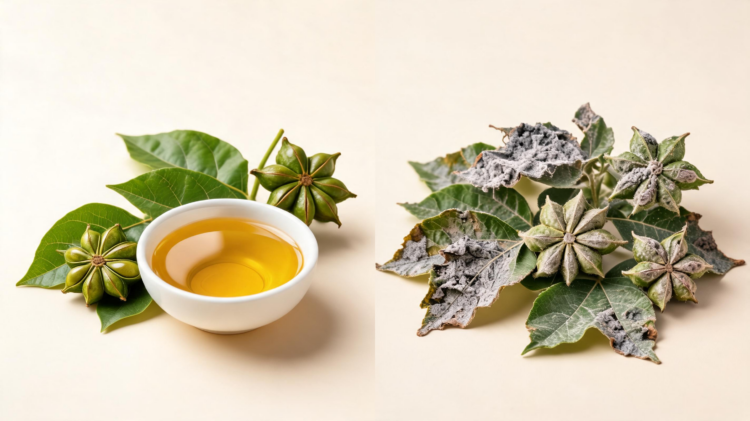
Aromatic plants from Peru’s Andean-Amazonian region may offer new starting points for controlling gray mold, a destructive disease that affects crops before and after harvest. In a study published in Plant Biosystems, researchers analyzed essential oils from nine native plant species and tested their ability to inhibit the growth of Botrytis cinerea, the fungus responsible for gray mold. Two oils stood out: those extracted from Baccharis genistelloides and Peperomia inaequalifolia produced the strongest activity in laboratory assays. The findings do not yet demonstrate that either oil can protect crops in commercial storage or fields, but they identify chemically distinct natural products that warrant further investigation. They also add data on plants whose volatile chemistry remains poorly characterized, including the Andean species Gynoxys malcabalensis. For researchers seeking alternatives to conventional fungicides, the work illustrates how regional plant diversity can expand the search for disease-management compounds.
Botrytis cinerea is a generalist plant pathogen capable of infecting numerous fruits, vegetables and ornamental crops. Its gray mold disease commonly develops when tissues are wounded, aging or exposed to humid conditions, and infections can spread rapidly during transport and storage. The fungus produces abundant spores, allowing it to move between plants and commodities, while its flexible lifestyle helps it colonize living and dead plant material. Repeated use of chemical fungicides has also contributed to resistance in some Botrytis populations, increasing interest in complementary approaches. Essential oils are complex mixtures of volatile compounds produced by plants, often including terpenes and oxygen-containing derivatives. These molecules can affect microbial membranes, disrupt cellular functions or interfere with fungal development, although their activity depends on the particular compounds, their concentrations and how they interact. Because essential oils vary with species, geography, plant tissue and environmental conditions, chemical characterization is essential before biological results can be interpreted or reproduced.
The researchers used gas chromatography–mass spectrometry, commonly abbreviated GC–MS, to examine the oils’ chemical profiles. In this technique, gas chromatography separates volatile molecules according to properties such as volatility and their interactions with the column, while mass spectrometry records characteristic fragmentation patterns that help identify them. The approach allowed the team to compare the dominant constituents of oils obtained from the nine selected native species. The plants produced markedly different quantities of oil. The yield ranged from 0.25 percent for B. genistelloides to 1.28 percent for P. inaequalifolia, indicating that extraction efficiency differed substantially among species. The chemical profiles also fell into distinct broad patterns: some were dominated by monoterpene hydrocarbons, others by oxygenated monoterpenes, and others by sesquiterpene hydrocarbons. Such differences are important because two oils can share the same general botanical origin yet behave very differently against a pathogen when their constituent mixtures differ.
The most striking result came from P. inaequalifolia, whose oil was rich in oxygenated monoterpenes and contained eucalyptol as its principal identified component, at 35.22 percent. In the laboratory, the oil completely inhibited fungal mycelial growth at a concentration of 500 microliters per liter. Its median effective dose, or ED50, was 200.63 microliters per liter. ED50 represents the concentration estimated to reduce the measured biological response by half, so lower values generally indicate greater potency under the tested conditions. The oil also had an ED90/ED50 ratio of 1.31. This relatively small ratio indicates a steep concentration–response relationship: a modest increase above the concentration associated with half-maximal inhibition produced a much stronger effect. The result makes P. inaequalifolia an especially interesting candidate for follow-up studies, while also emphasizing that laboratory potency alone does not establish safety, stability or practical effectiveness on harvested produce.
Baccharis genistelloides produced the lowest ED50 among the oils tested, at 71.50 microliters per liter, making it the strongest performer by that measure. Its chemical profile differed sharply from that of P. inaequalifolia. Rather than being dominated by oxygenated monoterpenes, the B. genistelloides oil was characterized by sesquiterpenes, particularly gamma-muurolene and delta-cadinene. The contrast suggests that strong antifungal activity may arise through more than one chemical route. A single abundant constituent may contribute substantially, but activity can also reflect additive or synergistic effects among several compounds present at lower concentrations. The study’s results do not identify which individual molecule, or combination of molecules, is responsible for inhibiting B. cinerea. Determining that mechanism will require experiments with purified compounds, reconstructed mixtures and tests designed to distinguish effects on fungal membranes, respiration, spore germination and mycelial growth.
Several other oils showed intermediate activity. These came from Gynoxys malcabalensis, Piper acutifolium, Piper lanceifolium and Siparuna muricata. The study provides the first chemical characterization and antifungal evaluation reported for the essential oil of G. malcabalensis, adding a new entry to the phytochemical record of an understudied Andean plant. By contrast, oils from Baccharis latifolia and the Purple and Yellow cultivars of Arracacia xanthorrhiza were comparatively weak in the assay, with ED50 values above 900 microliters per liter. That range of responses is scientifically useful. It shows that “essential oil” is not a single type of treatment and that closely related or locally available plants cannot be assumed to have equivalent antifungal properties. Chemical composition must be measured alongside biological activity, and the performance of each oil must be evaluated under the conditions relevant to its intended use.
The research is relevant to postharvest disease management because essential oils can potentially be applied to crop surfaces, packaging materials or storage environments. Their volatility may allow active compounds to contact fungal growth without requiring the same application strategy as a conventional liquid fungicide. However, translating an in vitro result into a usable treatment involves multiple hurdles. An oil must remain effective on a real commodity, where waxes, moisture, temperature and surface texture can alter its distribution. It must not damage the fruit or vegetable, change its flavor or aroma undesirably, or create unacceptable residues. Formulation is another challenge: volatile compounds can evaporate, oxidize or separate from water-based preparations. Encapsulation and controlled-release systems may improve stability, but these approaches require independent testing. Dose, exposure time and application method must also be optimized, and any treatment would need evaluation for effects on beneficial microorganisms and other organisms in the production system.
The authors describe the oils from P. inaequalifolia and B. genistelloides as promising sources of antifungal compounds for future postharvest applications, but the evidence remains an early-stage screening result. The experiments were conducted against B. cinerea under controlled laboratory conditions rather than on infected plants, commercial fruit or stored produce. The study therefore establishes comparative activity, not a ready-to-deploy biopesticide. Future work will need to confirm the findings across fungal isolates, assess the oils’ toxicity and phytotoxicity, identify active components and examine how chemical profiles change with cultivation site, harvest stage and extraction procedure. Trials on representative crops will be particularly important because an effective concentration in culture medium may not behave similarly on a fruit surface. Even with those limitations, the study highlights a practical research strategy: combine chemical profiling with direct pathogen assays to discover locally available plant resources that could support more diverse and sustainable crop-protection systems.
The study’s comparison between oil yield and antifungal potency raises an important practical distinction. Baccharis genistelloides generated the lowest reported oil yield, yet its oil had the lowest ED50 in the test system. Conversely, a higher extraction yield does not automatically predict stronger biological activity. Production planning would therefore need to consider at least two separate variables: how much oil can be obtained from plant material and how much oil is required to produce a defined inhibitory effect. A species that is highly active but produces little oil could still be valuable if its active constituents can be concentrated, reproduced through cultivation or incorporated into a formulation efficiently.
The chemical groupings reported by the researchers can also help organize subsequent experiments. Oils dominated by monoterpene hydrocarbons, oxygenated monoterpenes or sesquiterpene hydrocarbons represent different starting mixtures, but these broad categories do not by themselves explain antifungal performance. The abundance of a compound is only one consideration; volatility, chemical stability, interactions among constituents and the biological accessibility of the mixture may all influence the measured response. Comparing oils with similar major chemical classes, while also examining their minor constituents, could help determine whether activity tracks a specific molecule, a chemical family or a combination of compounds.
Interpretation of the concentration–response data will benefit from distinguishing the biological endpoint being measured. The reported inhibition concerns fungal mycelial growth in vitro, an important indicator of activity but not a complete description of the pathogen’s life cycle. A candidate oil might affect germination, spore production or establishment on plant tissue differently from established mycelium. Follow-up assays could therefore test several stages of B. cinerea development and use multiple isolates. Such comparisons would indicate whether the observed effects are broadly reproducible or depend on the particular fungal population and laboratory conditions used in the initial screening.
Reproducibility will likewise depend on documenting the plant material and extraction process in detail. Essential-oil composition can vary among botanical populations, and the study’s focus on native plants from a geographically distinctive region makes chemical reference data especially valuable. The newly characterized Gynoxys malcabalensis oil provides a baseline for comparisons with related species and future collections. Access to the underlying data upon request may support those comparisons, including reassessment of constituent identifications and activity estimates. Building such a record is an essential step before promising oils can be evaluated as consistent agricultural inputs rather than as one-time extracts from a particular collection.
Subject of Research: Antifungal activity of essential oils from native northern Peruvian plants against Botrytis cinerea
Article Title: Chemical characterization and in vitro antifungal activity of essential oils from selected native plants of the Andean-Amazonian region of northern Peru against Botrytis cinerea (Sclerotiniaceae)
Article References: Mena-Chacon, L. M., Chávez-Chacón, E., Coronel-Castro, E., Santillan-Huaman, N., Rojas-Vargas, J., Huaman-Pilco, J., Mondragon-Herrera, E., Oliva, M., & Huaman-Pilco, A. F. (2026). Chemical characterization and in vitro antifungal activity of essential oils from selected native plants of the Andean-Amazonian region of northern Peru against Botrytis cinerea (Sclerotiniaceae). Plant Biosystems, 160(5), Article 260. https://doi.org/10.1007/s44473-026-00258-7
Image Credits: AI Generated
DOI: 10.1007/s44473-026-00258-7
Keywords: essential oils, Botrytis cinerea, gray mold, Peru, plant pathology, biopesticides, GC–MS, postharvest disease, natural products, Chemical, characterization, vitro
Cite Scienmag News
APA MLA Chicago
Scienmag. (August 29, 2026). Peruvian Plant Oils Show Promise Against Crop-Damaging Gray Mold. https://scienmag.com/peruvian-plant-oils-show-promise-against-crop-damaging-gray-mold/
Scienmag. “Peruvian Plant Oils Show Promise Against Crop-Damaging Gray Mold.” Scienmag, 29 August 2026, https://scienmag.com/peruvian-plant-oils-show-promise-against-crop-damaging-gray-mold/. Accessed 29 August 2026.
Scienmag. “Peruvian Plant Oils Show Promise Against Crop-Damaging Gray Mold.” Scienmag. August 29, 2026. https://scienmag.com/peruvian-plant-oils-show-promise-against-crop-damaging-gray-mold/
Copy citation Download RIS
Tags: Andean-Amazonian region crop disease controlbiopesticidesBotrytis cinereacharacterizationchemicalchemical profiling of Peruvian medicinal plantsEssential oilsessential oils against Botrytis cinereaGC–MSgray moldnative Peruvian plant species antimicrobial propertiesnatural fungicides for gray moldnatural productsnatural products research for crop disease resistancePeruPeruvian aromatic plantsplant pathologyplant-derived compounds for fungal inhibitionpostharvest diseasepotential of Baccharis genistelloides and Peperomia in agricultureregional plant diversity in disease managementsustainable crop protection alternativesvitrovolatile chemistry of Andean plants