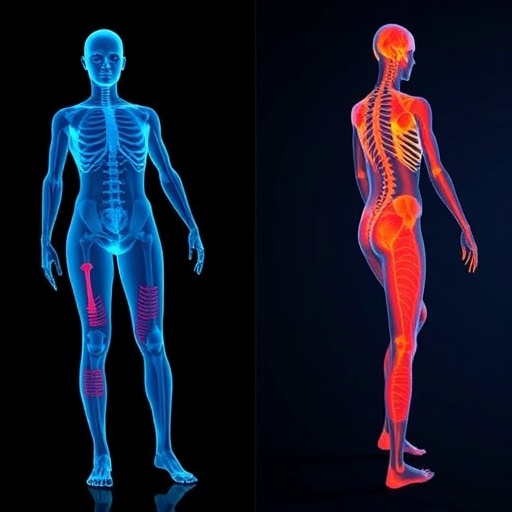
A new approach to designing sports compression leggings could replace static body measurements with a moving map of how skin stretches and compresses during running. The method, developed by researchers at The Hong Kong Polytechnic University, uses four-dimensional digital body scanning to track changes across the lower limb and convert them into garment patterns. The result is a six-panel legging design whose seams and fabric zones are positioned according to the body’s changing biomechanics rather than relying solely on measurements taken while a person stands still.
Compression garments are widely used by endurance athletes and players in field sports. Their close fit is intended to limit soft-tissue vibration, support venous return and muscle blood flow, and improve the wearer’s sense of stability and comfort. Evidence that they directly enhance athletic performance, however, remains mixed. The researchers behind the new design argue that one reason may be that many garments are engineered from static anthropometric data. A pair of leggings can fit well when a person is motionless yet become restrictive, wrinkle or create concentrated pressure when the hips and knees repeatedly flex during running.
The central problem is that skin does not deform uniformly. As a runner moves through a stride, some regions lengthen while neighboring areas shorten or remain relatively stable. The effects are especially pronounced near joints, where bones rotate and soft tissues shift. If a fabric’s stretch direction does not correspond to the direction in which the skin is moving, the material can resist motion or bunch up. Seams crossing a high-deformation zone may also experience greater traction, potentially increasing discomfort. Conventional patternmaking rarely captures these phase-specific changes in sufficient detail, leaving designers to estimate how a garment will behave from static shape and experience.
To measure the changing surface, the researchers recruited six healthy men with an average age of 28. Their mean height was 178.5 centimeters, mean weight was 82.5 kilograms and average body-mass index was 25.9. Each participant ran barefoot on a treadmill at 6 kilometers per hour for two minutes, allowing the team to capture motion during a steady running state. All participants were right-leg dominant, so the right leg was selected for analysis. The scanning system used six camera groups and 360-degree surface capture, recording at 60 frames per second for the experiment, with a stated accuracy of 0.7 millimeters.
The team placed 108 thin adhesive markers across each participant’s hip, thigh, knee and calf. Rather than positioning the markers at identical distances on every person, the researchers used anatomical landmarks and proportional divisions to create a comparable grid. The grid contained 15 transverse levels and eight longitudinal columns, dividing the leg into anterior, lateral, posterior and medial sectors. This marker system solved a major challenge in dynamic scanning: identifying the same location from one posture to the next. A scanner can record the body’s shape in successive frames, but without landmarks or computational correspondence it cannot reliably establish whether a surface point in one frame is the same point observed later.
The researchers selected five representative moments from a running cycle: initial contact, mid stance, toe off, mid swing and late swing. For each anatomical region, they compared its surface area during these phases with its area in a standing posture. Relative area deformation was calculated as the change in area divided by the standing area, expressed as a percentage. The team then used cubic spline interpolation to turn measurements at the marker locations into continuous strain fields across the leg. In mathematical terms, the interpolation produces a smooth surface with continuous first and second derivatives, avoiding the abrupt jumps that could arise if values between markers were connected by simple straight lines. The resulting maps showed tensile regions, compressive regions and neutral boundaries across the moving limb.
The most dramatic changes clustered around the hip and knee. The anterior hip shifted from compression toward stretching during the stance portion of the stride, reaching elongation of up to about 10 percent in many participants near toe off. The posterior hip followed a different trajectory, gradually moving toward a neutral state during stance and then becoming elongated during the swing phase. The anterior knee remained tensile throughout the gait cycle, with peak elongation exceeding 20 percent at toe off or mid swing, depending on the individual. The posterior knee showed the opposite behavior: it remained compressive, with maximum compression greater than 30 percent below the standing reference during mid swing. By contrast, the medial and lateral knee, posterior calf and medial calf generally remained close to neutral, with most values within 10 percent of the standing configuration.
Statistical analysis confirmed that deformation depended on both the phase of motion and the anatomical region. A linear mixed-effects model accounted for repeated measurements within each participant while testing posture, region and their interaction. Compared with initial contact, deformation was significantly lower during mid swing and late swing but higher at toe off. The posterior hip and anterior knee showed greater deformation than the anterior hip, while the posterior knee showed less. Crucially, the interaction between posture and region was significant, demonstrating that the same running phase did not affect every part of the leg in the same way. The anterior knee had a particularly strong positive response during mid swing, while the posterior hip at toe off and posterior knee at mid swing showed pronounced negative deviations.
The researchers translated these maps into garment architecture using isolines, or contours joining points with the same deformation value. The zero-percent isoline marked a neutral corridor separating tensile and compressive zones, while contours at plus or minus 10 percent identified areas of relatively high deformation. Placing seams along or near neutral corridors could reduce mismatches between neighboring fabric panels, limiting seam tension, wrinkling and localized pressure. Regions with similar deformation patterns were merged, while areas separated by clear strain boundaries were assigned to different panels. The final virtual design contained six functional panels, each associated with a characteristic magnitude and direction of skin movement.
Area change alone was not enough to select fabric. Knitted compression textiles are anisotropic, meaning they can stretch differently along different directions, often corresponding to the fabric’s wale and course orientations. The team therefore measured transverse and longitudinal changes in selected regions, particularly during mid swing, when both tensile and compressive deformation were prominent. On the front of the leg, transverse stretch reached 10.7 percent in the thigh, 12.3 percent at the knee and 6.2 percent in the calf. Longitudinal measurements showed compression at the front hip of up to 18.5 percent, while the anterior knee combined central tension of 29.3 percent with lateral compression of 21.6 percent. On the back of the leg, the hip showed 11.3 percent transverse tension and as much as 25.1 percent longitudinal tension, whereas the posterior knee reached 42.4 percent longitudinal compression.
These directional measurements provide a blueprint for matching fabric behavior to local biomechanics. A panel exposed to substantial tensile deformation could be assigned a more extensible textile or oriented so that its greatest stretch follows the skin’s movement. A relatively stable region could instead receive a firmer material intended to provide support. Transition zones between these areas could be designed to smooth pressure gradients rather than forcing one fabric to accommodate sharply different demands. The framework therefore links the body’s measured motion to pattern geometry, seam placement and material zoning in a single workflow that combines 4D scanning, mathematical reconstruction and three-dimensional garment software.
The findings do not yet establish that the resulting leggings improve running speed, reduce injury risk or enhance recovery. The study was exploratory and involved only six young adult men running on a treadmill at one speed. The authors emphasize that the deformation maps should not be treated as universal rules for women, older adults, people with different body shapes or athletes performing other movements. Squatting, cycling and jumping may generate different strain patterns, and outdoor running could alter them as well. The study also analyzed selected gait phases rather than every frame of multiple strides, and its marker-assisted method may be difficult to scale for routine commercial design.
Even with those limitations, the work points toward a broader shift in wearable technology: clothing can be designed around dynamic human movement rather than a frozen body shape. The researchers’ dynamic skin deformation-informed patterning framework offers a quantitative way to make that shift. Future versions could use automated marker detection, fewer fiducial markers or markerless surface-tracking algorithms to process more strides and larger, more diverse populations. If validated, the approach could extend beyond compression leggings to cycling skinsuits, rehabilitation garments and other adaptive clothing in which comfort and function depend on how fabric and skin move together.
Subject of Research: Dynamic skin deformation-informed design of sports compression leggings using 4D digital body scanning
Subject of Research: Technology and Engineering
Article Title: Data-driven dynamic skin deformation approach using 4D digital body scanning for ergonomic design of sports compression leggings
Article References: Wang, A., Liu, R., & Li, H. (2026). Data-driven dynamic skin deformation approach using 4D digital body scanning for ergonomic design of sports compression leggings. Results in Engineering, 32, Article 112489. https://doi.org/10.1016/j.rineng.2026.112489
Image Credits: AI Generated
DOI: 10.1016/j.rineng.2026.112489
Keywords: 4D body scanning, skin deformation, compression leggings, sportswear design, running biomechanics, strain mapping, ergonomic garments, textile engineering
Cite Scienmag News
APA MLA Chicago
SCIENMAG. (August 28, 2026). 4D Body Scans Enable Data-Driven Skin Modeling for Better Compression Leggings. https://scienmag.com/4d-body-scans-enable-data-driven-skin-modeling-for-better-compression-leggings/
SCIENMAG. “4D Body Scans Enable Data-Driven Skin Modeling for Better Compression Leggings.” Scienmag, 28 August 2026, https://scienmag.com/4d-body-scans-enable-data-driven-skin-modeling-for-better-compression-leggings/. Accessed 28 August 2026.
SCIENMAG. “4D Body Scans Enable Data-Driven Skin Modeling for Better Compression Leggings.” Scienmag. August 28, 2026. https://scienmag.com/4d-body-scans-enable-data-driven-skin-modeling-for-better-compression-leggings/
Copy citation Download RIS
Tags: 4D body mapping for apparel4D body scanning4D digital body imaging4D digital body scanningadaptive sportswear innovationathletic performance enhancement through custom fitbiomechanical movement analysisbiomechanical skin deformation modelingbiomechanics-based garment patterningdata-driven athletic weardata-driven garment designdynamic garment patterningdynamic sports compression leggingsgarment fitting during physical activityimproving compression garment performanceinnovative sportswear engineeringlower-limb biomechanicsmoving body measurement technologypersonalized athletic apparel designreal-time body measurement technologyreducing restrictive pressure in compression clothingskin deformation during runningskin stretch and compression analysissports compression leggings design