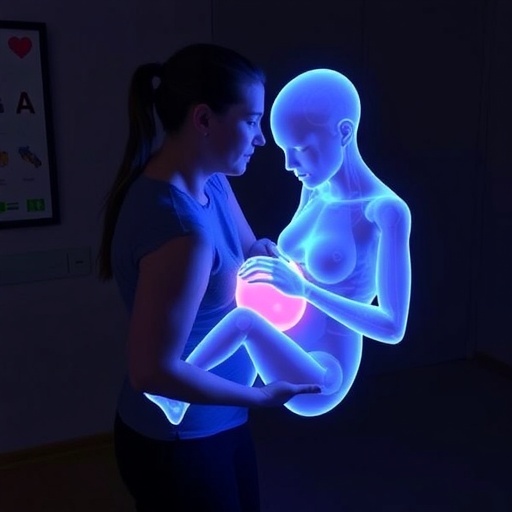
Childbirth training is moving into the augmented-reality era with a simulator that lets trainees see their hands as “ghost” images, compare them with expert-recommended positions and receive immediate feedback while practising on a physical obstetric mannequin. Called BirthARssistant, the system combines Microsoft HoloLens 2, three-dimensional printing, electromagnetic tracking and motion-capture software to teach the delicate hand coordination required during vaginal delivery. In an initial workshop involving 11 gynecology residents, midwifery residents and final-year medical students, the technology was associated with substantial improvements in hand placement and reductions in movement errors. The developers say the approach could make obstetric simulation more objective, repeatable and less dependent on continuous expert observation.
The practical problem the simulator addresses occurs during the final stages of vaginal birth, when clinicians must guide the emerging fetus while protecting the mother’s perineum—the tissue between the vaginal opening and anus. Perineal injury can cause pain, infection and longer-term functional problems, and manual protection techniques are intended to reduce those risks. Yet the manoeuvres are difficult to learn from written descriptions or lectures because they depend on the precise position of individual fingers, the direction of pressure and the timing of movements over a brief period. The source study notes that previous research has found only 5.6 per cent of professionals performing the technique adequately, highlighting the gap between knowing the recommended steps and executing them correctly under pressure.
Traditional mannequin-based simulation offers a safe environment in which trainees can repeat a delivery without endangering a patient. However, its educational value often depends on an expert standing beside the learner, watching hand movements and providing verbal corrections. That arrangement can introduce subjectivity: two instructors may judge the same posture differently, while trainees may receive inconsistent opportunities to practise. BirthARssistant was designed to turn those observations into measurable data. Rather than merely showing an anatomical model or a prerecorded demonstration, it tracks where the trainee’s hands and fingers are located in three-dimensional space and compares those coordinates with reference postures recorded from an experienced obstetrician.
The physical setup uses a PROMPT Flex–Advanced mother-and-fetus mannequin. Three electromagnetic sensors from a 3D Guidance trakSTAR system are attached to the mannequin: one to the mother and two to the fetus, positioned at the head and body. Electromagnetic tracking is useful in this context because it does not require a camera to maintain a direct line of sight with every sensor, unlike many optical tracking systems. A separate sensor mounted on a pointer helps register the physical mannequin with its digital counterpart. The system also uses a custom three-dimensional-printed holder to place a QR marker at a fixed position on the mother mannequin. When the HoloLens detects the marker, it can establish a stable reference frame and anchor the virtual anatomy to the real object.
That registration process is crucial to making augmented reality clinically meaningful. If the virtual pelvis, fetal head or digital hands were even slightly displaced from the corresponding physical structures, the visual guidance could become misleading. In BirthARssistant, tracking data are processed through a customised module in the open-source medical-imaging platform 3D Slicer. The resulting geometric transformations—mathematical descriptions of position and orientation—are sent to the Unity game engine using OpenIGTLink, a communication protocol designed for real-time medical-image and navigation systems. Unity then delivers the updated scene to HoloLens 2 through Holographic Remoting. If the QR code becomes temporarily hidden, the software retains its last valid pose; if detection is lost for more than two seconds, the system pauses pose updates and signals the failure visually.
The simulator divides the delivery procedure into seven hand positions. During an initial session, the head of the Maternal–Fetal Medicine Service at Madrid’s Hospital General Universitario Gregorio Marañón demonstrated the intended posture of the dominant and non-dominant hands at each stage. The dominant hand primarily protects the perineum during the emergence of the fetal head and shoulders, while the other hand initially follows and controls descent of the fetal head and later stabilises it. As the shoulders and trunk are delivered, the hands work together and the dominant hand supports the newborn. These expert postures were stored digitally. During training, the reference hands appear in purple, while the trainee’s tracked hands appear in blue. When the trainee moves close enough to the target posture, the digital hands turn green, creating a simple visual signal that the position is sufficiently accurate.
The system records the three-dimensional coordinates of 25 joints in each hand, allowing performance to be evaluated more precisely than by visual inspection alone. Researchers calculated positional error by aligning the participant’s hand at the wrist with the reference hand and measuring the average Euclidean distance between corresponding joint points. In other words, the metric captures how far the learner’s fingers and other tracked joints are from the expert configuration in millimetres. They also calculated angular error, measuring differences in clinically important configurations such as the opening between the thumb and index finger. Those measurements matter because a hand can be located near the correct place while still having the wrong finger orientation, potentially changing how it supports the perineum or guides the fetal head.
Each participant completed three simulations: an unassisted attempt based on personal clinical judgement, a guided attempt using the displayed reference postures and a final attempt without guidance, intended to test whether the learner retained what had been practised. Four participants were gynecology residents, three were midwifery residents and four were final-year medical students. Nearly two-thirds had never used augmented reality or HoloLens 2. Comparing the first and final attempts, correct hand positioning increased by 57.1 per cent, while correct use of the dominant hand increased by about 30 per cent, with statistically significant differences for both measures. Mean positional error fell from approximately 65 millimetres to 47 millimetres, and mean angular error declined from roughly 12 degrees to 8 degrees. The largest difficulties initially appeared in the earliest and most complex positions, but those configurations also showed notable improvement after training.
The findings suggest that real-time visual feedback can help learners identify mistakes that are otherwise easy to miss, particularly when the error involves finger opening or the division of responsibility between the two hands. Participants responded favourably to the technology: all considered the application intuitive and useful for learning, all said they would integrate it into training programmes and 91.9 per cent reported that it helped them identify and correct erroneous practices. The researchers caution, however, that the evaluation was small and conducted at a single hospital, so the results cannot yet establish that the simulator improves clinical outcomes or reduces perineal injuries in actual births. Larger studies involving multiple institutions and more varied healthcare professionals will be needed. Even so, BirthARssistant illustrates how augmented reality can add a measurable layer to hands-on medical education: the mannequin supplies physical resistance and context, while tracking and digital overlays expose the invisible geometry of a trainee’s movements, potentially shortening the path from classroom practice to safer clinical care.
Subject of Research: An augmented-reality simulator for training hand positioning and manoeuvres during vaginal childbirth
Subject of Research: Medicine
Article Title: BirthARssistant: a childbirth delivery training simulator integrating microsoft HoloLens2, 3D-printing and electromagnetic tracking
Article References: González Aranda, A., Sevilla-García, M., de León Luis, J., Pascau, J., & Pose-Díez-de-la-Lastra, A. (2026). BirthARssistant: a childbirth delivery training simulator integrating microsoft HoloLens2, 3D-printing and electromagnetic tracking. International Journal of Computer Assisted Radiology and Surgery. https://doi.org/10.1007/s11548-026-03780-3
Image Credits: AI Generated
DOI: 10.1007/s11548-026-03780-3
Keywords: Birth delivery training, augmented reality, electromagnetic tracking, medical simulation, 3D printing, hand tracking, obstetric education
Cite this news
APA MLA Chicago
SCIENMAG. (August 28, 2026). BirthARssistant: Childbirth Training Simulator Combines HoloLens 2, 3D Printing and Electromagnetic Tracking. https://scienmag.com/birtharssistant-childbirth-training-simulator-combines-hololens-2-3d-printing-and-electromagnetic-tracking/
SCIENMAG. “BirthARssistant: Childbirth Training Simulator Combines HoloLens 2, 3D Printing and Electromagnetic Tracking.” Scienmag, 28 August 2026, https://scienmag.com/birtharssistant-childbirth-training-simulator-combines-hololens-2-3d-printing-and-electromagnetic-tracking/. Accessed 28 August 2026.
SCIENMAG. “BirthARssistant: Childbirth Training Simulator Combines HoloLens 2, 3D Printing and Electromagnetic Tracking.” Scienmag. August 28, 2026. https://scienmag.com/birtharssistant-childbirth-training-simulator-combines-hololens-2-3d-printing-and-electromagnetic-tracking/
Copy citation Download RIS
Tags: 3D printed obstetric mannequinsaugmented reality obstetric trainingchildbirth injury prevention trainingChildbirth training simulationChildbirth training simulatorelectromagnetic tracking for delivery techniqueselectromagnetic tracking in medical trainingHoloLens 2 childbirth educationimmersive medical simulation for gynecologyinnovative obstetric training technologiesmedical training feedback systemsmotion capture in obstetric simulationmotion-capture for vaginal deliveryobjective childbirth skill assessmentobjective obstetric skill assessmentobstetric simulation technologyperineal injury prevention trainingperineal protection techniquesreal-time feedback in childbirth trainingvaginal delivery hand coordination trainingvirtual reality in gynecology education