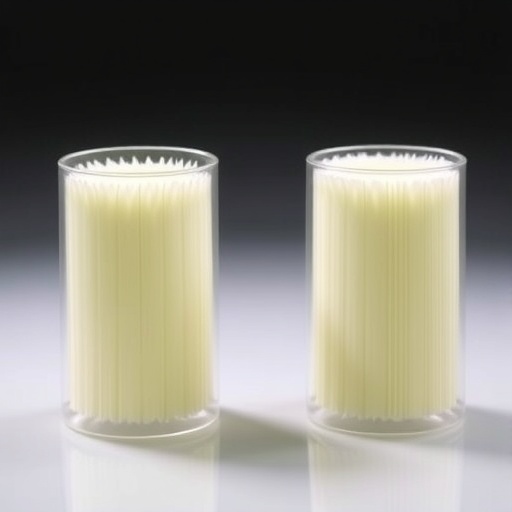
Sugar beet pulp, the fibrous residue left behind after sugar is extracted from beets, could become the raw material for advanced sustainable biomaterials under a new chlorine-free processing route. Researchers at the University of Copenhagen have shown that peracetic acid can replace sodium chlorite in the production of cellulose nanofibers, preserving key performance characteristics while reducing reliance on a bleaching chemical associated with toxic and environmentally persistent by-products. The study, published in Biotechnology for Biofuels and Bioproducts, explores how different oxidation mechanisms affect the colour, chemistry and flow behaviour of nanocellulose suspensions made from this abundant secondary biomass.
Cellulose nanofibers, or CNFs, are extraordinarily slender strands derived from the cellulose that gives plant cell walls their strength. Their nanoscale dimensions and high aspect ratio—the relationship between length and diameter—allow them to form networks with unusual mechanical and rheological properties. These characteristics make CNFs attractive for packaging, coatings, composite materials, filtration membranes and other applications where petroleum-based or energy-intensive materials might otherwise be used. Yet turning agricultural residues into high-quality CNFs generally requires removing lignin, pigments and other matrix components. Bleaching is therefore a crucial step, and the chemicals used at this stage can determine whether a process is genuinely sustainable or merely shifts environmental costs upstream.
Sugar beet pulp is particularly promising because it is a low-lignin residue. Much of the structural complexity that makes woody biomass difficult to process is already reduced, meaning that the pulp can be converted into cellulose-rich material with comparatively mild treatment. The researchers’ starting process uses enzymes to digest the pulp before chemical oxidation and mechanical fibrillation separate the cellulose into nanoscale fibres. In the established method, sodium chlorite performs the key bleaching step. Although effective, sodium chlorite can generate chlorinated compounds and requires careful handling, motivating the search for an alternative that removes chlorine from the process entirely.
The team investigated peracetic acid, or PAA, an oxidising agent formed from acetic acid and hydrogen peroxide. PAA is already used in some disinfection and bleaching applications, and it decomposes primarily into compounds such as acetic acid, water and oxygen-related products rather than chlorinated residues. In the experiments, the acid was used in two ways: it was either added directly as an external reagent, described as exogenous PAA, or generated inside the reaction mixture from precursor chemicals. The researchers also compared PAA-driven peroxyl chemistry with a hydrogen-peroxide-based Fenton reaction, in which iron-mediated free radicals produce highly reactive oxidising species.
That distinction proved decisive. Oxidation is not a single chemical event but a family of reactions whose outcomes depend on the reactive molecules involved, their concentrations and the structures they encounter. Peroxyl-mediated bleaching brightened the sugar beet pulp, whereas free-radical bleaching darkened it. The difference suggests that the reactive intermediates attacked lignin and other coloured molecules through substantially different pathways. Peroxyl species appear to remove or modify chromophores—the molecular structures responsible for absorbing visible light—more effectively under the tested conditions. By contrast, the aggressive free-radical route may have fragmented matrix polysaccharides or transformed lignin into products that absorb more strongly, producing a darker material despite extensive oxidation.
In terms of appearance, the PAA-treated nanofibers came remarkably close to those produced with sodium chlorite. Both reached a relative brightness index of approximately 67 percent, according to the study. Brightness is not merely cosmetic in a biomaterial: it can influence the visual quality of paper-like films, coatings and packaging, as well as indicate how much coloured non-cellulosic material remains. However, the chemical composition of the products differed. PAA-oxidised CNFs retained more lignin than sodium-chlorite-oxidised CNFs, with lignin levels reported at about 9 percent and 4 percent, respectively. The Fenton-oxidised material contained about 10 percent lignin.
At first glance, retaining more lignin might seem to be a disadvantage, because lignin can contribute colour and interfere with cellulose processing. But the researchers found that the PAA- and Fenton-derived suspensions were more viscous than the sodium-chlorite product. Viscosity describes a fluid’s resistance to flow, and in a suspension of nanofibers it reflects how effectively the fibrils interact, entangle and create a three-dimensional network. The PAA-CNF suspension reached approximately 4,500 centipoise, compared with 2,500 centipoise for the Fenton material and 2,000 centipoise for the sodium-chlorite CNFs. Such differences could be valuable in applications requiring a thick, stable coating or a material that resists drainage and separation during processing.
The team also examined the electrical stability and shape of the fibrils. All of the CNF suspensions showed zeta potentials between approximately −17 and −23 millivolts. Zeta potential is the electrical potential at the slipping plane around particles or fibres suspended in a liquid; its magnitude provides an indication of how strongly those particles repel one another. More negative values generally help a colloidal suspension resist aggregation, although stability depends on ionic strength, pH and the chemistry of the fibre surface as well. The reported values indicate that the oxidised CNFs were at least incipiently stable, meaning they could remain dispersed under the tested conditions rather than rapidly clumping together.
Oxidation and fibrillation also increased the aspect ratio of the cellulose structures compared with unoxidised CNF material. A higher aspect ratio can improve network formation because long, thin fibrils span larger distances and create more points of contact. The researchers used microscopy and surface-related analyses to assess the products, including scanning electron microscopy and array-based microfibril surface assessment. These measurements are important because nanocellulose performance depends not only on chemical purity but also on fibril dimensions, surface charge, aggregation state and the extent to which individual fibres have been liberated from the original plant matrix.
One of the most significant findings was that PAA generated within the process produced CNFs of similar quality to those treated with PAA added from outside. In situ generation could simplify storage, transport and handling by avoiding the need to prepare and introduce a separate supply of peracetic acid. The results also demonstrate that three alternatives to sodium chlorite can work within the researchers’ production strategy: exogenous PAA, in situ PAA and hydrogen-peroxide Fenton oxidation. The products are not identical, and the choice of route would depend on whether brightness, viscosity, residual lignin or reaction safety is the dominant requirement. Rather than identifying one universal replacement, the work maps how chemistry can tune the properties of a biomass-derived nanomaterial.
The study’s broader significance lies in connecting waste valorisation with safer process chemistry. Sugar beet pulp is generated in large quantities by the sugar industry, and its conversion into CNFs could create a higher-value use for material that might otherwise be burned, composted or treated as low-value feedstock. An enzyme-mediated, totally chlorine-free process could reduce hazardous inputs while retaining the possibility of producing functional nanocellulose. The researchers caution implicitly that successful laboratory chemistry is only one stage in commercial development: future work will need to assess reagent recovery, water use, energy demand, lifecycle emissions, process scale-up and the performance of the materials in real products. Even so, the results show that removing chlorine does not require abandoning the desired properties of the fibres. By choosing the oxidation mechanism carefully, agricultural residue can be transformed into a versatile nanomaterial with a smaller toxicological footprint and a potentially stronger role in the circular bioeconomy.
Subject of Research: Chlorine-free production of cellulose nanofibers from sugar beet pulp using peracetic acid and alternative oxidation methods
Subject of Research: Biology
Article Title: Exploring totally chlorine-free bleaching methods to produce sugar beet pulp cellulose nanofibers
Article References: Donohoe, C., Engquist, E., Carstens, N., Kinsella, T., Sand, K. K., Jørgensen, B., Faisal, M., & Ulvskov, P. (2026). Exploring totally chlorine-free bleaching methods to produce sugar beet pulp cellulose nanofibers. Biotechnology for Biofuels and Bioproducts. https://doi.org/10.1186/s13068-026-02806-x
Image Credits: AI Generated
DOI: 10.1186/s13068-026-02806-x
Keywords: sugar beet pulp, cellulose nanofibers, peracetic acid, chlorine-free bleaching, nanocellulose, green chemistry, biomass valorisation, oxidation
Cite this news
APA MLA Chicago
SCIENMAG. (August 28, 2026). Chlorine-Free Bleaching Produces Cellulose Nanofibers from Sugar Beet Pulp. https://scienmag.com/chlorine-free-bleaching-produces-cellulose-nanofibers-from-sugar-beet-pulp/
SCIENMAG. “Chlorine-Free Bleaching Produces Cellulose Nanofibers from Sugar Beet Pulp.” Scienmag, 28 August 2026, https://scienmag.com/chlorine-free-bleaching-produces-cellulose-nanofibers-from-sugar-beet-pulp/. Accessed 28 August 2026.
SCIENMAG. “Chlorine-Free Bleaching Produces Cellulose Nanofibers from Sugar Beet Pulp.” Scienmag. August 28, 2026. https://scienmag.com/chlorine-free-bleaching-produces-cellulose-nanofibers-from-sugar-beet-pulp/
Copy citation Download RIS
Tags: biomass valorization of sugar beet pulpbiomass-based nanomaterialscellulose nanofiber applicationscellulose nanofibers from agricultural wastecellulose nanofibers productionchlorine-free bleachingchlorine-free bleaching in nanocellulose productioneco-friendly bleaching chemicals for nanocelluloseeco-friendly pulp bleaching techniqueseffects of oxidation mechanisms on nanocellulose propertiesenvironmentally friendly bleaching methodsenvironmentally persistent bleaching chemicalsenvironmentally sustainable biomass processing methodsimpact of bleaching chemicals on nanocellulose performancenanocellulose applications in packaging and compositesnanocellulose suspension propertiesperacetic acid for environmentally friendly bleachingperacetic acid in nanocellulose processingsugar beet pulp as renewable resourcesustainable biomaterials from sugar beet pulpsustainable nanocellulose manufacturingsustainable packaging and coatings