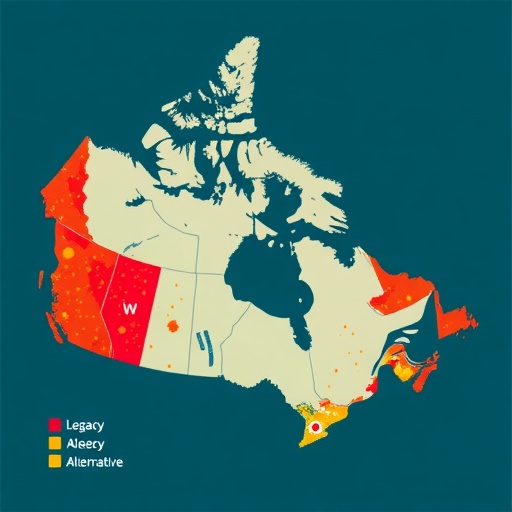
Per- and polyfluoroalkyl substances, or PFAS, have long been described as “forever chemicals” because the carbon–fluorine bonds that define many of these compounds are exceptionally resistant to environmental and biological breakdown. A new analysis of blood samples from 2,775 premenopausal participants in Canada shows that exposure is not limited to the older PFAS chemicals most commonly measured in human studies. The research detected several newer replacement compounds and chemical precursors as well, suggesting that a broader range of these substances may be circulating at low levels in the Canadian population. The study also found that reproductive history was linked to larger differences in blood PFAS concentrations than many other personal characteristics examined, offering a detailed picture of how pregnancy and breastfeeding can influence the body burden of persistent chemicals.
The study, published in Environmental Health, used biological samples and information from the Canadian CARTaGENE population cohort. Participants were drawn from two collection phases, conducted in 2009–2010 and 2013–2014, and were premenopausal women whose sociodemographic characteristics, lifestyle factors and reproductive histories had been recorded. The researchers measured 40 PFAS in serum, the liquid component of blood left after cells and clotting proteins are removed. Serum measurements are widely used in biomonitoring because they provide an estimate of the amount of a chemical present in the body at the time of sampling. Unlike an exposure questionnaire, which may capture potential sources such as food packaging or household products, a serum test reflects the combined result of absorption, distribution, metabolism and elimination.
PFAS are a large family of thousands of manufactured chemicals, not a single substance. Their molecular structures generally contain fluorinated carbon chains attached to functional groups such as carboxylic acids or sulfonates. These structures can repel both water and oil, properties that have made PFAS useful in stain-resistant fabrics, nonstick coatings, firefighting foams, food-contact materials and industrial applications. Some PFAS bind to proteins in blood rather than accumulating primarily in body fat, and several can remain in the human body for years. The best-studied examples include perfluorooctane sulfonic acid, commonly called PFOS, and perfluorooctanoic acid, or PFOA. Regulatory restrictions have reduced the use of some legacy PFAS, but manufacturers have introduced alternative compounds and precursor chemicals that can transform into persistent PFAS in the environment or within biological systems.
Of the 40 substances tested, eight were detected in more than 60 percent of participants. The geometric mean concentration—a measure that is more suitable than a simple arithmetic average for quantities that vary across several orders of magnitude—ranged from 0.03 micrograms per liter for PFHpS and MeFOSAA to 4.25 micrograms per liter for PFOS. The combined concentration of seven PFAS, designated Σ7PFAS, had a geometric mean of 8.00 micrograms per liter. A geometric mean is calculated by averaging logarithmic values and then converting the result back to the original scale, reducing the influence of unusually high measurements. It should not be interpreted as a threshold for safety or harm; the study was descriptive and was not designed to establish health effects or identify a disease risk associated with any individual concentration.
The investigators also found evidence that alternative and precursor PFAS are present in human serum, although generally at lower concentrations than the most prominent legacy chemicals. The compounds detected included sulfonamidoacetic acids, sulfonamides, fluorotelomers and fluoroethers. For these newer or less routinely measured substances, the 95th-percentile concentrations were below 0.5 micrograms per liter. The 95th percentile represents the level below which 95 percent of measurements fall, making it useful for describing the upper part of a population distribution without focusing exclusively on extreme outliers. The findings do not show that these substances are harmless, nor do they reveal precisely how participants encountered them. Rather, they demonstrate why biomonitoring programs that measure only a small set of familiar PFAS may overlook part of the population’s chemical exposure profile.
The strongest patterns emerged when the researchers compared concentrations with reproductive history. For several legacy PFAS—including PFOS, PFNA, PFOA and PFHxS—concentrations declined monotonically with each additional child a participant had given birth to. The same pattern was observed for Σ7PFAS. In this context, a monotonic decline means that the measured concentration generally decreased as the number of births increased, rather than fluctuating randomly between categories. Concentrations were also higher among participants who had gone longer since their most recent pregnancy, while those who reported a history of breastfeeding tended to have lower levels. The results are consistent with pregnancy and lactation acting as routes through which PFAS can leave the maternal circulation. During pregnancy, chemicals can be transferred across the placenta to the developing fetus, while breastfeeding can transfer chemicals into milk. These processes may reduce maternal serum concentrations, even though they represent exposure pathways for the fetus or infant.
Age would normally be expected to increase the body burden of persistent substances because longer-lived chemicals have had more time to accumulate. Yet in this analysis, the concentration-lowering association of parity—the number of births—appeared to outweigh the age-related bioaccumulative effect for most legacy PFAS. This does not mean that age is unimportant or that pregnancy eliminates PFAS from the body. PFAS elimination depends on the specific compound, kidney and liver processes, protein binding, exposure patterns and individual physiology. A person may also continue to encounter PFAS through drinking water, food, dust, consumer products or occupational settings after pregnancy. The finding instead illustrates how biological events can alter the concentration measured in blood and why reproductive history is essential when scientists compare PFAS levels between individuals or populations.
Socioeconomic patterns were also visible. Participants who reported a household income below the Canadian low-income cut-off had lower concentrations of PFOS, PFNA, PFOA, PFHxS, PFDA, PFUnA and the combined Σ7PFAS measure. The authors note that this result is consistent with previous investigations reporting lower exposure to some PFAS among financially disadvantaged populations, although the study does not establish the reason for the association. Income can correlate with numerous exposure-related factors, including occupation, housing conditions, diet, consumer-product use, access to treated or contaminated water, and geographic location. A lower serum concentration therefore cannot be interpreted as evidence that people with fewer financial resources face lower environmental risks overall. Different pollutants can follow entirely different socioeconomic patterns, and the measured PFAS may not represent every relevant chemical exposure.
The researchers emphasize that their work expands the scope of human biomonitoring rather than providing a final assessment of health risk. The study was a descriptive analysis of premenopausal participants in one Canadian cohort, and its measurements came from defined sampling periods more than a decade ago. Because the analysis was not designed as a longitudinal experiment, it cannot prove that pregnancy, breastfeeding or income caused a particular change in PFAS concentration. It also cannot identify which products, foods, workplaces or environmental sources contributed to exposure, and it does not determine whether the detected alternatives have the same persistence or toxicity as legacy compounds. Even so, the widespread detection of several newer PFAS at low levels is an important signal for environmental surveillance. As older substances are restricted and replaced, scientists will need analytical methods capable of tracking a shifting chemical landscape, while studies of pregnancy and early-life exposure will remain central to understanding how these durable pollutants move through the human body and across generations.
Subject of Research: Serum concentrations and population patterns of legacy, alternative, and precursor PFAS among premenopausal participants in the Canadian CARTaGENE cohort
Subject of Research: Medicine
Article Title: Serum concentrations of legacy, alternative, and precursor per- and polyfluoroalkyl substances: a descriptive analysis of premenopausal participants in the Canadian CARTaGENE cohort
Article References: Borghese, M. M., Lelievre, R., Packull-McCormick, S., Ashley-Martin, J., Velez, M. P., Noisel, N., Xu, M., Bruin, J. E., Pollock, T., & St-Amand, A. (2026). Serum concentrations of legacy, alternative, and precursor per- and polyfluoroalkyl substances: a descriptive analysis of premenopausal participants in the Canadian CARTaGENE cohort. Environmental Health. https://doi.org/10.1186/s12940-026-01326-3
Image Credits: AI Generated
DOI: 10.1186/s12940-026-01326-3
Keywords: PFAS, biomonitoring, serum concentrations, pregnancy, breastfeeding, environmental chemicals, legacy PFAS, alternative PFAS
Cite this news
APA MLA Chicago
SCIENMAG. (August 28, 2026). Study tracks legacy, alternative, and precursor PFAS levels in premenopausal Canadian women. https://scienmag.com/study-tracks-legacy-alternative-and-precursor-pfas-levels-in-premenopausal-canadian-women/
SCIENMAG. “Study tracks legacy, alternative, and precursor PFAS levels in premenopausal Canadian women.” Scienmag, 28 August 2026, https://scienmag.com/study-tracks-legacy-alternative-and-precursor-pfas-levels-in-premenopausal-canadian-women/. Accessed 28 August 2026.
SCIENMAG. “Study tracks legacy, alternative, and precursor PFAS levels in premenopausal Canadian women.” Scienmag. August 28, 2026. https://scienmag.com/study-tracks-legacy-alternative-and-precursor-pfas-levels-in-premenopausal-canadian-women/
Copy citation Download RIS
Tags: analysis of 40 PFAS in blood serumbiological monitoring of persistent chemicalsblood sample biomonitoring in womenblood serum biomonitoring of PFAS compoundsCanadian population cohort study of persistent chemicalsCanadian population PFAS studycomparison of older and newer PFAS chemicals indetection of novel PFAS precursors in human bloodenvironmental contaminants in Canadian womenenvironmental health impact of legacy and replacement PFASenvironmental health impact of PFASinfluence of pregnancy and breastfeeding on chemical levelsinfluence of pregnancy and breastfeeding on PFAS levelslegacy and emerging PFAS chemicalslong-term health effects of PFAS exposurelong-term persistence of per- and polyfluoroalkyl substancesPFAS exposure in premenopausal Canadian womenPFAS exposure in premenopausal womenreplacement and precursor PFAS detectionreproductive history and chemical body burdenserum analysis of PFAS compounds