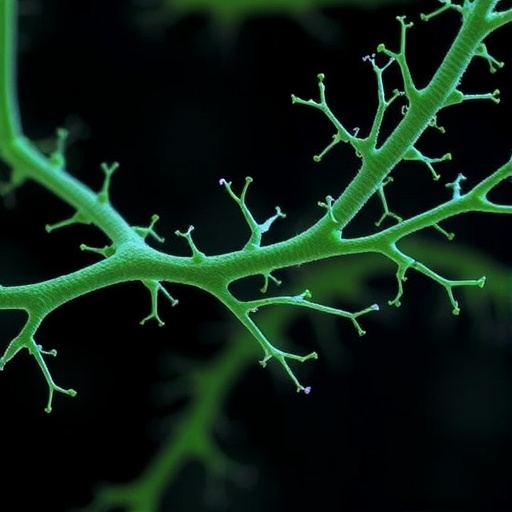
Plants do not build their vascular systems as randomly distributed pipes. Inside developing roots, stems and leaves, cells are arranged into remarkably ordered strands that later mature into the tissues responsible for transporting water, minerals and sugars. A research article titled “PAX-regulated self-organizing polarity drives procambial strand formation,” published in Nature Plants in 2026, focuses on a fundamental question behind that architecture: how do initially similar plant cells acquire coordinated directions and assemble themselves into the narrow, continuous files that become vascular tissue? The study’s title points to a mechanism in which PAX-regulated polarity is not merely a consequence of tissue formation. Instead, directional information appears to be part of the process that organizes the tissue in the first place. That idea reaches into one of plant biology’s most important problems—how molecular signals are converted into large-scale anatomy without a central command system.
The procambium is a developmental tissue that gives rise to the plant’s primary vascular network. Its descendants differentiate into xylem, which conducts water and dissolved minerals, and phloem, which distributes sugars and other organic compounds. To form these transport routes, cells must divide in controlled orientations, remain connected with their neighbors and adopt positions that preserve the continuity of the strand. A cell that divides in the wrong plane, loses its directional identity or fails to coordinate with adjacent cells could disrupt the emerging network. Yet plants lack the mobile immune or nervous systems found in animals, and their cells are enclosed by rigid walls that restrict movement. Their solution depends heavily on communication across cell membranes, directional transport of hormones and the ability of each cell to interpret local information. The research described by Bassukas, Xiao, Kim and colleagues addresses how such local decisions can generate a stable, tissue-wide pattern.
In developmental biology, polarity means that a cell has distinguishable sides. The top and bottom of a cell, or its inner and outer face, may contain different proteins, transporters and signaling activities. This asymmetry allows cells to move molecules preferentially in one direction and to respond differently depending on which neighboring cell sends a signal. In plants, polarity is especially consequential because cells are cemented together and cannot readily rearrange their positions. A directional pattern must therefore be established through the coordinated placement of proteins at the plasma membrane, the selective movement of signaling compounds and feedback between neighboring cells. The phrase “self-organizing polarity” suggests a system in which directional states emerge from interactions among cells rather than being imposed entirely by a pre-existing anatomical template. Such systems can produce robust patterns because each cell both receives information from its surroundings and helps shape the environment experienced by the cells around it.
The PAX component named in the article title is therefore central to the proposed molecular logic. PAX proteins are transcriptional regulators: proteins that influence which genes are active by binding, directly or indirectly, to regulatory regions of DNA. Changes in transcription can alter the abundance of receptors, transport proteins, cell-wall regulators or other components that determine a cell’s behavior. A transcription factor does not ordinarily point a cell physically toward a neighboring cell. Instead, it can change the set of molecular tools that makes a directional response possible. If PAX activity regulates the machinery establishing polarity, it could connect gene expression to the positioning of cell-surface factors and to the feedback loops that align neighboring cells. The title alone does not specify which PAX factor, target genes or experimental perturbations were examined, so those details cannot be assigned here. It does, however, identify PAX-regulated polarity as the organizing principle the authors investigated in relation to procambial strand formation.
A key technical challenge in studying this process is separating cause from consequence. A vascular strand is already a visibly polarized structure, so researchers must determine whether polarity initiates strand formation or simply appears after the strand has begun to develop. This generally requires combining genetic manipulation with cellular imaging and developmental analysis. Scientists may compare normal plants with specimens in which a regulatory gene is removed, reduced or activated in particular cells. They may also track fluorescently tagged proteins to determine whether they accumulate on specific sides of a cell, and follow the behavior of the tissue over time rather than examining only a fixed endpoint. Measurements of cell division orientation, strand continuity and the arrangement of vascular precursors can reveal whether a molecular factor acts early, when the pattern is being established, or later, when the tissue is differentiating. The supplied source identifies the article and its conclusion through the title, but does not provide the experimental datasets or detailed methods; claims about specific phenotypes or molecular targets would therefore go beyond the available evidence.
The broader significance lies in the concept of emergent biological order. In a self-organizing system, a complex structure can arise through relatively local rules. A cell may polarize in response to a small difference in a hormone or membrane signal. That polarization can change the direction in which it exports a signal, creating a stronger difference for nearby cells. Repeated across many cells, the feedback may stabilize a common axis and generate a strand-like arrangement. In mathematical terms, the tissue could be understood as a dynamic network in which each cell updates its state according to both internal gene regulation and interactions with adjacent cells. Stable patterns emerge when positive feedback reinforces a shared orientation while negative feedback prevents the entire tissue from collapsing into uniform activation. This kind of logic is found across biology, but in plants it is particularly valuable because growth is continuous and new cells are constantly added to existing structures.
Understanding procambial organization may also clarify why vascular development is both flexible and reliable. Plants frequently encounter changing light, temperature, water availability and mechanical stress. Their vascular systems must adapt as organs expand, yet they must preserve long-distance transport. A mechanism based on local polarity could allow new strands to connect with established tissue without requiring every cell to receive a complete blueprint from the organism. It could also help explain how branching patterns arise, how vascular cells maintain continuity during growth and how developmental programs remain robust despite small variations between cells. These questions matter beyond basic anatomy. Vascular architecture influences crop productivity, drought tolerance and the movement of nutrients and chemical signals through plants. However, the article information supplied here does not report applications, crop experiments or evidence that manipulating PAX would improve any agricultural trait. The defensible conclusion is narrower: the work concerns a molecular-developmental mechanism for organizing procambial strands.
The study’s title places polarity before strand formation, a sequence that carries an important conceptual message. Rather than viewing the procambium as a preassembled track that later acquires directional features, it presents directional organization as an active driver of tissue construction. That framing could help connect several levels of plant biology that are often studied separately: transcriptional regulation inside the nucleus, protein localization at the cell membrane, exchange of signals between adjacent cells and the geometry of a developing organ. The achievement of such a connection would be to show how information encoded in regulatory networks becomes visible as a vascular pattern. Because the available source material contains only the bibliographic record and article title, it is not possible to determine how broadly the findings apply, which plant species were used or whether the proposed mechanism is universal across organs. Even so, the research highlights a vivid principle: in plants, organized anatomy can emerge when cells continually read their neighbors, establish polarity and feed that information back into the growing tissue.
The importance of this work is ultimately conceptual as well as practical. Every leaf depends on vascular strands that were patterned during development, but the final network gives little indication of the molecular negotiations that produced it. By focusing on PAX-regulated self-organizing polarity, the researchers place those negotiations at the center of the story. The result is a view of plant development in which form is not simply dictated from above by a fixed genetic plan. Genes provide regulatory capacities; cells deploy those capacities in response to local conditions; and interactions among cells generate the coherent structures that keep the plant alive. Further details from the full research article will be needed to establish the exact PAX factors, downstream pathways and evidence linking polarity directly to procambial formation. The reported research nevertheless points toward a powerful explanation for how plants build transport systems: not by moving cells into place, but by coordinating the directional behavior of cells that remain rooted in their positions.
Subject of Research: PAX-regulated self-organizing polarity in procambial strand formation
Subject of Research: Biology
Article Title: PAX-regulated self-organizing polarity drives procambial strand formation
Article References: Bassukas, A. E. L., Xiao, Y., Kim, N., & Schwechheimer, C. (2026). PAX-regulated self-organizing polarity drives procambial strand formation. Nature Plants. https://doi.org/10.1038/s41477-026-02382-w
Image Credits: AI Generated
DOI: 10.1038/s41477-026-02382-w
Keywords: plant vascular development, procambium, cell polarity, self-organization, PAX regulation, plant development, tissue patterning, vascular strands
Cite this news
APA MLA Chicago
SCIENMAG. (August 28, 2026). PAX-Regulated Cell Polarity Self-Organizes Procambial Strands in Developing Plants. https://scienmag.com/pax-regulated-cell-polarity-self-organizes-procambial-strands-in-developing-plants/
SCIENMAG. “PAX-Regulated Cell Polarity Self-Organizes Procambial Strands in Developing Plants.” Scienmag, 28 August 2026, https://scienmag.com/pax-regulated-cell-polarity-self-organizes-procambial-strands-in-developing-plants/. Accessed 28 August 2026.
SCIENMAG. “PAX-Regulated Cell Polarity Self-Organizes Procambial Strands in Developing Plants.” Scienmag. August 28, 2026. https://scienmag.com/pax-regulated-cell-polarity-self-organizes-procambial-strands-in-developing-plants/
Copy citation Download RIS
Tags: cell polarity in plantscellular differentiation in plantsdirectional cell growth in plantsdirectional cell growth in roots and stemsmolecular mechanisms of plant tissue organizationmolecular mechanisms of plant tissue patterningPAX-regulated polarity signalingPAX-regulated signaling in plantsPlant cell polarityplant cell signaling pathwaysplant developmental biologyplant tissue architectureplant tissue patterning without central controlPlant vascular developmentplant vascular differentiation processesplant vascular system architectureplant vascular tissue differentiationprocambial strand formationself-organization in plant tissuesself-organizing plant tissuesvascular system formation in plantsvascular tissue development