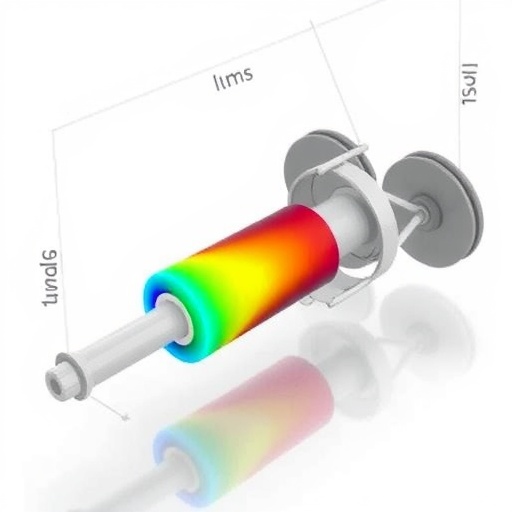
A new study is drawing attention to one of the least visible but most important components in modern vehicles: the shock absorber. The research, published in Communications Engineering, examines how adjustable shock absorbers can be modeled using hydraulic impedance physics, with particular emphasis on the way damping changes with both velocity and acceleration. The paper is titled “Velocity & acceleration-dependent damping characteristic modeling for adjustable shock absorbers based on hydraulic impedance physics” and is authored by F. Su, J. Zhao, Y. Zhuang and colleagues. Although the supplied publication information does not report specific experimental results or performance gains, the subject addresses a central engineering challenge: predicting how a suspension system will respond when road conditions, vehicle speed and driving forces change rapidly.
Shock absorbers are designed to control the motion generated when a vehicle’s wheels encounter uneven ground. Without them, springs would continue oscillating after every bump, allowing the vehicle body to bounce, pitch and roll. A shock absorber converts some of that mechanical motion into heat by forcing oil through small passages inside a sealed cylinder. The resistance created by this flowing fluid is known as damping. In a conventional damper, the amount of resistance depends strongly on how quickly the piston moves. Adjustable shock absorbers add another layer of complexity by changing the flow path, valve opening or internal pressure to produce different damping states. That adjustability is increasingly important in cars, motorcycles, robotics and other machines that must remain stable while operating under constantly changing loads.
The study’s central concept, hydraulic impedance, comes from treating the fluid system as an engineered network that resists motion in a manner analogous to electrical circuits resisting current. In a hydraulic system, pressure difference plays a role similar to voltage, while fluid flow resembles electrical current. Narrow passages, valves and chambers create resistance, storage and transmission effects that determine how quickly pressure responds to piston movement. By expressing these relationships mathematically, engineers can build models that connect the motion of a shock absorber to the forces measured at its ends. Such a framework can be more physically informative than simply fitting a curve to test data, because it attempts to represent the internal mechanisms producing the observed damping behavior.
The title specifically highlights velocity- and acceleration-dependent characteristics. Velocity dependence is familiar: when a piston moves faster, it generally pushes more oil through the damper’s hydraulic passages, increasing the pressure difference and therefore the resisting force. Acceleration introduces a different effect. When piston speed changes rapidly, the fluid and moving mechanical components cannot always respond instantaneously. Pressure may build or release with a delay, valves may open progressively rather than all at once, and the inertia of the fluid can influence the force transmitted through the device. A model that includes acceleration can therefore capture transient events, such as a wheel striking a sharp obstacle or a suspension system suddenly changing direction, more realistically than a model based only on instantaneous velocity.
This distinction matters because real-world suspension behavior is rarely steady. Laboratory tests often move a damper through controlled sinusoidal cycles, making it possible to compare force and displacement under repeatable conditions. On the road, however, the piston may experience a sequence of irregular movements: a rapid compression, a brief pause, a rebound and another impact within fractions of a second. During such events, two damper states with the same instantaneous velocity may not produce exactly the same force if their recent acceleration histories differ. The fluid pressure distribution, valve motion and internal flow patterns can retain a short-lived memory of what happened immediately before. Capturing that history is one reason dynamic hydraulic models are valuable for advanced suspension design.
Adjustable shock absorbers are especially difficult to represent with simple equations because their internal configuration can change while they are operating. An electronically controlled damper may alter a valve opening in response to sensors that monitor wheel movement, vehicle body acceleration, steering input or braking. A mechanically adjustable unit may use a dial or a variable orifice to change its baseline resistance. In either case, the device does not have one fixed damping curve. Instead, it has a family of curves, each associated with a different setting and potentially modified by the speed and direction of motion. A model based on hydraulic impedance physics could provide a common description of these states, helping engineers analyze how adjustments influence pressure, flow and force rather than treating every operating condition as an unrelated data set.
The practical significance extends beyond ride comfort. Suspension damping affects tire contact with the road, braking stability, cornering behavior and the loads transmitted into the vehicle structure. If damping is too weak, the wheel and body can oscillate excessively. If it is too strong, the suspension may struggle to move over rough surfaces, reducing comfort and potentially limiting tire contact. The ideal response depends on the situation: a vehicle may benefit from one damping profile during smooth highway travel, another during emergency braking and a third on a rough road. Accurate models are essential for control algorithms that must select or continuously adjust those profiles without creating new instabilities.
The same physics can apply to systems far beyond passenger vehicles. Heavy machinery, rail vehicles, aerospace mechanisms, prosthetic devices and robotic platforms all use components that regulate motion through fluid resistance. In each case, designers must understand not only the average force generated by a damper but also its response to rapid changes. A hydraulic impedance model can potentially help connect component-level measurements with system-level simulations, allowing engineers to test virtual designs before building hardware. It may also support more efficient calibration of adjustable devices, since the model can identify how changes in valve geometry or hydraulic passages alter the system’s dynamic response. The supplied record, however, does not specify which applications were tested by the authors or whether the proposed method has already been adopted in commercial products.
The research arrives as vehicle manufacturers and component suppliers seek suspension systems that are simultaneously comfortable, efficient and responsive. Electrification makes this goal more demanding: battery packs add substantial mass, while autonomous-driving systems require predictable behavior during automated steering and braking. At the same time, software-controlled hardware is making it possible to adjust damping many times per second. That capability is useful only if engineers can predict how the damper will behave during fast transients. By focusing on velocity and acceleration within a hydraulic-impedance framework, Su, Zhao, Zhuang and their colleagues are addressing the mathematical bridge between a damper’s internal fluid dynamics and the rapidly changing forces experienced by a moving machine. The citation alone does not establish a particular breakthrough, numerical improvement or validated application, but it identifies a research direction with broad engineering relevance: turning the hidden flow of oil inside a shock absorber into a model precise enough to guide the next generation of adaptive machines.
Subject of Research: Velocity- and acceleration-dependent modeling of adjustable shock absorbers using hydraulic impedance physics
Subject of Research: Technology and Engineering
Article Title: Velocity & acceleration-dependent damping characteristic modeling for adjustable shock absorbers based on hydraulic impedance physics
Article References: Su, F., Zhao, J., Zhuang, Y., Wang, Y., Feng, J., Fan, W., & Guo, K. (2026). Velocity & acceleration-dependent damping characteristic modeling for adjustable shock absorbers based on hydraulic impedance physics. Communications Engineering. https://doi.org/10.1038/s44172-026-00766-6
Image Credits: AI Generated
DOI: 10.1038/s44172-026-00766-6
Keywords: adjustable shock absorbers, hydraulic impedance, damping modeling, vehicle suspension, fluid dynamics, acceleration-dependent damping, adaptive suspension
Cite this news
APA MLA Chicago
SCIENMAG. (August 28, 2026). Physics-Based Model Predicts Velocity- and Acceleration-Dependent Damping in Adjustable Shock Absorbers. https://scienmag.com/physics-based-model-predicts-velocity-and-acceleration-dependent-damping-in-adjustable-shock-absorbers/
SCIENMAG. “Physics-Based Model Predicts Velocity- and Acceleration-Dependent Damping in Adjustable Shock Absorbers.” Scienmag, 28 August 2026, https://scienmag.com/physics-based-model-predicts-velocity-and-acceleration-dependent-damping-in-adjustable-shock-absorbers/. Accessed 28 August 2026.
SCIENMAG. “Physics-Based Model Predicts Velocity- and Acceleration-Dependent Damping in Adjustable Shock Absorbers.” Scienmag. August 28, 2026. https://scienmag.com/physics-based-model-predicts-velocity-and-acceleration-dependent-damping-in-adjustable-shock-absorbers/
Copy citation Download RIS
Tags: aiming to improve vehicle suspension system performance under diverse driving conditions.providing a more comprehensive understanding of shock absorber behavior. This model utilizes hydraulic impedance physics to predict adjustable damping characteristicsvehicle moves over bumpsvehicle wheel movement occurswith damping typically increasing with velocity. The study introduces a physics-based model that accounts for how damping varies not only with velocity but also with acceleration