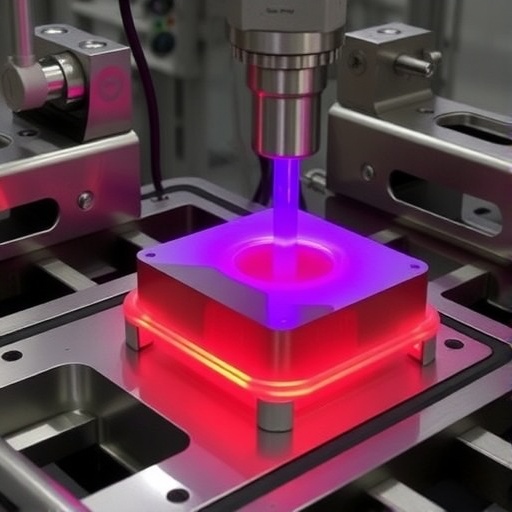
Soft magnetic components are the quiet workhorses of modern technology. They channel and reshape magnetic fields inside electric motors, transformers, inductors, sensors and power-conversion systems, yet their manufacture remains a stubborn engineering challenge. A new study by R. Kalsar, H. Das, L. Li and colleagues introduces a potentially transformative route from loose powder to complex magnetic parts, using an unusual combination of powder processing and friction stir forging. Published in npj Advanced Manufacturing, the work explores how soft magnetic composites could be formed into near-final shapes without relying on conventional melting and extensive machining.
The central idea is deceptively simple: begin with a powder and use intense, localized mechanical deformation to create a dense component in the shape required by the application. In practice, however, soft magnetic materials are difficult to process because their magnetic behavior depends not only on chemical composition, but also on porosity, particle bonding, internal stress and electrical insulation between particles. A manufacturing process that improves shape while damaging these microscopic features can produce a mechanically impressive part with disappointing magnetic performance. The researchers’ approach, described as in-situ friction stir forging, is designed to address the shaping problem while keeping the material in a solid state.
Soft magnetic composites are typically built from electrically insulated magnetic particles, often based on iron or iron alloys, combined with a binder or other processing aid. The insulation is crucial at alternating current, where it interrupts circulating electrical currents known as eddy currents. These currents consume energy and generate heat, especially as magnetic fields change rapidly. At the same time, the compact must be sufficiently dense and mechanically coherent to survive assembly and operation. Traditional powder metallurgy can produce useful magnetic cores, but it may require specialized tooling, multiple compaction steps or post-processing. The geometry of the final component can also be limited, and machining can waste material or disturb the carefully engineered particle structure.
Friction stir processing offers a radically different physical mechanism from conventional forging or casting. A rotating tool moves through or across the material, generating heat through friction and plastic deformation. The temperature rises enough to soften the workpiece, but remains below its melting point. Because the material does not become a liquid, the process avoids solidification defects such as shrinkage pores and segregation that can occur during casting. The tool simultaneously stirs and compacts the material, encouraging particles to rearrange, deform and bond. In the reported manufacturing concept, forging takes place while the powder-based feedstock is being transformed, making the process “in-situ” rather than treating densification and shaping as completely separate operations.
That distinction matters because powder is not merely a miniature version of a solid block. Between individual particles are voids, contact points and interfaces that determine how force and heat move through the compact. As the rotating tool travels, it can collapse pores and redistribute the powder through severe plastic flow. The localized thermal cycle may also help a binder or matrix create stronger connections between particles, depending on the composite design. At the same time, controlling the temperature is essential. Excessive heat could degrade insulation or binder phases, while insufficient heat could leave the compact porous and weak. Tool rotation, travel speed, pressure, feedstock preparation and thermal management therefore become critical variables in determining the final microstructure.
The phrase “near net shape” points to one of the method’s biggest industrial attractions. A near-net-shape process produces a component already close to its final geometry, reducing the amount of cutting, grinding and finishing required afterward. For magnetic devices, that could mean more freedom to create integrated cores, channels, teeth, poles or other three-dimensional features that are difficult to obtain through simple pressing. Less machining could also reduce material waste and shorten production chains. Instead of making a large billet and carving away much of it, manufacturers could place powder where it is needed and use the friction-stir-forging step to consolidate and shape it in one coordinated operation.
The potential payoff extends beyond manufacturing efficiency. Magnetic components are increasingly being pushed toward higher power density, smaller size and more demanding operating frequencies. Electric vehicles, renewable-energy converters, compact actuators and high-frequency electronics all depend on materials that can guide magnetic flux while limiting energy losses. Soft magnetic composites are attractive because their electrically isolated particles can suppress eddy-current pathways in three dimensions, unlike a conventional bulk metal in which currents can circulate more freely. But those benefits are sensitive to how well the particles are bonded and how much porosity remains. A manufacturing technique that combines geometric flexibility with controlled densification could help designers use the material in places where conventional laminated steel or molded magnetic parts are less convenient.
The study is also significant because it highlights a broader shift in advanced manufacturing: powders are increasingly being treated as programmable starting materials rather than simple feedstocks for standard pressing and sintering. By coupling material placement with a solid-state tool, engineers can manipulate the structure of a component while it is being formed. The approach may ultimately allow local control over density, composition or reinforcement, although the practical limits of such control will depend on the powder system and process parameters. Questions about scale-up, tool wear, production speed, dimensional accuracy, residual stress and long-term magnetic stability will determine whether the technique moves from laboratory demonstration to factory floor. Those questions are not minor details; they are the bridge between an intriguing process and a commercially reliable one.
What makes the work especially compelling is its promise to connect two worlds that are often optimized separately: the microscopic architecture required for magnetic performance and the macroscopic geometry demanded by engineers. A component can only be considered successful if it retains the right balance of permeability, coercivity, core loss, strength and dimensional stability after manufacturing. In-situ friction stir forging offers a route for investigating that balance through a single, highly controlled solid-state operation. If further development confirms that complex soft magnetic composite parts can be produced with consistent quality, the process could reshape how magnetic cores are designed and manufactured. The powder would no longer be just the beginning of the production chain; it could become the foundation of a faster, more flexible generation of magnetic hardware.
Subject of Research: Powder-to-near-net-shape manufacturing of soft magnetic composites using in-situ friction stir forging.
Article Title: Powder-to-near net shape manufacturing: in-situ friction stir forging of soft magnetic composites.
Article References: Kalsar, R., Das, H., Li, L. et al. “Powder-to-near net shape manufacturing: in-situ friction stir forging of soft magnetic composites.” npj Adv. Manuf. (2026). https://doi.org/10.1038/s44334-026-00105-9
Image Credits: AI Generated
DOI: 10.1038/s44334-026-00105-9
Keywords: soft magnetic composites, friction stir forging, powder metallurgy, near-net-shape manufacturing, solid-state processing, magnetic materials, advanced manufacturing
Tags: advanced manufacturing of soft magnetic compositesavoiding melting in magnetic component productiondense magnetic parts fabricationimpact of porosity and particle bonding on magnetic propertiesin-situ friction stir forginginnovative magnetic material processing techniquesmagnetic field shaping in electric motorsmechanical deformation of soft magnetic powdersnear-net-shape magnetic componentspowder processing of magnetic materialsSoft magnetic composite manufacturingsolid-state magnetic material shaping methods