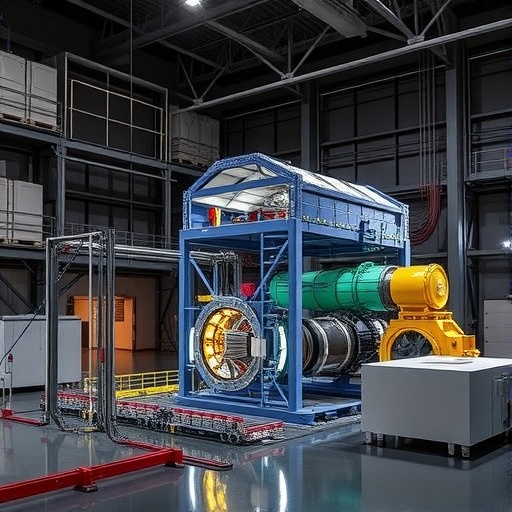
The United States is turning to robotic metal 3D printing in an effort to solve one of nuclear energy’s most stubborn manufacturing problems: the limited domestic supply of large, high-integrity pressure vessels. Oak Ridge National Laboratory (ORNL) and Idaho National Laboratory (INL) have announced a collaboration that will combine wire-arc additive manufacturing, artificial intelligence and nuclear materials expertise to produce and qualify these massive components more rapidly. If successful, the initiative could reshape how critical reactor hardware is built—and provide a faster manufacturing route for several industries that depend on exceptionally strong metal structures.
Pressure vessels are among the most demanding components used in energy systems. They must contain fluids or gases at high pressure while surviving intense heat, radiation, corrosion, mechanical stress and years of operation. Conventional vessels are generally produced through large-scale forging, a process that requires specialized facilities capable of shaping enormous pieces of steel or other alloys under extreme force. The United States has limited domestic forging capacity for components of this scale, creating a potential bottleneck as the country seeks to expand nuclear power and deploy advanced reactors.
The laboratory partnership will explore wire-arc additive manufacturing, commonly known as WAAM, as an alternative or complement to traditional forging. In WAAM, a metal wire is fed into an electric arc that melts the material and deposits it layer by layer. As each layer cools and solidifies, a robotic system adds the next, gradually building a three-dimensional structure. Unlike many powder-based 3D-printing processes, WAAM uses relatively inexpensive wire feedstock and can deposit metal at high rates, making it especially attractive for very large components.
The collaboration was announced on Aug. 19 during Materials and Manufacturing Innovation Days, an Oak Ridge event focused on advanced manufacturing, artificial intelligence, nuclear infrastructure and domestic supply chains. At the event, researchers demonstrated ORNL’s MedUSA platform, a large-scale printer that uses three coordinated robotic arms. The system can position deposition tools from multiple directions, enabling it to construct complex geometries that would be difficult to produce with a conventional fixed-axis machine.
In July, scientists at ORNL used MedUSA to print a demonstration pressure vessel approximately 3 feet by 5 feet. Although smaller than the vessels ultimately required for commercial nuclear systems, the object represented an important scale-up test. Researchers produced a large, closed vessel using a steel alloy relevant to nuclear applications, showing that wire-arc deposition could create a continuous structure rather than merely a collection of separate printed panels or fittings.
The demonstration also highlighted why manufacturing a nuclear pressure vessel is far more complicated than simply making a large object. During printing, the metal experiences repeated cycles of melting, cooling and reheating. These thermal changes can influence grain structure, residual stress, distortion and the formation of microscopic defects. The final component must possess predictable strength, toughness and dimensional accuracy throughout its walls, weld-like interfaces and complex curves. For nuclear service, those properties must remain reliable under harsh conditions for decades.
To address that challenge, the laboratories are developing digital tools that can monitor the vessel as it is being printed. Sensors and imaging systems can track variables such as arc behavior, deposition temperature, layer geometry and thermal history. Artificial intelligence can then compare these data with models and previously validated manufacturing records, identifying deviations that could affect the finished part. The long-term objective is to create what researchers describe as “born-qualified” components—parts whose quality and performance can be assessed from information collected during production rather than determined only through lengthy post-production testing.
That approach could significantly accelerate nuclear manufacturing. Today, qualifying a safety-critical component often requires extensive inspection, destructive testing, documentation and regulatory review after fabrication is complete. If real-time monitoring can reliably connect printing data with material properties and structural performance, manufacturers may be able to detect problems earlier, reduce waste and build a more complete digital record of each component. Such a system would not eliminate qualification requirements, but it could provide regulators and engineers with a richer evidence base for demonstrating that a part meets demanding specifications.
INL brings complementary expertise to the effort. As the Department of Energy’s lead laboratory for nuclear energy research and development, it has decades of experience designing, testing and deploying reactor components and manufacturing technologies. The laboratory will contribute knowledge of nuclear materials, harsh-environment performance, digital engineering and data science. INL also plans to apply artificial intelligence tools associated with its Prometheus initiative, while ORNL will provide its leadership in large-scale additive manufacturing and the characterization of printed parts.
The partnership has already extended beyond the pressure-vessel demonstration. Using the same MedUSA platform and material, ORNL produced neutron sensor brackets for Antares Nuclear Inc.’s R1 Mark-0 microreactor, an advanced reactor design that reached criticality at INL in June. The brackets are considerably smaller than a pressure vessel, but the project offers an opportunity to test accelerated production and data-driven verification on hardware connected to an operating nuclear research program. These early applications could help researchers refine the techniques needed for larger and more safety-critical structures.
The work comes as the United States seeks to strengthen its nuclear manufacturing base while responding to growing demand for reliable electricity. Advanced reactors are being developed for applications ranging from grid power and industrial heat to remote energy systems. At the same time, the rapid expansion of artificial intelligence data centers is increasing pressure on the energy sector to deliver dependable, high-capacity power. A shortage of specialized manufacturing infrastructure could delay that expansion, particularly if reactor developers must rely on a small number of overseas suppliers for major components.
The potential benefits are not limited to nuclear energy. Large pressure-bearing structures are also used in chemical processing, oil and gas production, aerospace, defense and other heavy industries. A qualified wire-arc printing system could allow companies to manufacture components closer to where they are needed, reduce dependence on oversized forging equipment and produce geometries that are difficult to achieve through conventional methods. It may also make it easier to repair or replace parts whose original suppliers are no longer operating.
Still, the technology faces substantial scientific and regulatory hurdles. Researchers must establish how variations in deposition speed, heat input, wire composition and cooling conditions affect the microstructure of printed alloys. They must also demonstrate resistance to fatigue, fracture, corrosion and radiation damage, while proving that defects can be detected with sufficient sensitivity. For nuclear applications, manufacturing data must be traceable, repeatable and compatible with strict safety standards. The transition from a successful demonstration to a commercially deployable reactor component will therefore require extensive testing and validation.
The ORNL-INL collaboration is designed to connect those pieces: high-rate robotic deposition, AI-assisted process control, advanced inspection and deep knowledge of nuclear materials. Its most ambitious vision is a manufacturing system capable of producing a large metal component while simultaneously evaluating its geometry and internal quality. By embedding measurement and analysis into the printing process, the laboratories hope to replace some of the uncertainty associated with conventional fabrication with a continuous, data-rich record of how each component was made.
If the approach succeeds, a pressure vessel could become more than a product assembled after a long chain of separate manufacturing steps. It could be a digitally documented structure built, inspected and assessed in one integrated process. That possibility is drawing attention because it addresses two urgent problems at once: the need for faster deployment of nuclear technologies and the need to rebuild domestic capacity for producing the enormous, highly engineered components on which those technologies depend.
Subject of Research: Wire-arc additive manufacturing, artificial intelligence-assisted quality monitoring, and the production and qualification of nuclear pressure vessels.
Article Title: Robotic Metal 3D Printing Targets America’s Nuclear Pressure-Vessel Bottleneck
Web References: Oak Ridge National Laboratory Manufacturing Demonstration Facility; U.S. Department of Energy advanced reactor criticality announcement; INL Prometheus initiative; Idaho National Laboratory
Image Credits: Leslie Mullen/ORNL; U.S. Department of Energy
Keywords
Wire-arc additive manufacturing, 3D printing, nuclear energy, pressure vessels, Oak Ridge National Laboratory, Idaho National Laboratory, MedUSA printer, artificial intelligence, advanced reactors, nuclear manufacturing, additive manufacturing, domestic supply chains
Tags: accelerating nuclear component productionaddressing bottlenecks in nuclear energy infrastructureadvanced manufacturing techniques for nuclear industryartificial intelligence in nuclear component qualificationcollaboration between Oak Ridge and Idaho National Labsdomestic supply challenges in nuclear reactor hardwarehigh-integrity pressure vessel fabricationinnovative solutions for large-scale metal fabricationnuclear component manufacturingrobotic metal 3D printing for large pressure vesselsuse of AI and robotic welding in critical energy systemswire-arc additive manufacturing in nuclear energy